Trump's Board of Peace Faces Credibility Crisis Over US Travel Bans
President Donald Trump's newly announced "Board of Peace," unveiled with considerable fanfare at the World Economic Forum in Davos, Switzerland, is already encountering significant scrutiny and ridicule. The initiative, which Trump positioned as a potential alternative to the United Nations, faces a stark contradiction: nearly half of the countries represented on the board are currently subject to stringent US travel bans imposed by the Trump administration itself.
A Stage of Allies Under Entry Restrictions
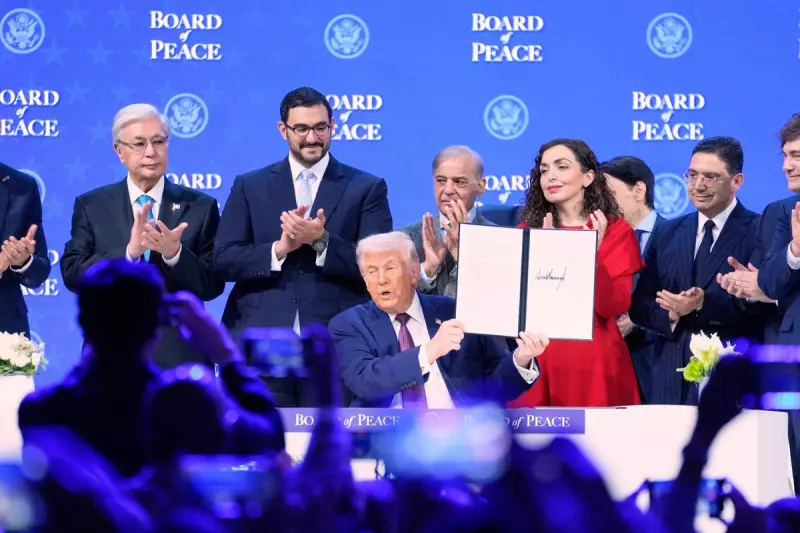
During the ceremonial launch on Thursday, President Trump welcomed representatives from a diverse array of nations onto the stage, including Argentina, Armenia, Azerbaijan, Bahrain, Bulgaria, Hungary, Indonesia, Jordan, Kosovo, Mongolia, Morocco, Pakistan, Paraguay, Qatar, Saudi Arabia, Turkey, the United Arab Emirates, and Uzbekistan. Notably, the address lacked representation from any European countries, amid reports that Russian leader Vladimir Putin had received an invitation to join.
However, this display of global partnership is undermined by the administration's own policies. Earlier this year, President Trump implemented an even more rigorous travel ban, indefinitely suspending immigrant visa processing for individuals from 75 countries. A significant overlap exists, with at least eight nations on the Board of Peace—Armenia, Azerbaijan, Jordan, Kosovo, Mongolia, Morocco, Pakistan, and Uzbekistan—falling under these restrictive measures.

Questions of Efficacy and a Billion-Dollar Price Tag
This contradiction raises profound questions about the board's practical efficacy and moral authority. President Trump boldly claimed the body "has the chance to be one of the most consequential bodies ever created," yet its composition includes nations whose citizens face barriers to entering the United States. The board emerged following Trump's involvement in a US-brokered ceasefire deal between Israel and Hamas, with member states expected to contribute a substantial $1 billion to participate.
The launch event also featured a controversial presentation by Trump's son-in-law, Jared Kushner, who unveiled bizarre, CGI-generated images depicting a futuristic "New Gaza." These visuals, which included data centres, luxury apartments, and plans for coastal tourism, over 100,000 housing units, and 75 medical facilities, appeared to mirror an AI-generated video released last year. That earlier video portrayed the war-torn Gaza Strip transformed into a luxurious "riviera," featuring cameos from Trump and Tesla billionaire Elon Musk.
Controversial Appointments and Lofty Ambitions
Further adding to the board's contentious nature was the controversial appointment of former British Prime Minister Tony Blair as a member. President Trump will chair the board himself. In his address to the gathering, Trump asserted, "When America booms, the entire world booms," framing the initiative as a vehicle for global prosperity under American leadership.
He elaborated on the board's mission, stating it is "composed of the top leaders in the world" and referencing a UN Security Council-adopted plan from October for a permanent end to the Gaza conflict. Trump stated the board would ensure Gaza's demilitarisation, while his Secretary of State, Marco Rubio, emphasised it would function as a "board of action."
The juxtaposition of this ambitious, peace-seeking rhetoric with the reality of the US travel bans on many member nations creates a significant credibility gap for the fledgling Board of Peace, casting doubt on its ability to mediate global conflicts effectively.