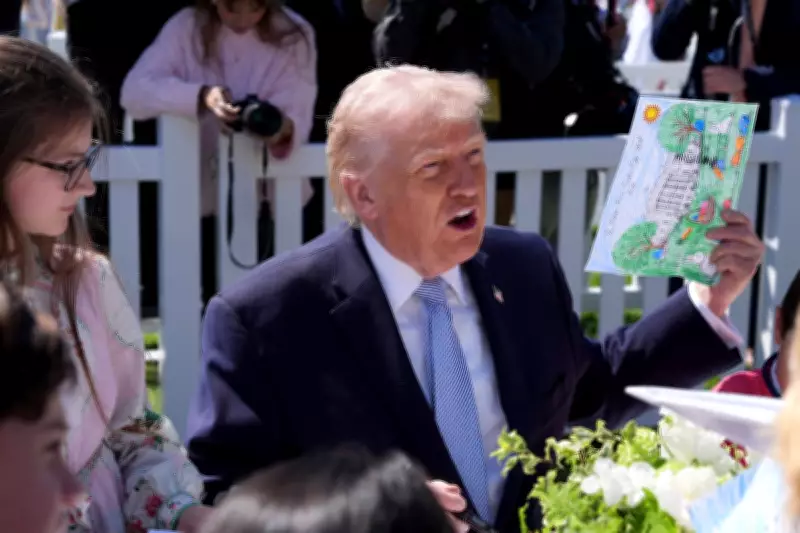
Donald Trump has intensified his criticism of UK Prime Minister Sir Keir Starmer by drawing a provocative comparison to Neville Chamberlain, the 1930s British prime minister infamous for his policy of appeasement toward Nazi Germany. This inflammatory remark came during a White House Easter event on Monday, where the US president discussed the ongoing conflict with Iran and expressed dissatisfaction with the UK's stance.
Transatlantic Strain Over Iran Policy
President Trump's invocation of Chamberlain signals a deepening rift in UK-US relations, particularly regarding military strategy in the Middle East. The president has repeatedly condemned Sir Keir for refusing to commit British forces to offensive operations against Iran, a conflict now entering its sixth week. At the event, Trump told reporters, "We won't want another Neville Chamberlain, do we agree? We don't want Neville Chamberlain," though his specific reference remained somewhat ambiguous amidst broader comments about the UK having "a long way to go."
Starmer's Defiant Stance
In response, Sir Keir Starmer has firmly stated that he will not "buckle under pressure" or allow the United Kingdom to be "dragged into the war." The UK government has clarified that it will not participate in offensive actions against Iran, despite Trump's threats to bomb civilian infrastructure such as power plants and bridges. Education Secretary Bridget Phillipson emphasized this position, noting that Trump's approach and language are not ones the UK government would adopt, and it is up to the president to explain his choices.

Trump's Threats and Deadlines
During the same event, President Trump reiterated his threat to target Iran's civilian infrastructure if Tehran does not reopen the Strait of Hormuz. He set a deadline of 8pm US time on Tuesday, which translates to 1am Wednesday UK time, for Iran to comply. This threat was initially made in an expletive-laden social media post on Sunday, sparking accusations that the president was threatening to commit war crimes. Trump also claimed to have already achieved "regime change" by eliminating Iran's previous leaders, including former supreme leader Ayatollah Ali Khamenei, asserting that current negotiators are "much more reasonable." However, some experts argue that removing the previous ayatollah has led to a more hardline group assuming control in Tehran.
UK's Limited Military Involvement
So far, the United Kingdom has restricted its military engagement in the Iran conflict to defensive measures. RAF jets have been conducting sorties to protect Gulf allies from drone attacks, with recent actions including an RAF Typhoon jet shooting down an Iranian drone in the Gulf overnight. Ground troops from the RAF Regiment have also been involved in eliminating drones in what the Ministry of Defence described as a "high-threat area." This cautious approach underscores the UK's commitment to avoiding escalation while supporting regional security.
Broader Diplomatic Context
This diplomatic friction occurs as King Charles prepares for a state visit to the United States, marking 250 years since American independence. Despite calls to cancel the trip amid the tensions, the visit is proceeding, highlighting the complex interplay between historical alliances and current geopolitical disagreements. The ongoing dispute over Iran not only strains bilateral relations but also raises questions about future cooperation on global security issues.
As the deadline for Iran approaches, the world watches closely to see how these transatlantic tensions will unfold, with Sir Keir Starmer standing firm against pressure while Donald Trump continues to employ aggressive rhetoric and historical analogies to push his agenda.