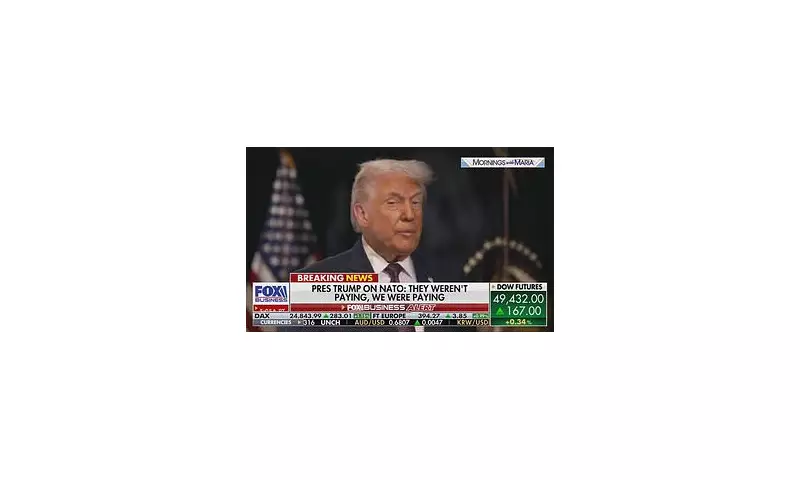
Former US President Donald Trump has provoked widespread condemnation after asserting that British and other NATO troops remained "a little off the front lines" during the conflict in Afghanistan. The controversial remarks, made during an interview with Fox News, have been met with fierce backlash from UK politicians and military figures who view them as a profound disrespect to those who served and died.
Questioning Alliance Commitment
During the broadcast, Trump expressed uncertainty about whether NATO members would support America if needed, stating, "We've never needed them," and adding, "We have never really asked anything of them." He acknowledged that allies sent troops to Afghanistan but claimed they "stayed a little back, a little off the frontlines." Trump emphasised that international relations "has to be a two-way street," despite the US having "been very good to Europe and to many other countries."
British Political Fury Erupts
The comments triggered immediate outrage from across the UK political spectrum. Labour MP Emily Thornberry, who chairs the Foreign Affairs Committee, labelled Trump's statement an "absolute insult" to the 457 British service personnel killed in Afghanistan. Speaking on BBC Question Time, Dame Emily declared, "How dare he say we weren't on the frontline, how dare he. We have always been there whenever the Americans have wanted us, we have always been there."

Liberal Democrat leader Sir Ed Davey echoed this sentiment, demanding, "How dare he question their sacrifice?" Meanwhile, Conservative MP Ben Obese-Jecty, who served as a captain in the Royal Yorkshire Regiment in Afghanistan, expressed sadness "to see our nation's sacrifice, and that of our NATO partners, held so cheaply by the president of the United States."
Firsthand Accounts Challenge Claims
Obese-Jecty provided a powerful rebuttal based on personal experience, stating, "I saw firsthand the sacrifices made by British soldiers I served alongside in Sangin, where we suffered horrific casualties, as did the US Marines the following year." He added that he does not believe US military personnel share Trump's view, suggesting the former president's words "do them a disservice as our closest military allies."
Social Care Minister Stephen Kinnock also criticised the remarks as "deeply disappointing," telling Sky News, "I don't know really why he said them. I don't think there's any basis for him to make those comments." Kinnock reaffirmed the UK's commitment to NATO, describing it as "at the heart" of the alliance defending democratic values.
NATO Chief Delivers Reality Check
NATO Secretary General Mark Rutte directly challenged Trump's assertions during discussions in Davos, providing crucial context about allied sacrifices. Rutte told the former president, "There's one thing I heard you say yesterday and today. You were not absolutely sure Europeans would come to the rescue of the US if you will be attacked. Let me tell you, they will, and they did in Afghanistan."
The NATO leader presented stark statistics, revealing that "for every two Americans who paid the ultimate price, there was one soldier from another NATO country who did not come back to his family – from the Netherlands, from Denmark, and particularly from other countries." Rutte offered an "absolute guarantee" that allies would stand with the US if attacked, expressing pain that Trump might think otherwise.
Historical Context and Sacrifice
The controversy unfolds against the backdrop of NATO's only invocation of Article 5's collective security provisions following the September 11 attacks in 2001, which triggered the US-led invasion of Afghanistan. While the United States suffered 2,461 military deaths during the conflict, the UK experienced the second-highest toll among coalition forces with 457 fatalities. Overall, America's allies accounted for 1,160 deaths – approximately one-third of total coalition casualties.
Trump's criticism extended to Denmark, which had the highest per capita death toll among coalition forces in Afghanistan, with the former president calling the country "ungrateful" for US protection during World War Two. This additional remark has further strained diplomatic perceptions amid the ongoing debate about allied contributions and sacrifices in modern conflicts.