The Guardian View on Trump's Iranian Campaign: An Illegal War That Risks Becoming the New Normal
Editorial
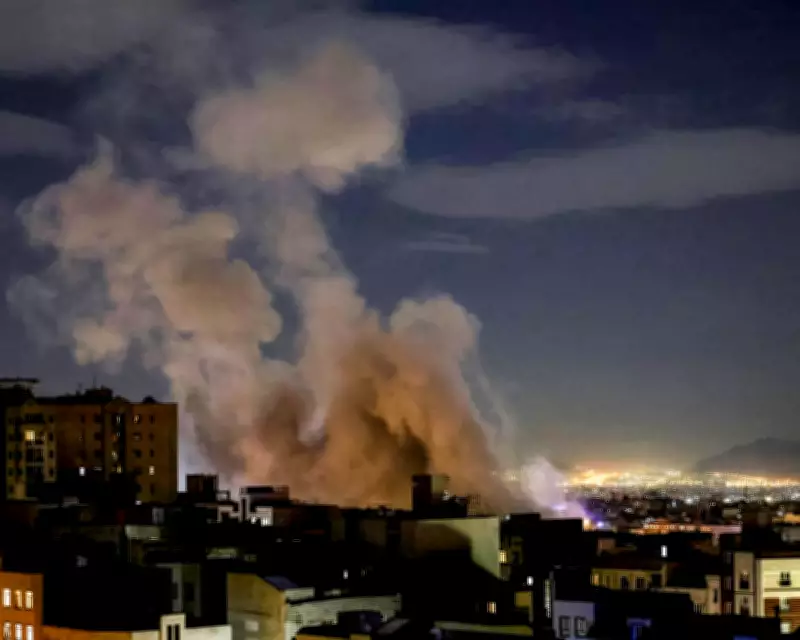
The US-Israeli military action will test the fragile rules governing the use of force in international relations. The killing of Iran's supreme leader, Ayatollah Ali Khamenei, by a coordinated US-Israeli strike represents a targeted assassination of a head of state. This act marks a grave and dangerous escalation in a region already burdened with smouldering conflicts and fragile states. The consequences of this deliberate and calculated strike will reverberate powerfully across a Middle East still marked by the deep aftershocks of previous foreign interventions.
Legal Justifications and the Absence of Self-Defence
Revulsion against the hardline regime in Tehran, or a genuine desire for a better future for the Iranian people, does not confer any legal justification for such an attack. Under the United Nations charter, the use of force is lawful only in self-defence against an imminent attack or with explicit security council approval. Neither of these critical conditions has been met in this instance. There was no credible evidence presented of an "instant, overwhelming" Iranian attack being prepared against the United States or Israel.

What Donald Trump's Operation Epic Fury appears to represent is not pre-emption but prevention: a deliberate decision to eliminate a perceived future risk while an adversary appeared politically or militarily weak. It is, unequivocally, a war of choice. Mr Trump's public call to overthrow a sovereign government was extraordinary and sets a perilous precedent. Unlike pre-emptive wars, preventive ones are widely deemed unlawful because they grant powerful nations a licence to strike at will based on speculative threats.
The Dangerous Precedent and Shaky Domestic Foundations
This distinction is profoundly important; it is precisely why many European governments rejected Russia's justification for its invasion of Ukraine by claiming it needed to head off a future threat. International law cannot be optional for allies and binding only for adversaries. The domestic foundations of Mr Trump's action are also remarkably shaky. There is little discernible public support in the United States for this aggressive attack, and Congress was notably not asked to authorise these hostilities.
Public appetite will likely diminish further as the inevitable civilian death toll mounts and American soldiers begin returning home in body bags. The war may have been launched with swift military precision, but its political and economic consequences are likely to be devastatingly long-lasting. Iranian retaliation has already extended beyond Israel to include Gulf monarchies where significant US forces are deployed.
Economic Fallout and Strategic Gambles
Tehran has announced it has closed the Strait of Hormuz, a critical chokepoint through which roughly twenty percent of the world's oil exports pass. Energy analysts are warning that global crude prices could surge by fifty percent, potentially reaching one hundred dollars a barrel. Escalation is no longer a theoretical notion but a stark reality. Tehran's strategy appears less about achieving a clear battlefield victory than about demonstrating survival – proving that, despite leadership decapitation, the state can and will fight on.
This is a high-stakes gamble. Excessive restraint by Iran could invite national humiliation; significant overreach risks forging a broader international coalition against it. Khamenei's death is undoubtedly a moment of profound rupture. However, large, cohesive states with deep institutional structures rarely collapse solely under air assault. The illusion of regime change from the sky has been repeatedly disproven – in Afghanistan, Iraq, and Libya. Removing leaders is not synonymous with remaking a country's complex political fabric.

Narrowing the Path to Diplomacy
Perhaps Mr Trump desires a compliant Tehran, much as his illegal kidnapping of Nicolás Maduro has given him leverage in Venezuela. However, Mr Trump's decision to authorise the bombing of Iran when negotiations, mediated by Oman, had shown tentative signs of a potential diplomatic breakthrough will severely narrow the space for any future compromise. The critical question is not merely whether Mr Trump's war weakens Iran militarily. It is whether this action fundamentally weakens the entire system of international rules and norms on which global stability has depended for decades.
A World Governed by Raw Power
Once the concept of preventive war is normalised and accepted, it can be invoked by any state that considers itself threatened in the long term. That establishes an exceptionally dangerous precedent in an age defined by expanding missile arsenals, sophisticated cyberthreats, and ongoing nuclear proliferation. The idea that complex societies can be effectively reshaped by external military force is not new. History shows it almost never works as intended.
Mr Trump's triumphalism following Khamenei's killing is particularly worrying at a moment when restraint from all parties is desperately needed. This volatile moment requires cool heads, strategic patience, and a firm commitment to stand up for the legal principles that, however imperfectly observed in the past, remain humanity's best defence against a world governed solely by raw power and military might.