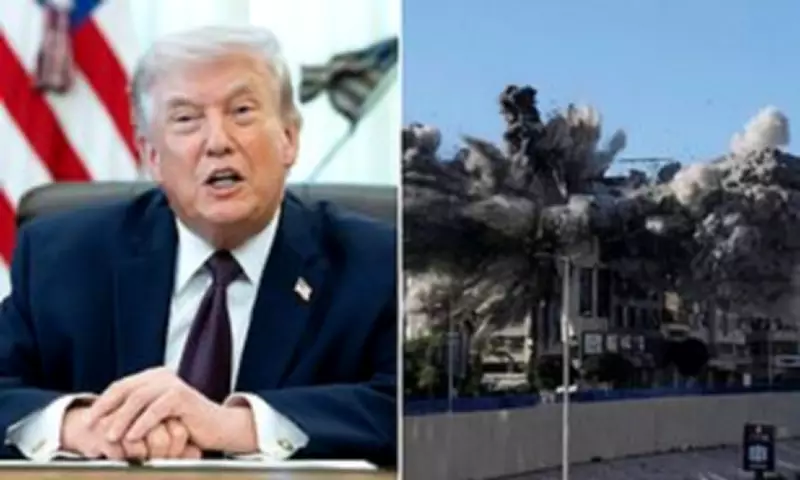
Donald Trump delivered one of his strongest indications yet that the ongoing conflict with Iran may be concluding, vowing to "leave" the country within two to three weeks. However, as the US President prepares to address the nation with an important update on Iran, speculation mounts that he could be buying time for a surprise invasion on Good Friday.
Contradictory Messages and Military Buildup
Throughout the conflict, Trump has issued a flurry of contradictory statements—declaring victory one moment, extending deadlines the next, and threatening to "completely obliterate" Iran's energy infrastructure if the Strait of Hormuz wasn't immediately reopened. NATO allies have been variously dismissed as "cowards" and a "paper tiger" alliance, while simultaneously being urged to intervene in the strait themselves.
While US officials maintain that talks with Iran continue optimistically, Iranian Foreign Minister Abbas Araqchi stated on Tuesday that direct messages from US special envoy Steve Witkoff did not constitute formal negotiations. Amid growing hopes for a diplomatic resolution, tonight's presidential address could announce an end to hostilities—or potentially serve as cover for an Easter invasion.

Strategic Timing and Market Considerations
An invasion on Good Friday would coincide with the closure of Wall Street and major European markets for a three-day weekend. Military analysts suggest Trump might time operations for when markets are closed, particularly if planning short, sharp missions before trading resumes.
The USS Tripoli arrived in the Middle East on Friday with approximately 5,000 sailors and Marines distributed across multiple warships. They will soon be joined by the San Diego-based USS Boxer amphibious assault ship and two other vessels comprising the 11th Marine Expeditionary Unit. Additionally, thousands of paratroopers from the 82nd Airborne are heading to the region, accompanied by hundreds of Special Forces personnel.
Expert Analysis and Historical Patterns
Becca Wasser, a Bloomberg economics analyst who conducted war games analysis for the Department of Defence from 2015 to 2025, told the Times: "The troop deployments are real, they are in motion and once they start there’s almost a strange inevitability to them based on how President Trump has used them in the past."
She noted that Trump prefers keeping all options open as long as possible, using threats against Tehran's infrastructure to pressure Iran into agreement while simultaneously preparing for potential ground invasion. "We’ve seen this pattern in the Caribbean and already in the Middle East," Wasser explained. "Once forces are deployed, action typically follows."
Mixed Signals and Economic Impacts
Even as troops build up in the region, Trump has boasted about peace progress, claiming last week that Tehran handed Washington a "significant prize" worth a "tremendous amount of money" related to the Strait of Hormuz. "They did something yesterday that was amazing," he told reporters in the Oval Office. "I'm not going to tell you what that present is, but it was a very significant prize."
Oil prices fell more than three percent to just above $100 per barrel following Trump's remarks about leaving Iran "very soon." However, Brent crude remains 39 percent higher than on February 28, when Tehran effectively closed the Strait of Hormuz—the vital waterway through which approximately one-fifth of global daily oil and liquefied natural gas supplies pass.
Throughout the conflict, Trump has consistently attempted to reassure markets that hostilities were nearing conclusion, particularly during periods of potential sell-off pressure. Yet with American troop concentrations increasing in the region, escalation remains a distinct possibility.
International Reactions and Diplomatic Tensions
As Trump ramped up criticism of Britain—claiming the UK "doesn't even have a navy" and accusing Prime Minister Keir Starmer of focusing only on "windmills"—Starmer signaled a renewed push to unwind Brexit. At a Downing Street press conference, Starmer declared Iran "not our war" while emphasizing "calm leadership."

The Prime Minister announced a new drive for closer EU relations, stating: "We seek closer economic cooperation, closer security cooperation." A summit will soon be held to develop a "more ambitious" relationship as transatlantic ties show increasing strain.
Trump further dismissed NATO as a "paper tiger," asserting that America leaving the military alliance was now "beyond reconsideration." These developments occur against a backdrop of ongoing military preparations and diplomatic uncertainty, leaving observers questioning whether Trump's latest signals indicate genuine de-escalation or strategic misdirection ahead of potential Easter hostilities.