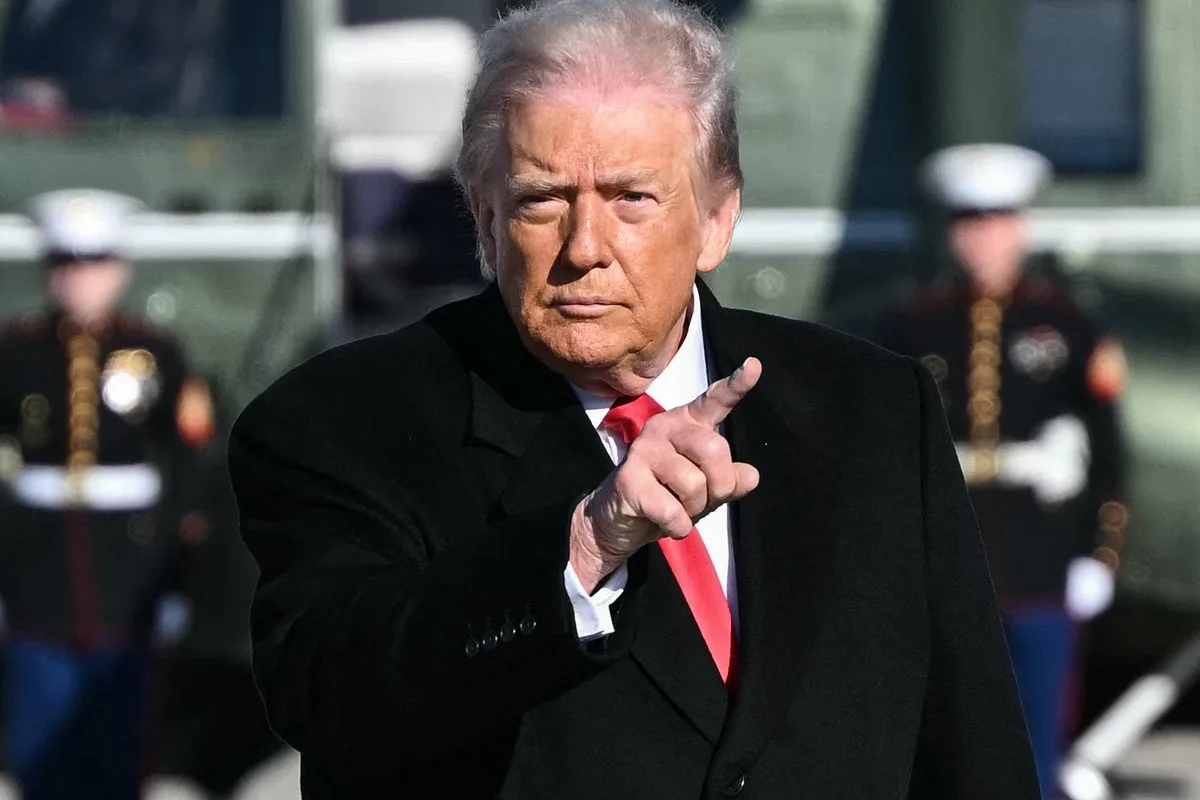
Trump's Greenland Obsession Reveals Strategic Contradictions in Foreign Policy
Trump's Greenland Obsession Reveals Foreign Policy Contradictions

Trump's Greenland Fanaticism Exposes Foreign Policy Contradictions

As Donald Trump takes centre stage at the Davos summit, his persistent obsession with acquiring Greenland reveals the complex and often contradictory nature of his administration's approach to international relations. The world affairs editor Sam Kiley examines how this fixation illuminates broader patterns in Trump's foreign policy, which has veered dramatically from Iran to Venezuela, Gaza to Ukraine throughout his first year in office.

A Year of Contradictory Approaches

Remarkably, Trump publicly signalled his desire to acquire Greenland for the United States even before being formally installed as the 47th President. Now, twelve months into his administration, the future of this ice-clad mega-island sits at the heart of escalating tensions between Western nations, potentially triggering a significant trade war. Within this complex geopolitical puzzle, understanding the jumble of global contradictions revealed by Trump's latest territorial fixation demonstrates there exists both method and outright madness in his relations with the outside world.

Trump has systematically dismantled numerous pillars of American democracy while simultaneously advancing the interests of America's greatest strategic rival, Russia, in ways that frequently appear senseless and difficult to comprehend. Beyond US borders, he has consistently supported Russian positions regarding Ukraine, thereby undermining the foundational structures of the North Atlantic Treaty Organization. His national security strategy has incorporated outright falsehoods circulating in the darker corners of social media, presenting as fact the notion that European civilisation stands on the verge of erasure.

Wide Pickt banner — collaborative shopping lists app for Telegram, phone mockup with grocery list

Pro-Russian Actions and American First Policy Shifts

In pursuing this course, Trump has behaved in a manner that only a former KGB officer like Vladimir Putin could have dreamed of achieving—weakening European cohesion and undermining the military alliance that the Kremlin perceives as its primary threat. Meanwhile, Trump's America First policy has veered unpredictably from promises to focus exclusively on domestic issues and abandon foreign interventions to employing military force to remove Venezuela's president, killing untried alleged smugglers on the high seas, and authorising strikes against Iran—actions many argue violate international law.

He has recently declared that Venezuela will be governed according to his directives and that he intends to control its oil revenues, spending them as he sees fit. Should Caracas object to this arrangement, Trump has threatened further military action against the South American nation. This might-is-right attitude closely echoes Putin's approach toward neighbouring states, notably Georgia and Ukraine—both of which the Russian president has invaded with apparent intentions of recolonisation. Thus far, these actions appear overwhelmingly pro-Russian in their orientation and consequences.

The Greenland Paradox: Protection Against Rivals

Yet the situation becomes more complex when examining Trump's Greenland fixation. The administration insists that bringing Greenland under US sovereignty is essential to protect it against Russian and Chinese threats and depredations. Officials also highlight that control of Greenland would assist in securing Arctic northern sea passages that Russia is aggressively opening with a new fleet of icebreakers. The North Atlantic serves as the key route for Russia's shadow fleet of oil tankers to circumvent sanctions, sell oil globally, and fund its ongoing war in Ukraine.

Greenland hosts Russia's nuclear submarine fleet, where both Russia and, to a lesser extent, China are perceived as significant threats by the Trump administration—a perspective shared by every US president since the Second World War. During the Cold War's peak, the United States maintained at least 17 bases and approximately 15,000 military personnel in Greenland as part of NATO's early warning systems. America retains the right to almost unlimited military investment there if required, yet this existing arrangement proves insufficient for Trump, who desires outright ownership of the vast landscape that climate change is gradually revealing to contain substantial mineral wealth.

Pickt after-article banner — collaborative shopping lists app with family illustration

Economic Fallout and Strategic Intent

Europe, including the United Kingdom, now stands on the brink of a trade and tariffs war with the United States as ministers prepare economic countermeasures against Trump that could prove costly for both sides, having already triggered share price declines and gold price increases. Herein lies evidence of Trump's strategic intent. He has spoken plainly about his desire to re-establish American dominance over the western hemisphere, displaying indifference toward the economic chaos his threats regarding Greenland and NATO's existence have generated.

"Under our new national security strategy, American dominance in the western hemisphere will never be questioned again," Trump declared earlier this year. This same strategy perceives Europe as fading and failing, consistent with Trump's long-term worldview dividing the globe into three spheres of interest: America controlling the West, Russia receiving its designated chunk, and China taking the remainder. It has become increasingly clear that Trump no longer views Europe as a natural component of the western hemisphere he seeks to control, possibly convinced by Putin or reaching his own conclusion that European nations, particularly in the east, no longer represent strategic assets for America.

Resource Competition and Global Minerals Race

Consequently, Trump believes Europeans should finance their own defence against Russia independently. Within this context, he aims to establish a "Golden Dome" missile defence system protecting America with its outer perimeter in Greenland. From his perspective, owning the island, controlling its resources, and leaving Europe to manage its disputes with Putin represents logical strategy. The crucial factor extends beyond Greenland's geographical location to Trump's conclusion that, regarding protection and domination of US access to essential minerals and rare earths, Americans have been "asleep at the wheel" while China has raced ahead.

According to Chatham House's David Lubin, Brazil, Chile, Peru and Venezuela all count China as a primary trading partner, with much of this trade involving Chinese investments in mining and critical ore extraction. Chile and Argentina collectively hold approximately half the world's lithium reserves, while Peru and Chile possess about 30 percent of global copper reserves. Venezuela reportedly contains the earth's largest oil reserve alongside significant gold, bauxite and iron ore deposits. Bolivia hosts the biggest lithium deposits at 20-25 percent, while Brazil possesses substantial iron ore, nickel and manganese reserves.

Greenland's Strategic Mineral Significance

Unsurprisingly, as Trump retreats from global engagement into a western sphere dominated by the United States, he seeks to wrest control of these defence and energy-critical resources from China. Beijing already controls up to 40 percent of the world's rare earths and up to 90 percent of its rare earth processing capacity. Greenland contains special minerals known as heavy rare earths—the most scarce and defence-critical varieties with scientific names like dysprosium, terbium, yttrium, neodymium and praseodymium.

The high northern island holds up to 12 percent of global reserves of these rare earths, essential for missile guidance systems, radar, jet engines and magnets. Greenland represents one of the largest deposits of these special minerals outside Chinese control. Not content with Greenland alone, Trump assisted Argentina through a currency swap facility, abducted Venezuela's president, threatened Colombia and will undoubtedly continue flexing American economic and military power throughout South America.

African Mineral Interests and Ukrainian Calculations

Trump is also eyeing mineral deals in the Democratic Republic of the Congo, where civil war, invasion, ethnic strife and general chaos have driven away many investors—though not China, which maintains state-backed strategic investments there. The DRC produces about 70 percent of the world's mined cobalt, predominantly controlled by Chinese companies, plus at least 30 percent of global coltan essential for computer production. Trump claims to have brought peace to eastern DRC where Rwandan-backed rebels operate extensive mining networks, while considering supporting the central government's efforts to recapture the mineral-rich region in exchange for mineral access.

Throughout the past year, Trump's sole pro-Ukrainian engagement involved forging a minerals deal with Kyiv granting the United States up to 50 percent ownership of future profits from new mineral extraction investments in return for not abandoning Ukraine entirely. While advantageous for America, this arrangement lacks strategic commitment, as Trump views Ukraine firmly within Russia's sphere. He has endorsed Russia's false claim that President Volodymyr Zelensky lacks legitimacy and supported the Kremlin's annexation of at least 20 percent of Ukrainian territory.

NATO Tensions and Psychological Drivers

America's NATO allies are rushing to reassure Trump that they remain committed to Greenland's defence, sending a small naval flotilla to its waters as a gesture supporting North Atlantic alliance principles and offsetting his threats to dismantle that alliance by attempting to seize the island. This is where his strategic "method" begins to unravel. As a senior NATO general explained to The Independent, "He doesn't realise that the security of the United States' eastern seaboard is guaranteed by NATO. The US can't possibly defend it all and can't police the high north either without NATO's help. NATO needs the US but he has not seen that it cuts both ways. The US needs NATO. His staff realise that—and his military certainly do."

Yet Trump appears to hold Europe, which provides the bulk of NATO's forces—collectively about double the size of US forces with more tanks, artillery, personnel and aircraft—in remarkably low esteem. His indifference toward whether Putin seizes additional European territory forms part of his apparent madness, driven, according to former White House Russia adviser Fiona Hill from his first term, by his relationship with Putin. "It is a man crush. It's because Putin's the badass. He's what Trump would like to be," Hill told The Independent's 'World of Trouble' podcast.

She elaborated: "Trump looks at people who are frankly in charge of everything, who have the kind of, basically, the bling. You know, they're emblazoned in gold. And that's what he wants to be. And he believes that he is elevated in everybody's minds, by their association, by being in their company. And that's what Putin's got on him. Putin's got his number. Putin realises he is a man with a very fragile ego, and that he's somebody that can be manipulated." Consequently, Trump attempts to construct a world revolving around three men: China's Xi Jinping, Putin, and himself. As Hill concludes, "Trump himself is wanting to be recognised by absolutely everybody who matters. And he only gets that if he has the approval of people like President Xi of China, President Putin of Russia, the royal families of here, there and everywhere. For Trump, that's what really matters, that's the coin of the realm for him."




