Donald Trump has offered a characteristically cryptic response when pressed on the extent of his ambitions to acquire Greenland, telling reporters "you'll find out" while simultaneously casting doubt on NATO's willingness to defend the United States.
White House Press Conference Revelations
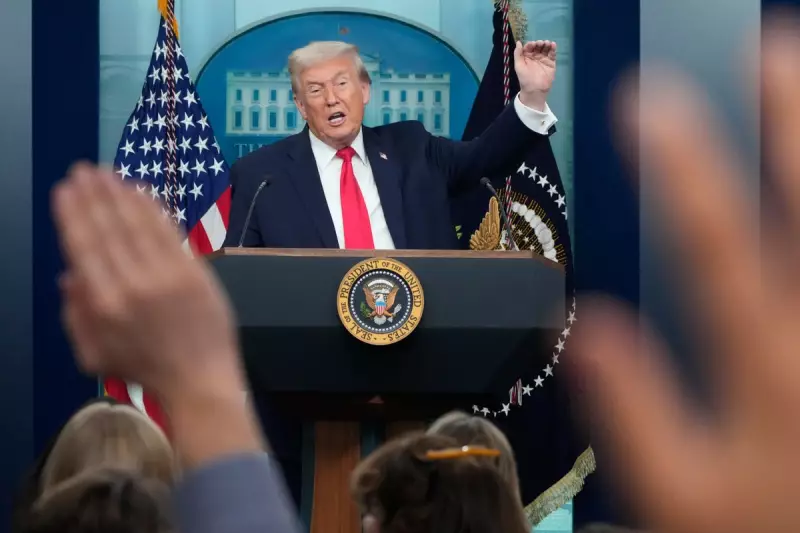
During a wide-ranging White House press conference marking the first year of his second term, the US president faced questioning about whether he was prepared to accept the potential breakup of NATO as a consequence of his Greenland ambitions. Mr Trump responded with characteristic ambiguity, stating: "I think something's going to happen that's going to be very good for everybody. I think that we will work something out... NATO is going to be very happy and where we're going to be very happy."
The president went on to justify his interest in the semi-autonomous Danish territory by citing security concerns: "But we need it for security purposes, we need it for national security and even world security. It is very important."

Questioning NATO's Reliability
In a significant departure from traditional transatlantic solidarity rhetoric, Mr Trump expressed serious reservations about America's ability to rely on its NATO allies for mutual defence. "The big fear I have with NATO is we spend tremendous amounts of money with NATO, and I know we'll come to their rescue but I just really do question whether or not they'll come to ours," the US president stated bluntly.
This scepticism about alliance reciprocity represents a notable escalation in rhetoric from a president who has long criticised NATO members for what he perceives as insufficient defence spending contributions.
Social Media Provocations and Diplomatic Fallout
Earlier on Tuesday, the president had engaged in a social media spree that included attacking the UK's decision regarding sovereignty of the Chagos Islands, sharing private messages from European leaders including French President Emmanuel Macron, and posting images depicting Greenland as US territory.
When questioned about these provocative posts during the press conference, Mr Trump insisted he maintains good relationships with both Prime Minister Sir Keir Starmer and President Macron, though he revealed they had not communicated since his Truth Social activity. "I mean, they always treat me well. They get a little bit rough when you know, when I'm not around, but when I'm around they treat me very nicely," he remarked.
The president then offered unsolicited criticism of both leaders' domestic situations: "You know. I like both of them; they're both liberal. They've got to straighten out their countries though: you look at London, it's having a lot of problems and if you look at Paris, got a lot of problems."
Economic Threats and Military Implications
Mr Trump has explicitly threatened to impose 10% tariffs on the UK and other European allies beginning February 1 unless they acquiesce to his proposed purchase of Greenland. Furthermore, he has refused to rule out employing military force to seize the strategically important Arctic territory.
The president has repeatedly framed his Greenland ambitions within national security parameters, warning that Russia and China present significant security risks from the Arctic region and asserting that Denmark lacks the capability to adequately protect Greenland.
Market Reactions and International Responses
The escalating tensions have already produced measurable economic consequences, with London's FTSE 100 index experiencing declines mirrored by other European exchanges and US markets.
In Downing Street, Prime Minister Sir Keir Starmer addressed the growing crisis, noting there was a clear consensus among NATO members that enhanced efforts were needed to secure the Arctic region. A Number 10 spokesperson confirmed that during Cabinet meetings, Sir Keir "reiterated that Greenland's future was a matter for Greenlanders and the Kingdom of Denmark, and that the prospect of tariffs imposed against allies by the US was wrong."
The Prime Minister emphasised his ongoing diplomatic engagement with European leaders regarding the proposed US tariffs, describing them as measures that served "in no-one's interests" and represented a significant challenge to transatlantic cooperation.