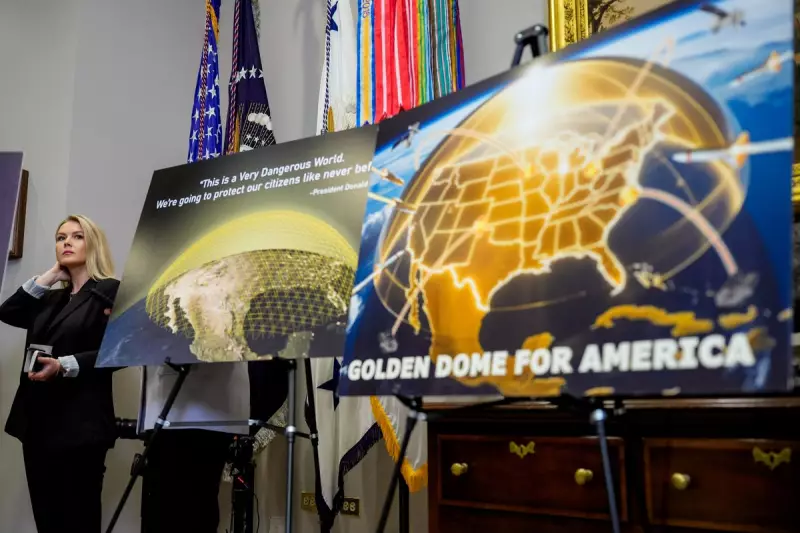
In a significant geopolitical development, former US President Donald Trump has unveiled ambitious plans for a multibillion-dollar missile defence system he calls the "Golden Dome," with Greenland positioned as a critical component. Trump asserts this advanced defensive network will become fully operational before his potential term concludes in 2029, marking a substantial shift in Arctic security strategy.
The Strategic Importance of Greenland
Greenland's geographical position places it at a crucial crossroads for potential nuclear defence scenarios. The vast Arctic territory lies directly under the flight paths that intercontinental ballistic missiles from nuclear adversaries like Russia and China might traverse en route to targets within the United States, and vice versa. This strategic reality forms the cornerstone of Trump's persistent campaign to secure US control over Greenland, a move that has unsettled both Greenlanders and longstanding European allies.
During a press conference at the White House in May 2025, Trump presented charts and posters depicting the "Golden Dome for America," emphasising its importance. "Because of The Golden Dome, and Modern Day Weapons Systems, both Offensive and Defensive, the need to ACQUIRE is especially important," Trump declared in a subsequent Truth Social post, reigniting debate about the territory's future.

Nuclear Flight Paths and Arctic Geography
Intercontinental Ballistic Missiles typically follow the shortest direct route on a ballistic trajectory through space. The most direct flight paths between China or Russia and the United States frequently cross the Arctic region, placing Greenland directly in the line of potential conflict. For instance, Russian Topol-M missiles launched from the Tatishchevo silo complex southeast of Moscow would arc high over Greenland if targeted at US Minuteman III missile bases in North Dakota, Montana, or Wyoming.
Similarly, Chinese Dong Feng-31 missiles, potentially fired from newly constructed silo fields identified by the US Defense Department, could also overfly Greenland if aimed at the US Eastern Seaboard. "If there is a war, much of the action will take place on that piece of ice. Think of it: those missiles would be flying right over the centre," Trump remarked at the World Economic Forum in Davos, Switzerland.
Pituffik Space Base: The Northern Watchtower
Central to Greenland's defence value is the Pituffik Space Base, formerly known as Thule Air Base. Renamed in 2023 to acknowledge the Indigenous community displaced during its 1951 construction, this facility hosts the northernmost early warning radar in the Pentagon's network. Its position above the Arctic Circle, approximately midway between Washington and Moscow, enables unparalleled surveillance capabilities.
The advanced AN/FPS-132 radar at Pituffik can detect and track ballistic missile launches—including submarine-based systems—across a 240-degree arc extending nearly 5,550 kilometres. Even at maximum range, it can identify objects as small as a car, providing crucial data to inform presidential response decisions and guide interceptor missiles.
"That gives the United States more time to think about what to do," observed Pavel Podvig, a Geneva-based analyst specialising in Russia's nuclear arsenal. "Greenland is a good location for that."
Questioning the Ownership Argument
Trump has repeatedly argued that US ownership of Greenland is essential for defending the "Golden Dome" system. "You can't defend it on a lease," he insisted in Davos. However, defence specialists challenge this logic, noting the US has operated the Pituffik base for decades under a 1951 defence agreement without requiring territorial ownership.
French nuclear defence expert Etienne Marcuz highlights the inconsistency in Trump's position. "Trump's argument that Greenland is vital for the Golden Dome—and therefore that it has to be invaded, well, acquired—is false for several reasons," Marcuz stated. "One of them is that there is, for example, a radar in the United Kingdom, and to my knowledge there is no question of invading the UK."

Marcuz further notes that emerging technologies, including space-based sensors being tested for missile detection, could potentially reduce Greenland's importance in future defence architectures. "There are new sensors that are already being tested, in the process of being deployed, which will in fact reduce Greenland's importance," he explained.
Diplomatic Ramifications and Future Prospects
Trump's aggressive posture toward Greenland has dramatically altered diplomatic relations with Denmark, the territory's sovereign power. Previously considered one of America's most compliant allies, Denmark's willingness to authorise expanded US military presence in Greenland has become uncertain following Trump's acquisition campaign.
"Denmark was the most compliant ally of the United States," Marcuz recalled. "Now, it's very different. I don't know whether authorisation would be granted, but in any case, before, the answer was 'Yes.'"
Despite announcing a "framework of a future deal" on Arctic security, Trump's position remains fluid, ensuring the Greenland question will continue to feature prominently in transatlantic defence discussions. The proposed "Golden Dome" system—potentially incorporating interceptors stationed in Greenland to destroy incoming warheads—represents both a technological ambition and a geopolitical challenge that will shape Arctic security dynamics for years to come.