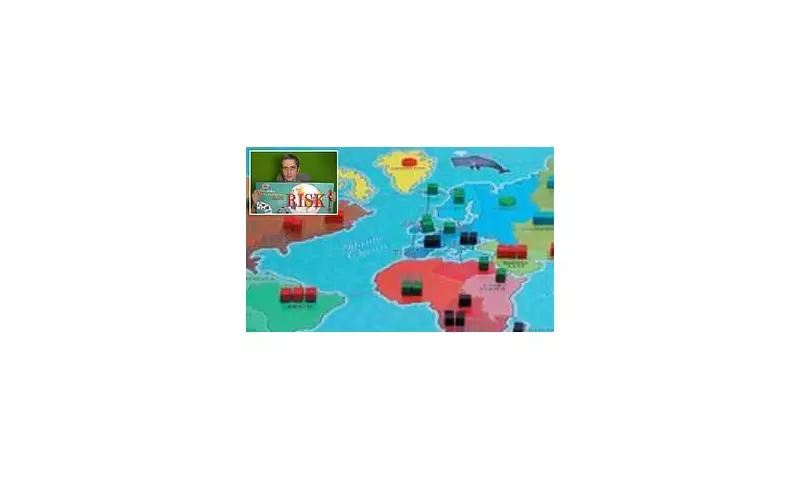
A former world number one player of the classic strategy board game Risk has observed striking similarities between President Donald Trump's recent geopolitical manoeuvres in the Western Hemisphere and advanced tactics used in the game.
From Game Board to Geopolitics: A Champion's Analysis
Michael Olivol, a grandmaster who held the top global ranking in Risk in October 2021, explained that expert players frequently aim to secure the entire North American continent first. This strategy provides a powerful base before expanding into other regions like South America. The 32-year-old accountant from New Jersey noted the real-world parallels are unmistakable.
Since beginning his second term, President Trump has pursued policies and actions focused on the Americas. These include renewed efforts to acquire Greenland, discussions over the Panama Canal, and military strikes targeting alleged drug cartels in Mexico and Venezuela. Trump has emphasised the vast natural resources, including oil and precious metals, that greater US control over these continents would unlock.

Controlling the Choke Points
In Risk, controlling a whole continent grants a player bonus armies each turn, creating a snowball effect. North America offers the second-largest troop bonus in the game, after Asia. Crucially, it is defended by just three access points: Alaska, Greenland, and Central America. Olivol described these as vital 'choke points' for preventing invasion.
"You need those territories, as well as Alaska or Kamchatka [Russia's closest point to the US], to safely hold the North American continent," Olivol told the Daily Mail. In reality, Trump has framed US control of Greenland as critical for national security, stating on January 4 that "We need Greenland from the standpoint of national security," citing Russian and Chinese presence.
Similarly, the administration has focused on Central America, with Trump accusing drug traffickers of causing hundreds of thousands of American deaths annually. On Thursday night, he told Fox News, "We are gonna start now, hitting land about the cartels."
Diplomacy, Alliances, and Global Parallels
Olivol, who uses the gamer tag OliveXC, highlighted another parallel: the relative simplicity of a Americas-focused strategy compared to managing the complex diplomacy required in a continent like Europe. "Every position requires diplomacy. I think Europe requires the most, because you can be attacked from so many areas," he said. This mirrors current events, with Europe embroiled in the ongoing Russia-Ukraine war.
The Risk expert stressed that the game is ultimately about manipulation and alliance-building. "Risk is a game about making your opponents not hate you, and hate each other," he explained. "If your opponents are wasting resources on each other and not you, you will accumulate more resources and win the game."
On the global stage, similar diplomatic moves are visible. UK Prime Minister Keir Starmer has urged NATO allies to 'step up' in the Arctic, partly to counter US ambitions in Greenland. Meanwhile, the Trump administration has strengthened ties with other South American nations featured on the Risk board. This includes moving to designate Peru as a major non-NATO ally in December 2025, holding trade talks with Brazil's President Lula, and supporting Argentine President Javier Milei's reforms.
Following the military action in Venezuela aimed at arresting leader Nicolas Maduro, Trump has now engaged with all four territories on Risk's South American continent. This has sparked commentary on social media, with one user asking, "Anyone concerned that Trump's approach to military conquest and world domination looks like a casual game of Risk with his buddies?"
The comparison, while unconventional, provides a unique lens through which to view current geopolitical strategy, suggesting the classic game's principles of resource control, choke points, and tactical alliances remain profoundly relevant.