
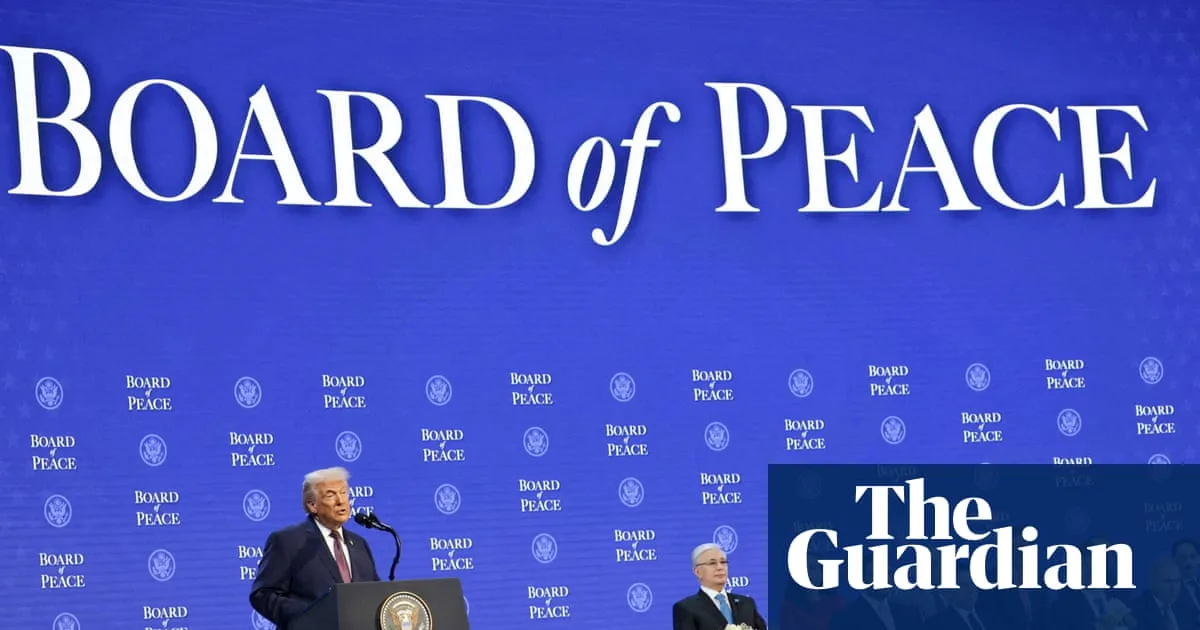
Dozens of world leaders and national delegations will meet in Washington DC on Thursday for the inaugural meeting of Donald Trump’s Board of Peace, as major European allies declined to join the group and criticised the organisation’s murky funding and political mandate.
The White House has indicated that the summit for his new ad hoc council at the renamed Donald J Trump Institute of Peace will heavily function as a fundraising round, with Trump announcing on social media that countries have pledged more than $5bn toward rebuilding Gaza, which has been devastated in the war with Israel and remains in a humanitarian crisis. The US president claimed that the member states had also “committed thousands of personnel to the International Stabilization Force and Local Police to maintain Security and Peace for Gazans”.
But, despite Trump’s characteristic bombast, the Board of Peace summit will open to heavy scepticism, with expectations limited both for Thursday’s meeting in Washington and in the Middle East, where the 100-day peace and recovery plan announced by Jared Kushner in Davos has stalled and aid into Gaza remains at a trickle. Aaron David Miller, a senior fellow at the Carnegie Endowment for International Peace and former US diplomat, said that the Board of Peace would have difficulty resolving the key questions in the Israel-Gaza conflict: who will govern the territory, who will provide security on the ground, and how to deal with the immediate needs of the Palestinian population.
Ursula von der Leyen, the president of the European Commission, has declined her invitation, and the leaders of key US allies including the United Kingdom, Germany and France have also said they won’t join the Board of Peace. Trump rescinded an invitation to Canada’s Mark Carney following a critical speech by the Canadian prime minister at the World Economic Forum in Davos last month. The White House initiative received another blow this week as Pope Leo XIV announced that the Vatican would not join the board, which critics have said is an attempt to usurp authority from other major international organisations including the United Nations and may allow Trump to remain as its chair even after his presidency ends.
The meeting instead will be attended by Middle Eastern delegations, including from Israel, the United Arab Emirates, Saudi Arabia, Turkey, Jordan and Qatar, along with a bevy of international states with little direct engagement in the conflict in Gaza, from Argentina and Paraguay to Hungary to Kazakhstan. Many are seen as currying favor with the Trump administration by joining the Board of Peace – which proposes securing a permanent seat for a $1bn donation – in an effort to prop up his latest signature initiative. Israel’s Benjamin Netanyahu, who signed up to the idea during a visit to Washington last week, has chosen to skip the meeting; the foreign minister, Gideon Saar, will attend instead.




