Trump's Gaza 'Board of Peace' Faces Scrutiny Over Composition and Approach
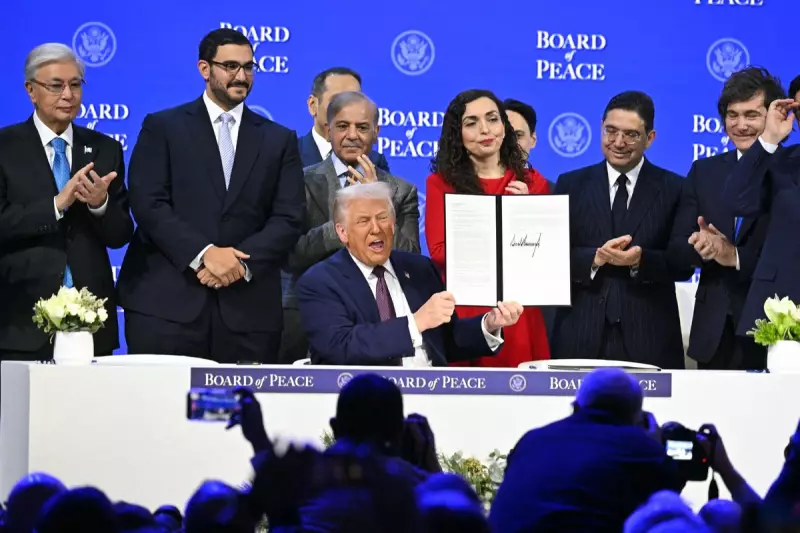
Donald Trump has declared that "things are calming down" during the signing ceremony for his newly established Gaza "board of peace," a development that has sparked considerable debate and criticism from observers and international leaders alike. The inauguration of what some have described as a political gimmick took place on Friday 23 January 2026, with the former president appearing delighted with the assembled delegation.
A Striking Lack of Diversity at the Signing Table
The visual representation of the board's inauguration revealed a glaring absence of women among the participants, with Kosovo's President Vjosa Osmani standing as the solitary female figure amidst what appeared to be a sea of male counterparts. This gender imbalance has raised questions about the inclusivity and representativeness of the peace initiative from its very inception.
Despite invitations being extended to sixty different nations, only twenty-one countries ultimately accepted the offer to participate in Trump's initiative. Observers have suggested that the substantial financial commitment required—reportedly involving billion-dollar contributions for permanent board positions—may have influenced the relatively modest acceptance rate among invited nations.

Notable Absences and Linguistic Concerns
Beyond the gender disparity, the board's composition drew additional criticism for excluding Palestinian representatives and Arabic speakers who might have provided crucial linguistic and cultural context. This omission became particularly apparent during Jared Kushner's presentation, which some attendees described as resembling a property sales pitch generated by artificial intelligence rather than a carefully crafted diplomatic proposal.
Trump himself appeared confident about the board's potential, stating: "Once this board is completely formed, we can do pretty much whatever we want to do." He further indicated that operations would proceed "in conjunction with the United Nations," though the board's newly unveiled logo—which dramatically reinterpreted UN imagery with gold accents and a prominently featured American continent—suggested a rather unilateral interpretation of this collaboration.
International Reactions and Diplomatic Tensions
The announcement has generated mixed reactions from global leaders, with some expressing outright rejection of the initiative. When Trump's spokesperson Karoline Leavitt announced Belgium's participation in the board, the country's foreign minister issued a swift correction via social media, emphatically stating that "Belgium has NOT signed the Charter of the Board of Peace" and describing the announcement as "incorrect."
This diplomatic exchange highlights the tensions surrounding Trump's approach to international relations, which has increasingly relied on unconventional communication channels rather than traditional diplomatic protocols over the past decade. The situation has drawn comparisons to literary depictions of authoritarian governance, with some commentators noting parallels to George Orwell's conceptualization of peace ministries in dystopian fiction.
Broader Implications for US Foreign Policy
The establishment of this peace board represents another chapter in what critics describe as a decade-long experiment with American populism on the global stage. Trump's administration continues to face scrutiny for its approach to international diplomacy, which has frequently prioritized dramatic announcements and unilateral actions over collaborative multilateral engagement.
As world leaders navigate this unconventional diplomatic landscape, questions remain about the substantive outcomes that might emerge from this latest initiative. The exclusion of key stakeholders, combined with the board's controversial visual branding and communication approach, suggests that significant challenges may lie ahead for this peace-building effort in one of the world's most complex geopolitical regions.