Donald Trump's newly established Board of Peace has ignited a global debate, not just over its ambitious mandate but also due to its visual identity. The logo unveiled during a signing ceremony in Davos, Switzerland, bears an uncanny resemblance to the emblem of the United Nations, prompting widespread scrutiny and commentary across social media platforms.
A Golden Globe with a Narrowed Focus
During the high-profile event at the World Economic Forum, President Trump launched the Board of Peace, a body conceived to resolve international conflicts with a reported price tag of $1 billion for permanent membership. However, it was the branding that quickly captured public attention. The Board of Peace logo, dipped in gold, features a centred globe flanked by olive branches on either side, mirroring the iconic design of the United Nations.
The critical distinction lies in the depiction of the globe itself. While the UN emblem is centred on the North Pole to represent the entire world, Trump's version has been reduced to show only North America. This design choice has not gone unnoticed, with dozens of internet users flooding social media to critique and analyse the symbolism.
Social Media Reactions and Symbolic Interpretations
Observers were quick to point out the parallels and implications. One user remarked, 'Trump’s "Board of Peace" logo is basically the UN logo, except dipped in gold and edited so the world only includes America.' Another added, 'The logo of Trump's "Peace Council," which the mob boss dreams is meant to replace the United Nations, inexplicably only depicts America.'
A more analytical perspective came from a user who noted, 'The board of peace logo includes the exact borders for the North American technate.' Further interpretations suggested deeper meanings, with one comment stating, 'Board of Peace logo is highly resembling with UN logo... But.... World map in Board of Peace is limited to America, and coloured Golden.... SYMBOLIC: USA to lead American Region only. Gold will overtake Dollar as Reserve Currency. UN to become redundant.'
Another observer speculated, 'The “Board of Peace" logo is the UN logo but dipped in gold and edited so the world only includes America with a shield implying “U.S protection”. Coincidence Or replacement? You tell me.'
Evolving Mandate and Ambitious Goals
The board, officially launched on Thursday, was originally conceived to oversee the rebuilding of Gaza following Israel's two-year conflict with the Strip. However, its 11-page charter makes no mention of Gaza, indicating a broader, more ambitious scope. Trump himself suggested the board may extend its work to other global crises, a role traditionally associated with the United Nations.
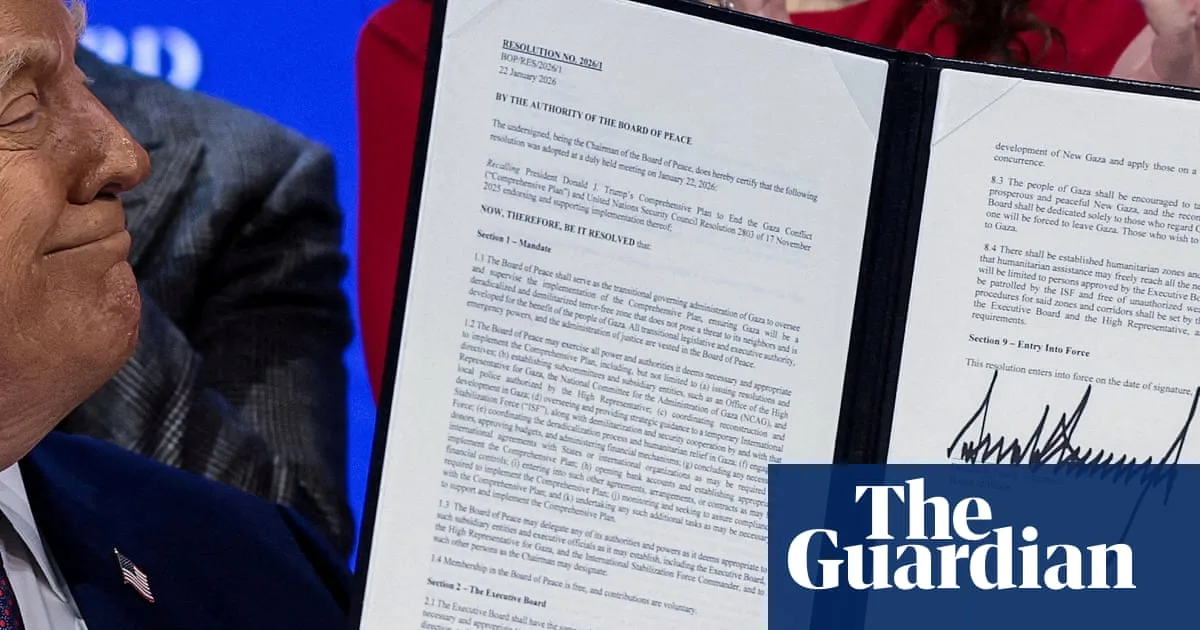
On stage at the World Economic Forum, Trump declared, 'Once this board is completely formed, we can do pretty much whatever we want to do,' before signing documents to formally establish the initiative. He was surrounded by other members, including leaders from Argentina, Azerbaijan, Indonesia, Bahrain, and Morocco.
Addressing Concerns and Outlining Vision
Some fear the Board of Peace could undermine the United Nations. Trump appeared to address these concerns in his opening remarks, stating the initiative would 'work with many others, including the United Nations,' while also listing other important diplomatic issues worldwide. He commented, 'I’ve always said the United Nations has got tremendous potential, has not used it.'
Trump praised US officials involved in the project for their efforts in establishing a ceasefire in Gaza, claiming, 'We have peace in the Middle East; nobody thought that was possible.' He added that the board was going to be 'very successful in Gaza,' and 'we can spread out to other things as we succeed with Gaza.'
Membership and Leadership Structure
According to a senior Trump administration official, around 60 nations have been invited to join the Board of Peace, with approximately 35 agreeing so far. Trump will serve as the inaugural chairman, a position he can hold for life under the current plans.
Those signed up include Middle East allies such as Israel, Saudi Arabia, the United Arab Emirates, Bahrain, Jordan, Qatar, and Egypt. Other participants include NATO members Turkey and Hungary, whose leaders maintain good ties with Trump, as well as Armenia and Azerbaijan, which reached a US-brokered peace agreement last year.
Additional nations agreeing to take part are Morocco, Pakistan, Indonesia, Kosovo, Uzbekistan, Kazakhstan, Paraguay, and Vietnam. More controversially, Belarusian President Alexander Lukashenko has accepted an invitation.
Notable Absences and Expanding Influence
Despite Trump's claim that 'every country' wants to join, notable snubs include US allies such as the UK, France, and Canada. The board is taking shape amidst a backdrop of recent US military strikes on Venezuela and presidential threats regarding Greenland and Iran.
Trump first proposed the idea in September when announcing his plan to end the war in Gaza, subsequently expanding its remit to tackle other global conflicts and promote peace worldwide. The Board of Peace's charter reportedly grants the chairman extensive executive power, including veto abilities and member removal, subject to certain constraints.
Executive Board and Unanswered Questions
The White House has selected Secretary of State Marco Rubio, special envoy Steve Witkoff, Trump's son-in-law Jared Kushner, and former British Prime Minister Tony Blair as members of the initiative's founding executive board. However, questions persist regarding the board's exact remit and operational mechanisms, causing hesitation among some invited nations.
Further concerns have been raised about the inclusion of authoritarian leaders, with invitations extended to figures such as Russia's President Vladimir Putin. As the Board of Peace moves forward, its logo controversy symbolises broader debates about its purpose, influence, and potential impact on established international institutions like the United Nations.






