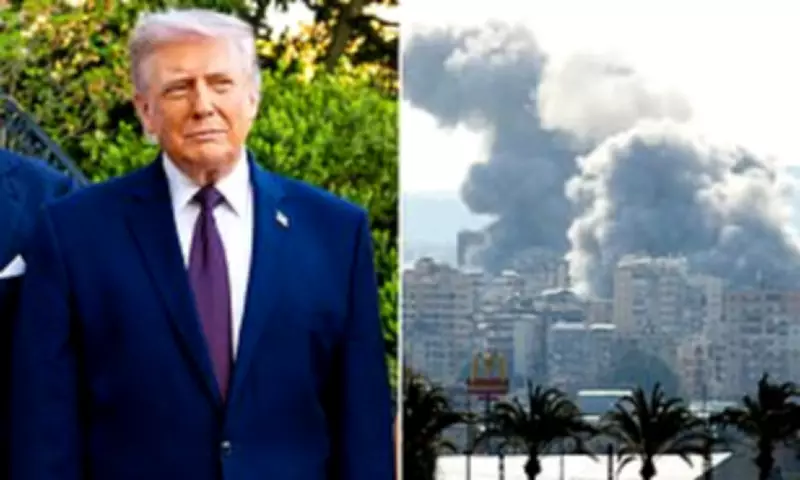
Former President Donald Trump has announced that talks between the United States and Iran could potentially restart within the next 48 hours. This development comes after negotiations led by JD Vance fell apart last weekend, derailing efforts to end the ongoing seven-week conflict.
Trump Points to Pakistan as Likely Venue
In comments to the New York Post on Tuesday, Trump indicated that additional peace talks with Iran might take place by Thursday in Pakistan. "You should stay there, really, because something could be happening over the next two days, and we're more inclined to go there," Trump stated. He elaborated, "It's more likely, you know why? Because the field marshal is doing a great job."
Praise for Pakistani Mediator
Trump's praise was directed at Pakistani Field Marshal General Asim Munir, who has played a central and instrumental role in mediating the US-Iran peace talks. "He's fantastic, and therefore it's more likely that we go back there," Trump continued. "Why should we go to some country that has nothing to do with it?"

Collapse of Previous Talks and Military Response
The previous round of peace talks collapsed in Islamabad after Vance pushed to bar Tehran from enriching uranium for a period of 20 years, a demand that ultimately failed to produce a long-term nuclear agreement. In response to this breakdown, Trump authorized a significant military action: shutting down the Strait of Hormuz with a naval blockade.
This critical waterway is responsible for transmitting approximately one-fifth of the world's oil trade, making the blockade a move with substantial global economic implications.
Strategic Options Under Consideration
Trump is currently weighing three distinct strategic options to compel Iran back to the negotiating table:
- Holding off on direct military strikes while maintaining a significant and visible US military presence in the region.
- Pursuing limited military action, such as targeted strikes on the regime's nuclear, ballistic missile, and energy facilities.
- A maximalist strategy aimed at overthrowing the Iranian regime by carrying out attacks against senior Iranian leadership.
However, according to reports from the Wall Street Journal, the President appears reluctant to restart a full-scale bombing campaign, wary that such an escalation could further inflame regional tensions and potentially widen the conflict across the Middle East.
Economic Consequences and Regional Warnings
The economic strain from the conflict is already being felt. Since the war began, US gas prices have remained above $4 per gallon nationwide, and global oil prices have surged past $100 a barrel. Furthermore, US wholesale prices experienced a sharp increase last month, driven primarily by rising energy costs linked to the conflict. The Labor Department reported that its producer price index rose 0.5 percent from February and 4 percent from March 2025.
Threats to Global Trade Routes
Saudi Arabia has issued a stark warning to Trump, indicating that Iran may retaliate for the naval blockade of the Strait of Hormuz by shutting down the Middle East's remaining critical oil routes. Riyadh specifically fears that Tehran could deploy its Houthi proxy forces in Yemen to disrupt the Bab al-Mandeb Strait.
This narrow waterway, just 18 miles wide at its narrowest point, is a vital artery carrying approximately 10 percent of global trade between Asia and European markets via the Suez Canal.
Trump is now facing mounting pressure from Riyadh to lift the Hormuz blockade and return to negotiations with Iran. Iranian officials have echoed these threats. Ali Akbar Velayati, an adviser to Iran's Supreme Leader, warned on April 5 that Iran "views Bab al-Mandeb as it does Hormuz." He added, "If Washington dares to repeat its foolish mistakes, it will soon realize that the flow of global energy and trade can be disrupted with a single move."
Iran's parliament speaker, Mohammad Bagher Ghalibaf, also warned that Tehran could throttle the Bab al-Mandeb Strait—Arabic for 'Gate of Tears'—a stretch notorious for its treacherous navigation. He posed pointed questions about the global reliance on this route for oil, gas, wheat, rice, and fertilizer shipments.

The situation remains highly volatile, with the potential for renewed diplomacy in Pakistan balanced against the risk of further military and economic escalation affecting global energy markets and regional stability.