
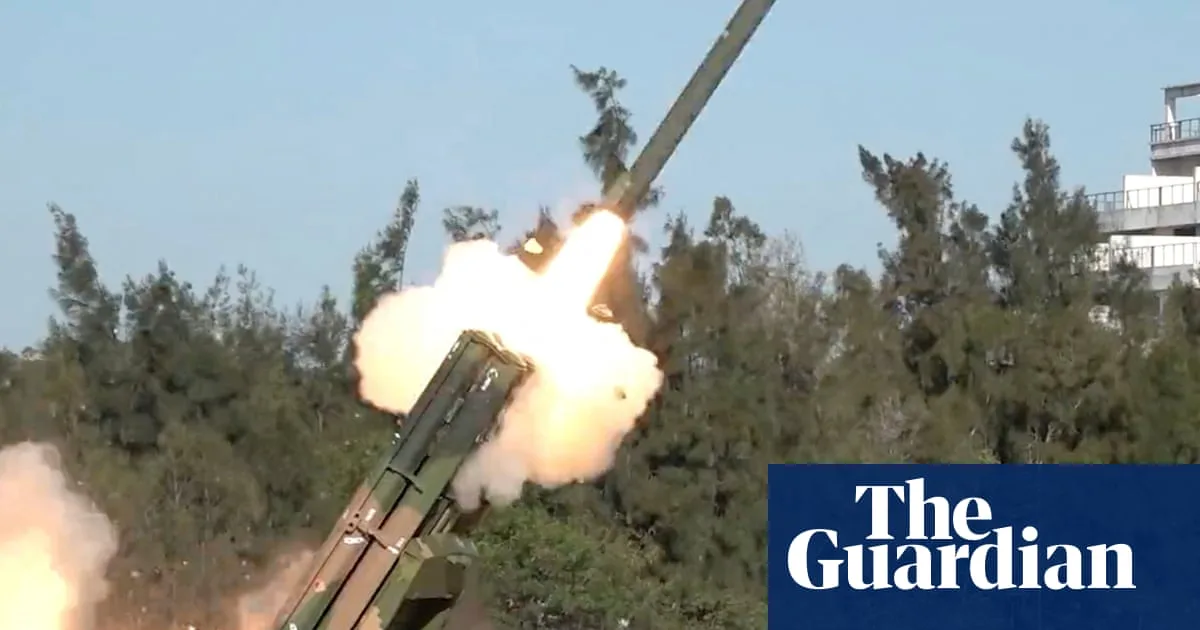
President Donald Trump has said he is not concerned by China's live-fire military drills surrounding Taiwan, describing his relationship with Chinese leader Xi Jinping as 'great' and noting that Xi 'hasn't told me anything about it'. The remarks came as the People's Liberation Army (PLA) conducted a two-day surprise attack simulation, dubbed 'Justice Mission 2025', involving missile launches into the Taiwan Strait.
According to Taiwan's defence ministry, the PLA fired 27 missiles from the Chinese coastline near Taiwan on Tuesday, with some landing within Taiwan's 24-nautical mile contiguous zone. At least 70 Chinese warplanes, 11 navy ships and 14 coast guard vessels were detected since 6am. This follows the detection of 130 warplanes, 28 ships, amphibious assault ships and a surveillance balloon in the preceding 24 hours. The defence ministry noted that the missiles came closer to Taiwan's main island than in previous exercises.
Beijing claims Taiwan as a Chinese province and has been preparing for a potential invasion by 2027, according to US intelligence. The US has been Taiwan's leading backer in resisting these annexation plans, but Trump's stance has been inconsistent. He met Xi in October but said Taiwan 'didn't come up' in their discussions. The current drills are the sixth and largest to target Taiwan since 2022, when major exercises followed a visit by former US House Speaker Nancy Pelosi.
Taiwan's president, Lai Ching-te, condemned the drills as 'irresponsible' and said Taiwan would defend its sovereignty without escalating conflict. Defence Minister Wellington Koo accused China of disregarding international norms and aiming 'to achieve cognitive warfare and deplete Taiwan's combat capabilities'.
Chinese state media framed the exercises as a simulation of a blockade on Taiwanese ports and a response to 'external foreign interference', specifically citing a recent US record $11bn arms sale to Taiwan. Foreign Minister Wang Yi also indicated the drills were a warning to Japan, whose leaders he said 'openly challenge China's territorial sovereignty'. An editorial in Xinhua declared that 'the trend of national reunification is unstoppable'.




