Trump Declares Unlimited Military Arsenal Amid Escalating Iran Conflict
President Donald Trump has publicly touted the United States military's extensive munitions stockpiles as his administration promises that the "hardest hits yet to come" in the ongoing conflict with Iran. In a Truth Social post during the early hours of Tuesday, Trump made bold claims about American military readiness.
"The United States Munitions Stockpiles have, at the medium and upper medium grade, never been higher or better - As was stated to me today, we have a virtually unlimited supply of these weapons," the president wrote in his characteristically emphatic style.
Presidential Confidence in Military Superiority
Trump expressed unwavering confidence in American military capabilities, stating his belief that the United States will "easily prevail" in the current conflict. He emphasized that the military is prepared for operations to continue for "whatever it takes" to achieve victory.
"Wars can be fought 'forever,' and very successfully, using just these supplies," Trump added in his social media declaration. The president attributed any perceived shortages of highest-grade munitions to the previous administration's support for the war in Ukraine, creating a clear political distinction between his approach and that of his predecessors.
"The United States is stocked, and ready to WIN, BIG!!!" Trump concluded in his characteristically bold fashion, leaving no doubt about his assessment of American military preparedness.
Recent Escalation and Regional Fallout
The president's comments come amid significant escalation in tensions between Washington and Tehran. Early Saturday morning, United States and Israeli forces conducted coordinated strikes on multiple cities across Iran, triggering swift retaliation threats from Tehran and a wave of attacks across the broader Middle East region.
Iranian authorities described these attacks as part of what they characterized as a "massive" and ongoing US-Israeli assault on their country. Large plumes of black smoke were reportedly seen rising near the headquarters of the U.S. Navy's Fifth Fleet in Manama, Bahrain, though the extent of any damage remains unclear, and American officials have not confirmed these claims.
Regional Military Buildup and Strategic Positioning
Trump has made no secret of the substantial U.S. military buildup near the Middle East in recent weeks, which preceded Saturday's airstrikes. This buildup comes amid rising tensions with Iran over its nuclear program and internal crackdown on protests.
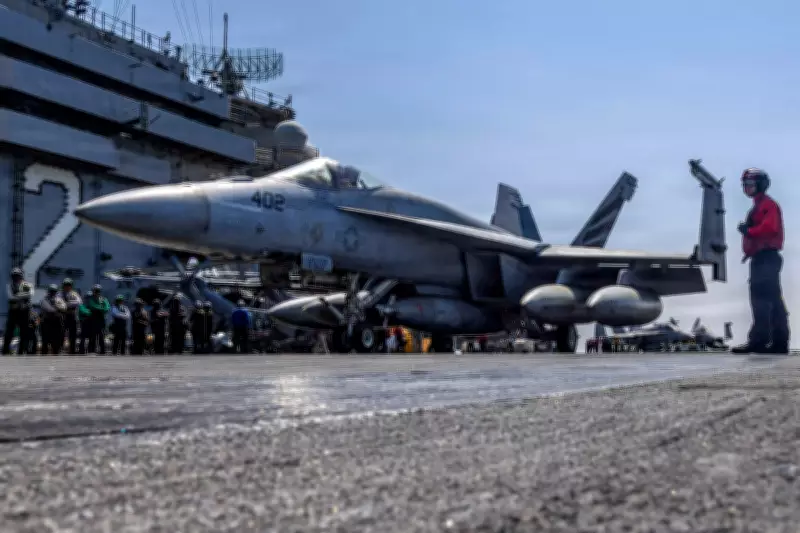
American naval and air deployments have expanded significantly across the region, including the positioning of major warships near the Arabian Peninsula. The aircraft carrier USS Abraham Lincoln was spotted off the coast of Oman, while the USS Gerald R. Ford, the U.S. Navy's newest and largest aircraft carrier, is expected to join regional deployments.
This substantial military buildup has seen destroyers and specialist combat ships move to cover Iran's southern flank, while F-15 and EA-18 fighter jets gather in increased numbers across military bases to the west. In total, eleven destroyers in the region will join three Littoral combat ships, with two or three attack submarines - including at least one with nuclear capabilities - loaded with Tomahawk missiles also present.
Iranian Retaliation and Regional Response
Across the wider Middle East, several countries hosting U.S. military bases reported intercepting incoming missiles, including the United Arab Emirates, Qatar, Jordan, and Kuwait. In Doha, Qatari authorities reported intercepting several incoming missiles believed to be targeting Al Udeid Air Base, the region's largest U.S. military installation.
Iranian Supreme Leader Ayatollah Ali Khamenei issued a stark warning this week, stating that the United States "may be struck so hard that it cannot get back up" if it renews attacks against the regime. Tehran's sabre-rattling extended to closing the Strait of Hormuz for the first time since the 1980s to conduct naval drills, with additional exercises conducted with Russia in the Sea of Oman.
Expanded Aerial Capabilities and Strategic Options
The United States has significantly strengthened its aerial options in the region. Jordan is home to the Muwaffaq Salti military base, where Washington has been building up combat and cargo aircraft in recent days. Ageing F-15s and A-10 Warthogs have been pictured alongside C-130 transport aircraft on the tarmac.
Further afield, modern and long-distance aircraft expand Washington's options for potential strikes. Flight trackers show the movement of Boeing KC-135 tankers to Europe and the Middle East, suggesting preparedness for longer haul flights. The U.S. has reportedly moved more than fifty F-35, F-22, and F-16 fighter jets to the broader region this week, according to flight radar data.
The two aircraft carriers in the region have additional capacity for up to 180 aircraft between them, creating substantial aerial firepower. The United States also maintains approximately 10,000 troops scattered across bases throughout the Middle East.
Potential British Involvement and International Dimensions
Trump has suggested that if Iran fails to agree to a deal, it may be "necessary" to attack the country from Diego Garcia or RAF Fairford, potentially dragging Britain into the conflict. RAF Fairford in Gloucestershire is a US-operated base used as a bomber forward operating base.
A Ministry of Defence spokesperson stated that, as routine, they do not comment on the operational activity of other nations, including third-party use of UK bases. Proposed U.S. operations from a base in the United Kingdom would be considered on a case-by-case basis according to established protocols.
Air Defense Preparations and Strategic Timeline
The United States appears to be tightening its air defenses in anticipation of potential Iranian retaliation. Last year's Israeli strike on Iran's nuclear capabilities led to retaliatory strikes by Iran on an American military base in Qatar, creating precedent for such responses.
American forces could be preparing for this eventuality by installing an extensive series of C-5s and C-17s, along with Galaxy and Globemaster flights, to bring air defense assets to its bases throughout the region.
Senior national security officials had reportedly informed Trump that the military would be ready to strike Iran by Saturday, according to multiple U.S. media outlets. However, one unnamed senior official suggested it could be weeks before everything is fully in place.
"The president has ordered the continued buildup in the region, including the arrival of the second carrier group. Full forces should be in place by mid-March," the official stated, providing a potential timeline for complete military readiness.