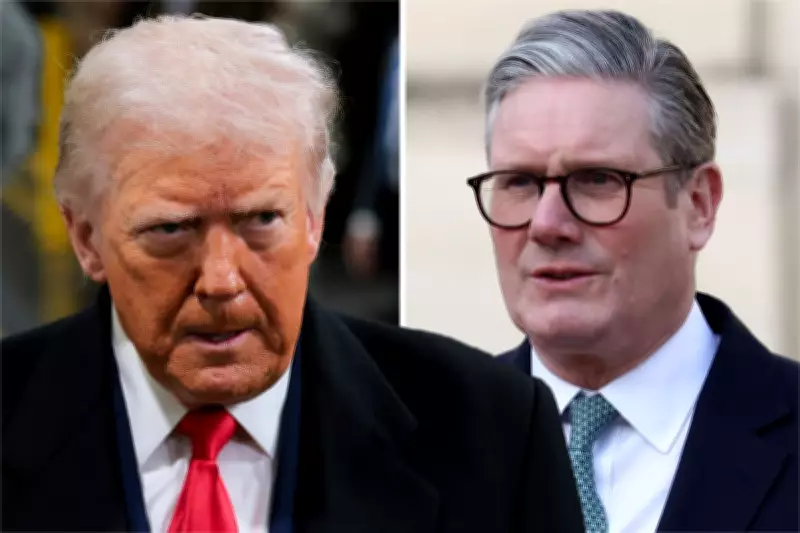
Former United States President Donald Trump has launched another verbal assault on the leadership of British Prime Minister Sir Keir Starmer, declaring that the historic alliance between the two nations is "obviously not what it was" under the current administration. Trump's comments come amid escalating tensions over the United Kingdom's decision not to participate in military strikes against Iran, a move that has drawn sharp criticism from the American leader.
Trump's Direct Criticism of Starmer's Foreign Policy
In a candid interview with The Sun newspaper, Trump did not mince words when addressing Starmer's refusal to permit US fighter jets to deploy from British military bases for operations targeting Iran. "He has not been helpful. I never thought I'd see that. I never thought I'd see that from the UK. We love the UK," Trump stated, highlighting his profound disappointment with the Prime Minister's stance. The former president elaborated further, noting, "It's a different world, actually. It's just a much different kind of relationship that we've had with your country before."
Trump's remarks underscore a growing rift in transatlantic diplomacy, with the former leader expressing sorrow over the perceived deterioration of the special relationship. "It's very sad to see that the relationship is obviously not what it was," he added, suggesting a significant shift from the close cooperation seen during previous administrations.

UK Government Defends Decision Based on Legality and National Interest
In response to Trump's criticisms, Chief Secretary to the Prime Minister Darren Jones robustly defended the government's position, emphasising that decisions are made strictly on the grounds of legal justification and British interests. Appearing on Sky News, Jones addressed the apparent frustration from the United States, stating, "Well I've seen the president's words but that doesn't really negate the fact that we make decisions, as I say, on the basis of legality and British interest."
The Cabinet minister clarified that while the UK did not participate in the initial military actions against Iran, it had agreed to provide logistical support by allowing the use of bases at Diego Garcia and RAF Fairford. "We were content to offer bases at Diego Garcia and RAF Fairford, because evidently, the operations the Americans will run from those airfields will reduce the risk to British citizens and British assets in the region and that's why we agreed to the request to use those bases on that basis alone," Jones explained.
He reiterated Prime Minister Starmer's firm stance, noting, "But the prime minister is very clear that we were not involved in that first strike and we're not kind of going to war with Iran or getting involved in a wider set of activities." When pressed on whether the UK's assessment found no legal basis for the weekend's military actions, Jones confirmed, "We were not involved in the first wave because it didn't meet the test the prime minister's set out."
Broader Implications for UK-US Diplomatic Relations
This public disagreement highlights ongoing challenges in the UK-US relationship under the Starmer government, with Trump's vocal disapproval potentially influencing future diplomatic engagements. The former president's lament over the state of the alliance reflects deeper concerns about alignment on international security matters, particularly in volatile regions like the Middle East.
As both nations navigate complex global issues, the emphasis on sovereign decision-making versus alliance solidarity remains a pivotal point of contention. The UK's adherence to legal frameworks and national interest, as articulated by Jones, contrasts sharply with Trump's expectations of unwavering support, setting the stage for continued diplomatic discourse.