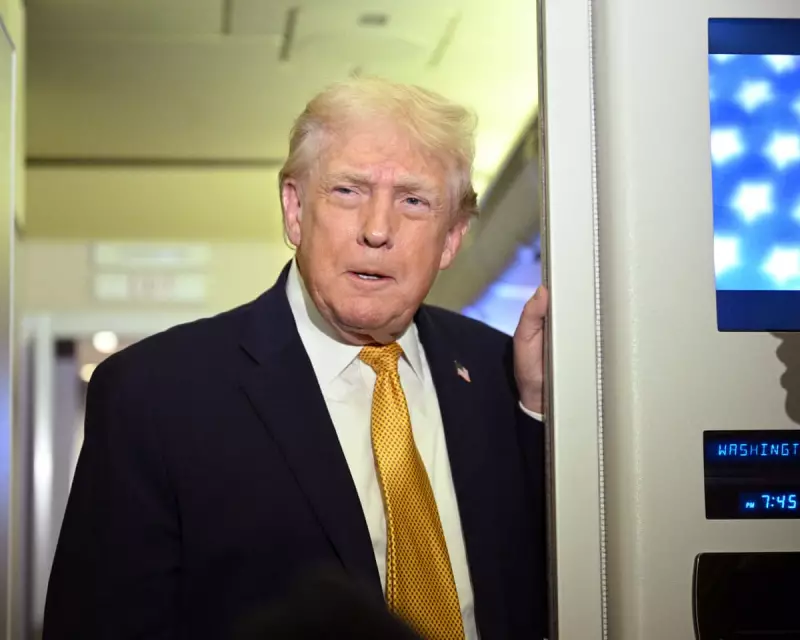
President Donald Trump has significantly qualified his earlier claim that the United States would "run" Venezuela, following the dramatic military operation that captured the country's president, Nicolás Maduro, and his wife. Speaking to reporters aboard Air Force One on 4 January 2026, Trump shifted focus to Venezuela's interim president, Delcy Rodríguez, stating she must accommodate US demands or face potential further military action.
Republican Unease and Shifting Demands
The prospect of direct US control over Venezuela appeared to recede on Sunday, as top Republicans sought to clarify the administration's intentions. Trump revealed that Secretary of State Marco Rubio had spoken with the 56-year-old Rodríguez, who had initially pledged loyalty to Maduro and condemned his capture as an "atrocity". According to Trump, Rodríguez told Rubio "'we'll do whatever you need'".
"She, I think, was quite gracious, but she really doesn't have a choice," Trump told the press corps. Despite this apparent compliance, US officials confirmed that a 15,000-strong military force remains stationed in the Caribbean, ready for a fresh intervention if Washington's conditions are not met.

Domestic Fury and International Fallout
The unilateral action has sparked fierce backlash at home and abroad. Democratic leaders in the US reacted with fury, condemning the raid as an illegal act undertaken without the required congressional approval. Senator Chris Murphy accused the administration of lying to Congress, stating that briefings had misleadingly framed the operation as a counter-narcotics mission rather than regime change.
Protests erupted in several US cities over the weekend, even as celebrations broke out in communities with large Venezuelan diasporas, such as Doral, Florida, where hundreds waved flags to mark Maduro's downfall.
Internationally, the episode prompted Danish Prime Minister Mette Frederiksen to publicly urge Trump to stop threatening to annex Greenland, stating the US has "no right" to do so. Meanwhile, Canadian officials issued warnings that US health institutions could no longer be relied upon for accurate information, particularly on vaccinations.
A Pattern of Erosion and Risk
Experts also highlighted that the first year of Trump's second term has seen a dangerous erosion of the US's capacity to handle natural disasters, due to crackdowns on climate science and the gutting of key federal agencies. This comes alongside domestic legal drama, including the resignation of a Wisconsin judge convicted of obstruction for helping an immigrant evade federal officers.
The situation remains volatile, with the Trump administration's next move contingent on the actions of Venezuela's interim leadership, while political and public pressure continues to mount both domestically and among allied nations.