White House Display of Trump-Putin Summit Photo Sparks International Controversy
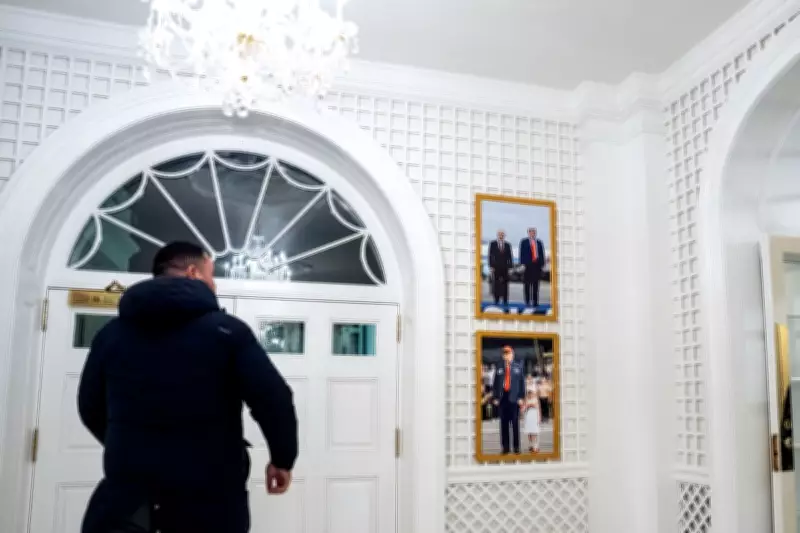
A framed photograph showing former US President Donald Trump standing alongside Russian President Vladimir Putin has been prominently displayed in the White House Palm Room, triggering widespread criticism from political figures and media commentators. The image captures the two leaders during their summit meeting in Alaska last August, which represented the first in-person encounter between American and Russian heads of state since Moscow's invasion of Ukraine in early 2022.
Location and Context of the Display
The photograph was first noted by PBS White House correspondent Elizabeth Landers on Tuesday, who shared images showing the framed picture hanging in the Palm Room, which serves as a connecting space between the West Wing and the executive residence. Notably, the Trump-Putin photograph is positioned directly above another framed image depicting Trump with one of his grandchildren, creating a striking visual juxtaposition that has drawn particular attention from observers.
The Palm Room typically functions as a lobby area for visitors and was recently renovated as part of broader refurbishment projects undertaken since Trump returned to office last year. These renovations have included significant structural changes, such as the demolition of the East Wing to make way for a new $400 million ballroom facility.

Official Justification and International Reactions
When questioned about the decision to display this particular photograph, a White House spokesperson provided a statement to the Guardian defending the choice. The spokesperson characterised the Alaska Summit as "a historic moment that helped bring Ukraine and Russia, whose brutal war was brought on by Joe Biden's incompetence, closer to a deal." They further explained that "this is one of many accomplishments that President Trump chooses to feature at the White House, where photographs are rotated frequently to highlight Presidential travel."
An additional White House official noted that it is standard practice for the administration to display photographs documenting the president's public meetings and events throughout the complex, with images being regularly updated and rotated to reflect different diplomatic engagements.
The display prompted a response from Moscow, with Kirill Dmitriev, Putin's special envoy, commenting on social media platform X: "Good. A picture is worth a thousand words," accompanied by emojis including a dove, Russian and American flags, and a handshake symbol.
Widespread Criticism from Political Figures
The decision to showcase the photograph has drawn sharp criticism from multiple quarters. Virginia Senator Mark Warner, a Democrat, remarked on social media: "Putting Putin above the American people and his own family. Almost a little too on the nose."
International condemnation came from Marko Mihkelson, chair of Estonia's parliamentary Foreign Affairs Committee, who stated: "If it is true that the US president considers it appropriate to hang on the White House wall a photo of the greatest war criminal of the 21st century, then a just and sustainable peace will have to wait. Unfortunately."
CNN broadcaster Jake Tapper described the display as "an interesting moment to commemorate," noting that "before the summit, Trump threatened 'severe consequences' if Putin didn't agree to a ceasefire. A red carpet was literally rolled out for Putin on US soil but still he didn't agree to one and Russia's war on Ukraine continues to this day."
Historical Context and Political Implications
The Alaska Summit itself was controversial when it occurred, drawing complaints from Democratic critics who accused Trump of "cozying up" to Putin and rolling out "the red carpet" for the Russian leader rather than "standing with Ukraine and our allies." The meeting took place against the backdrop of Russia's ongoing military aggression in Ukraine, which has resulted in significant loss of life and displacement of civilians.

The decision to memorialise this encounter through permanent display in the White House raises questions about diplomatic messaging and the normalization of relations with a nation currently engaged in what many international observers consider an illegal war of aggression. The photograph's prominent placement, particularly in relation to personal family imagery, has amplified concerns about the symbolic weight being accorded to the US-Russia relationship at a time of continued conflict in Eastern Europe.
As the White House continues its renovation projects and photographic rotations, this particular display highlights the ongoing tensions between diplomatic engagement and moral positioning in contemporary international relations, particularly concerning relationships with nations accused of human rights violations and breaches of international law.