Trump's Public Revelation of Macron's Private Message Designed to Hurt and Intimidate
The phrase "private and confidential" has historically carried significant weight in diplomatic circles, but for Donald Trump, these words appear to hold little meaning. The US president has consistently demonstrated a willingness to share not just the occurrence of conversations with world leaders, but their detailed content and emotional tone, ranging from what he describes as beautiful exchanges to nasty confrontations.
A New Level of Diplomatic Breach
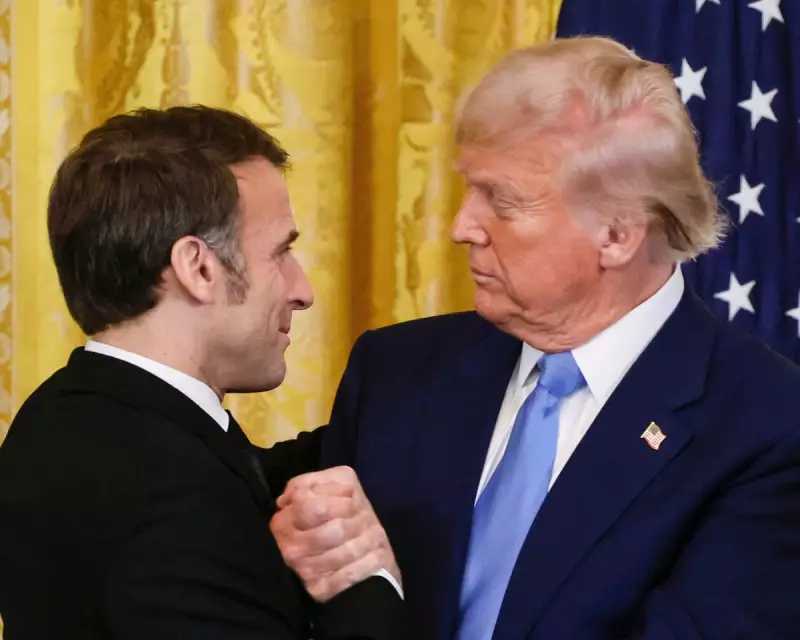
However, Trump's recent decision to copy and paste the entirety of private diplomatic correspondence onto social media represents a concerning escalation. This occurred specifically with a message from French President Emmanuel Macron proposing a G7 meeting in Paris to discuss Greenland, Ukraine, and Syria. While previous breaches included mildly solicitous correspondence from Volodymyr Zelenskyy, this complete public posting of confidential communication establishes a dangerous new precedent in international relations.
The publication of Macron's message was clearly designed to inflict damage, similar to how messages attacking political figures like Keir Starmer are intended to wound. Fortunately for the French president, his proposal for a G7 meeting—a characteristically bold Macron initiative—did not reveal any significant contradiction between his public and private positions. His expressed views on Greenland, Syria, Iran, and the necessity for coordinated action were concisely articulated, albeit with a slightly fawning tone, and remained largely consistent with his publicly stated positions.

Erosion of Basic Diplomatic Trust
This episode powerfully illustrates how Trump's methods systematically dismantle the fundamental trust required for effective cooperation between world leaders. While one leader attempts to operate within established diplomatic protocols, Trump deliberately subverts and destroys these conventions. In this particular instance, Trump's motivation may have stemmed from annoyance with Macron—a leader he frequently enjoys belittling—after the French president refused an offer to join his proposed "board of peace." This refusal threatens to unravel Trump's plan to replace the United Nations with a body he alone controls.
Additional frustration may have arisen earlier in the week following the leak of Trump's own message to Norwegian Prime Minister Jonas Gahr Støre, in which he expressed diminished commitment to peace considerations after being overlooked for the Nobel Peace Prize. However, the release of Macron's message transcends mere reprisal or attention-seeking indiscretion. It represents a strategic deployment of mass communication as a weapon to intimidate and destabilise rivals, allowing Trump to dominate information flows and rewrite established conventions.
From Diplomatic Protocol to Raw Data Disclosure
The traditional diplomatic practice of issuing carefully crafted, bland readouts designed to obscure meeting content has been replaced by the immediate disclosure of raw communication. Where Whitehall's thirty-year rule once governed the release of government documents, we now witness the emergence of a thirty-minute rule in Trump's approach to diplomatic transparency.
As French author Philippe Corbé observes in his recent work Weapons of Mass Distraction: "No president had ever achieved such omnipresence. In this fractured country, it gives him a singular power. It wasn't money that propelled him but conversation. The creation of chaos is not an accidental byproduct of Trump, it is the method. Every void is filled with a provocation. He lights more fires than can be put out day after day, he cuts through the fog, saturates the ambient noise."
The Risks of Norm Transgression
Trump's entire career has been built upon transgressing established norms while avoiding consequences. At eighty years old, diplomatic niceties represent the least of his constraints. This approach carries significant risks, as iron enters the soul of former allies who grow increasingly infuriated by repeated discourtesy and the humiliation of continually turning the other cheek. Leaders must eventually demonstrate to their electorates—and to themselves—that they can preserve their dignity and self-respect in the face of such treatment.

The arteries of frank diplomatic exchange may well dry up if every communication carries the expectation of immediate publication on Truth Social. Intelligence agencies will become increasingly guarded about sharing sensitive information if Trump demonstrates likely access to agent identities or confidential sources. Yet this precise moment in history demands more dialogue than ever—the fundamental purpose behind Macron's original message.
A Climate of Distrust and Fear
While Trump respects certain world leaders, he openly admits to trusting no one—not even Israel's Benjamin Netanyahu—and this sentiment is thoroughly reciprocated. No world leader trusts Trump; they only fear him and his unpredictable, unfiltered psychology. In reality, Trump appears to have lost interest in privacy altogether. During his first term, he expressed concern about leaks, but his second term features no quiet, reflective policy discussions. Instead, government has become a spectacle with doors flung open wide.
The presidency now exists entirely in public view—through continuous media encounters, whether on planes, in the White House, or across social media platforms. Consequently, there remains nothing left to leak, as every exchange occurs in the full glare of public scrutiny, fundamentally altering the nature of diplomatic engagement and international cooperation.