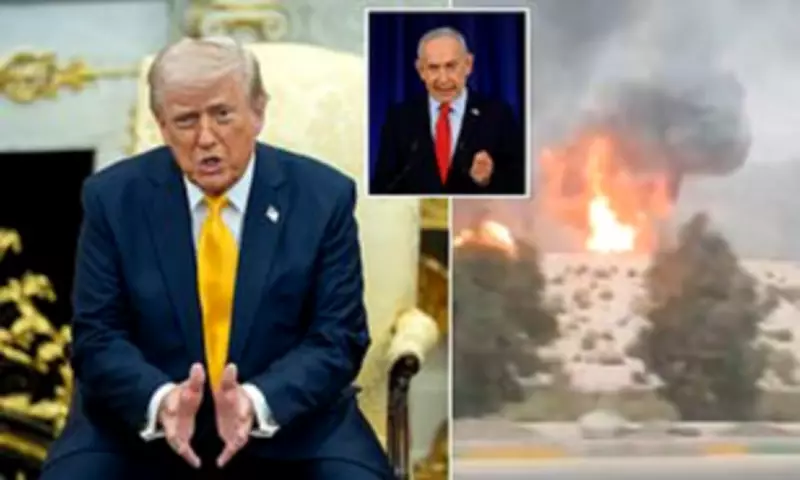
Former President Donald Trump stated on Thursday that he had directly communicated with Israeli Prime Minister Benjamin Netanyahu, urging him to discontinue assaults on Iran's oil fields. This directive comes as such military actions have triggered a sharp increase in fuel prices, exacerbating economic strain.
Trump Confirms Conversation with Netanyahu
When questioned in the Oval Office about a recent Truth Social post condemning the escalation in the Iran conflict, Trump affirmed the discussion. "Yeah, I did. I did," he said, referencing Netanyahu. "I told them, don't do that. And he won't do that."
Trump elaborated on the dynamic between the U.S. and Israel, noting, "We didn't discuss, we do - we're independent, we get along great, it's coordinated, but on occasion he'll do something and if I don't like it - so we're not doing that anymore."

Impact on Fuel Prices and Global Markets
The ongoing conflict has already inflicted financial pain on Americans, with national gas prices rising to approximately $3.90 per gallon, up from $2.90 before strikes commenced on February 28. This surge is directly linked to disruptions in oil production, particularly from attacks on key infrastructure.
In his Truth Social post, Trump claimed the U.S. was unaware of Israel's plans to target the South Pars gas field. He issued a stark warning, threatening to "massively blow up" the entire oil field if Iran retaliated again. "I do not want to authorize this level of violence and destruction because of the long-term implications that it will have on the future of Iran, but if Qatar's LNG is again attacked, I will not hesitate to do so," Trump cautioned.
International Backlash and Diplomatic Strains
Allies across the Middle East and Europe expressed fury over Israel's strike on South Pars, which set the gas field ablaze and prompted Iranian retaliation against Gulf nations, including an attack on a liquefied natural gas plant in Qatar. French President Emmanuel Macron labeled the move "reckless."
Leaders from the United Kingdom, France, Germany, Italy, the Netherlands, Japan, and Canada jointly condemned Iran for targeting ships in the Strait of Hormuz, a critical global shipping lane. A statement read, "We express our readiness to contribute to appropriate efforts to ensure safe passage through the Strait. We welcome the commitment of nations who are engaging in preparatory planning."
Trump's Criticism of NATO and Praise for Japan
Trump voiced frustration with NATO members for not promptly offering assistance in protecting commercial vessels from Iranian threats in the Strait of Hormuz. During a meeting with Japanese Prime Minister Sanae Takaichi, a political ally, he praised Japan's willingness to help patrol the strait. "We've had tremendous support and relationship with Japan on everything, and I believe that based on statements that were given to us yesterday, the day before yesterday, having to do with Japan, they are really stepping up to the plate," Trump said.
He contrasted this with NATO, adding, "Unlike NATO. They don't want to help us defend the Strait, and they're the ones that need it. But now they're getting much nicer, because they're seeing my attitude. But it's, as far as I'm concerned, it's too late."
Surprise Strategy and Historical Reference
Trump's decision to strike Iran on February 28 left many world leaders bewildered, as allies were not informed in advance. When a Japanese reporter asked why Japan was kept in the dark, Trump responded, "You don't want to signal too much ... we wanted surprise."
He then made a shocking historical allusion, stating, "Who knows better about surprise than Japan? Why didn't you tell me about Pearl Harbor!" This reference to the December 7, 1941, attack that drew the U.S. into World War II underscored the tense and unconventional nature of the diplomatic exchanges.
The situation remains volatile, with ongoing military actions, diplomatic rifts, and economic repercussions shaping the global response to the conflict in the Middle East.