Trump Asserts He Averted Catastrophic Nuclear War Between India and Pakistan
Former US President Donald Trump has once again made the extraordinary claim that his personal intervention prevented a devastating nuclear war between India and Pakistan, asserting that his actions saved the lives of approximately thirty-five million people. This dramatic statement comes amid ongoing tensions between the nuclear-armed neighbors, who have engaged in multiple military escalations in recent years.
State of the Union Address Claims
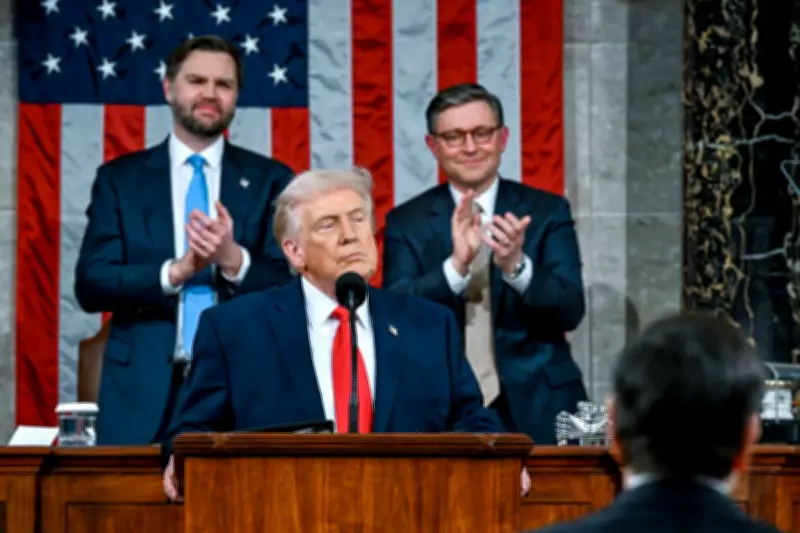
During his recent State of the Union Address, Trump declared, "We're proudly restoring safety for Americans at home and abroad. In my first ten months, I ended eight wars." He then specifically referenced the South Asian conflict, stating, "Pakistan and India would have had a nuclear war. Thirty-five million people, said the prime minister of Pakistan, would have died if it were not for my involvement." Trump further revealed that his administration is currently "working very hard to end a ninth war," though he did not specify which conflict this refers to.
Repeated Claims of Ceasefire Mediation
Since May of last year, when the two nations announced a "full and immediate" ceasefire following what Trump described as US-mediated talks, the former president has reportedly taken credit for brokering the truce at least eighty times across various media platforms and public appearances. However, the Indian government has consistently denied any American involvement in the peace process, maintaining that the ceasefire request originated from Pakistan's director general of military operations.

Recent Public Remarks and Tariff Threats
Last week, during an event for the Board of Peace initiative focused on ending the Gaza conflict, Trump recounted his version of events with Pakistan's Prime Minister Shehbaz Sharif in attendance. He claimed that both nations agreed to the ceasefire only after he threatened to impose two hundred percent tariffs on both countries. "I got on the phone with both of them," Trump stated, referring to Prime Ministers Modi and Sharif. "And when I heard that they were fighting... I saw that Pakistan and India were really going at it. And then it got worse and worse."
Trump elaborated on his alleged negotiation tactics, saying, "I called them, I said, 'Listen, I'm not doing trade deals with you two guys, if you don't settle this up.' They said, 'No, no, no.' I said, 'No, it has to. If you don't do it, I'm not doing a trade deal. We're not doing a trade deal.'"
Background of the 2025 Military Escalation
The conflict Trump references stems from last year's severe military escalation between India and Pakistan, which represented their worst confrontation in decades. The tensions began after India launched attacks on alleged militant camps within Pakistan, retaliating for a terror attack in Indian-controlled Kashmir on April 22 that killed twenty-six people, predominantly Hindu tourists. India accused Pakistan of supporting the gunmen responsible for the massacre, a charge Islamabad vehemently denied while calling for an independent investigation.
Aerial Combat and Conflicting Claims
Following these events, both nations engaged in extensive aerial combat involving over one hundred twenty-five aircraft, marking what analysts describe as the largest aerial battle since World War II. Pakistan claimed to have shot down five Indian aircraft, including advanced French Rafale jets, while India stated it had downed "a few planes" - a claim Pakistan disputed despite acknowledging hits on its air bases. India confirmed on May 31 that it had lost jets during the conflict but declined to specify the number or types of aircraft involved.
Ongoing Diplomatic Tensions
The situation remains diplomatically delicate, with Indian officials recently reiterating that they will never accept third-party mediation on Kashmir issues. This position was communicated to Trump by Indian diplomat Vikram Misri, who conveyed that Prime Minister Modi maintains India's longstanding policy against external involvement in bilateral disputes with Pakistan. The conflicting narratives between Trump's claims of decisive intervention and India's insistence on bilateral resolution continue to highlight the complex geopolitical dynamics in South Asia.