

Trump's Gaza Vision: Luxury Development or Exploitation of Palestinian Tragedy?
As the Trump administration reveals striking visualisations for a transformed Gaza Strip featuring luxury apartments and coastal tourism developments, serious questions are emerging about whether this represents genuine peace-building or a lucrative property deal built upon Palestinian suffering.
The Controversial Vision for Gaza's Future
Harvard University professor Sara Roy, a specialist in the Palestinian economy, offers a stark assessment of the plans being advanced by former President Donald Trump and his son-in-law Jared Kushner. "Jared Kushner can talk about building resorts or casinos or whatever he has in mind, but he's building them literally and figuratively on the graves of Palestinians," she told The Independent.
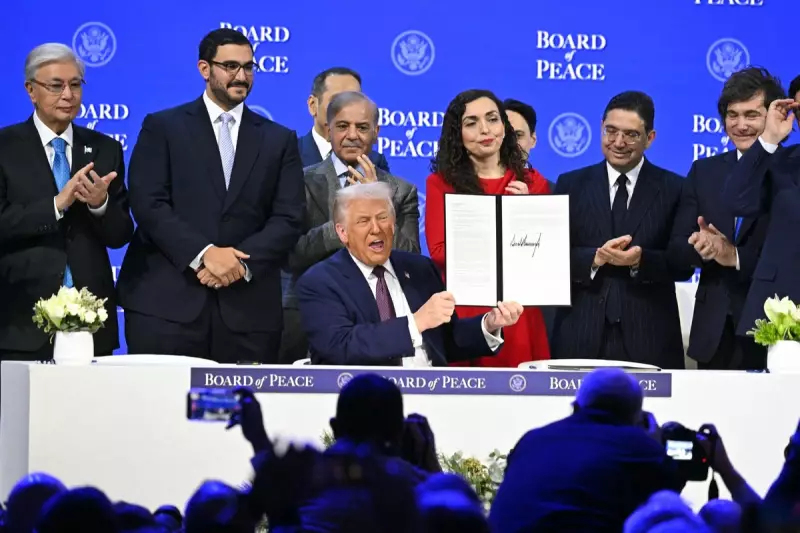
The vision, presented at the World Economic Forum in Davos, depicts modern skyscrapers lining Gaza's coastline, transforming the war-torn territory into what Trump has repeatedly called "the Riviera of the Middle East." This follows last year's UN Security Council endorsement of Trump's 20-point plan for Gaza, which the former president hailed as "one of the biggest approvals in the History of the United Nations."

Kushner's Dual Role: Peace Broker and Property Developer
Jared Kushner, who served as a senior adviser during Trump's first term, continues to play a significant behind-the-scenes role in Middle East peace efforts while simultaneously positioning himself for involvement in Gaza's reconstruction. His investment firm, Affinity Partners, reportedly manages approximately $4.8 billion in assets, with backing from Gulf sovereign-wealth funds including those of the UAE and Saudi Arabia.
This financial involvement raises serious concerns about potential conflicts of interest, particularly given Kushner's previous description of the Arab-Israeli conflict as "nothing more than a real-estate dispute between Israelis and Palestinians."
The Balkan Precedent: A Pattern of Post-Conflict Development
Kushner's approach to Gaza appears to follow a pattern established in the Balkans, where Affinity Partners has pursued several high-profile development projects in regions emerging from conflict or political transition:
- A proposed $1.4 billion luxury resort on Albania's Sazan Island
- Tourism developments in southern Albania
- Redevelopment of a former military complex in Belgrade, Serbia
These projects have faced criticism regarding their environmental impact and the role of Kushner's political connections in securing approvals. In Serbia, thousands protested legislation fast-tracking Affinity's development plans, with one demonstrator accusing Serbian president Aleksandar Vucic of "aiming to please Trump and curry favour."
The Practical and Humanitarian Challenges in Gaza
Professor Roy highlights the immense practical obstacles facing any reconstruction effort in Gaza, noting that the territory contains approximately 55 million tonnes of rubble mixed with human remains, unexploded ordnance, and toxic contaminants including asbestos.
"You're not just talking about removing rubble," she explains. "The rubble contains human remains; the rubble contains unexploded ordinance; you have rubble that's contaminated with all kinds of toxins and asbestos."
Beyond the physical challenges, Roy emphasises the humanitarian crisis: "A hundred and seventy thousand wounded, kids who are orphaned, people with amputations, and a population that, before October 7th, was already traumatised." She questions how these profound needs can be addressed alongside luxury development projects.
Financial Interests and Strategic Concerns
The reconstruction plan, estimated to require $70 billion, has attracted pledges from numerous governments including European, Arab, North American, and US commitments. However, concerns persist about who will control the funds and timeline, and whose interests will be prioritised.

Kushner has stated that "no reconstruction funds will be going into areas that Hamas still controls," while Trump's special envoy to the Middle East, real estate developer Steve Witkoff, has confirmed discussions with contractors from across the Middle East.
Professor Roy argues that the fundamental problem lies in the approach: "Every so-called peace plan for Palestine is defined by the same thing – they treat Gaza either as a technical or humanitarian problem or a political problem that basically means ensuring Israeli security."
A Future of Occupation in Different Form?
Roy believes the reconstruction plans may ultimately serve to cement Israeli control while preventing Palestinian sovereignty. "By isolating Gaza, you not only make it very difficult to create a unified political entity, you remove the geographical basis of an economy," she explains. "And by isolating people from each other, you make it much harder for them to act as a unified political collective; a unified nation."
As Trump, Kushner, and their associates promote their vision of a transformed Gaza, many Palestinians see a different reality: a future where self-determination is exchanged for construction projects, and where the true beneficiaries may be those who build profit from the rubble of their homes and communities.





