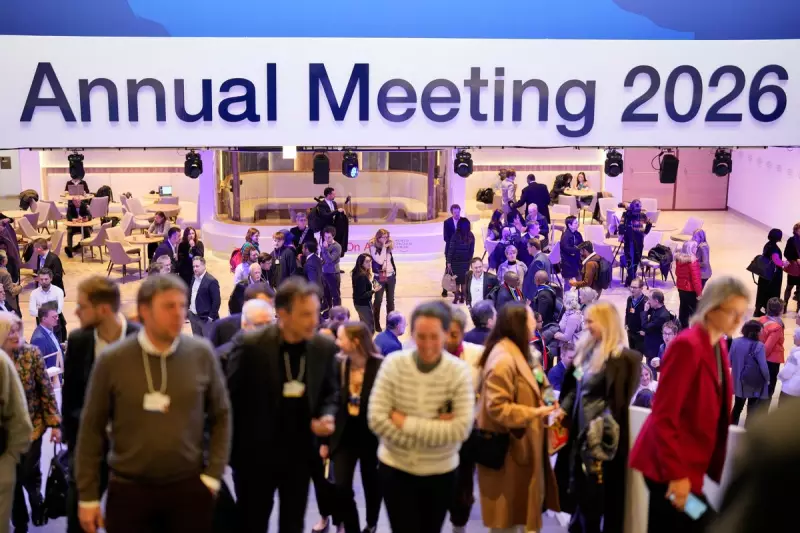
Former US President Donald Trump commanded the global stage during his whirlwind appearance at the World Economic Forum in Davos this week, diverting attention from the annual gathering's traditional focus on technology and climate change to his own brand of geopolitical theatre.
A Divided Forum Emerges
The elite gathering in the Swiss Alps, which concluded on Friday, revealed a stark division in priorities among attendees. While business leaders and experts discussed ambitious plans to harness artificial intelligence for productivity gains and examined China's leadership in renewable energy investment, Trump's presence created what former Democratic Congresswoman Jane Harman described as "two Davoses."
"One of them was very senior industrial leaders talking about AI," Harman observed. "The second was foreign policy, or geopolitics, and that was dominated by one person."

Mixed Reactions to Presidential Presence
During his approximately 24-hour visit - his third to Davos while holding presidential office - Trump delivered a characteristically rambling and hyperbolic speech that emphasised America's global role. Unlike his previous appearances before adoring corporate audiences, he faced public criticism from figures including California Governor Gavin Newsom, who repeatedly addressed media scrums in the Congress Centre.
Nevertheless, Trump received praise from some quarters. NATO chief Mark Rutte and Ukrainian President Volodymyr Zelenskyy, who both met with Trump in Davos, commended his efforts to help end Russia's war in Ukraine, strengthen Western defence capabilities, and deliver security guarantees to Kyiv.
Transatlantic Tensions Surface
A concerning narrative that emerged during the forum suggested that the United States under Trump's leadership and its Western allies have grown dangerously divided. Canadian Prime Minister Mark Carney spoke ominously of a "rupture" that might never be repaired between traditional partners.
This division was exemplified by Trump's pre-Davos announcement of planned tariffs against eight European countries that had opposed his takeover bid for Greenland - a semi-autonomous territory of NATO member Denmark. Following significant domestic and international uproar, Trump dramatically reversed this position by Wednesday, having previously insisted he wanted to acquire the island "including right, title and ownership."
In a subsequent social media post, Trump claimed to have agreed with NATO chief Rutte on a "framework of a future deal" regarding Arctic security, potentially defusing tensions that carried far-reaching geopolitical implications.
Controversial 'Board of Peace' Initiative
Trump launched his proposed "Board of Peace" during the forum, intended to spearhead ceasefire efforts in Israel's conflict with Hamas and eventually help underpin reconstruction plans for the war-torn Gaza Strip. The initiative attracted support from diverse nations including Belarus, Kosovo, Indonesia, and Argentina.
However, the proposal faced criticism from longstanding US allies in Europe, who rejected Trump's suggestion that it could one day rival the United Nations. Critics noted scarce details about how the board would operate under Trump's chairmanship and argued that reinforcing existing UN structures would be more effective than creating parallel institutions.
"I think they were trying to duplicate - replicate - what happened when the United Nations came about," commented Amnesty International Secretary-General Agnes Callamard in an interview. "But frankly it was a very poor and sad attempt to repeat what happened in the 1940s."
AI Optimism Persists Amid Political Drama
Despite the geopolitical distractions, artificial intelligence remained a significant topic of discussion, with billionaire Elon Musk and Nvidia CEO Jensen Huang making their Davos debuts. Musk, who had previously dismissed the WEF event as "boring," arrived with little advance notice to discuss robotics, address AI's substantial electricity demands, and gently criticise the Trump administration's tariffs on Chinese solar panels.

Huang countered fears that AI advancements might eliminate jobs, arguing instead that the technology boom would create employment opportunities for people building its infrastructure, including "plumbers and electricians and construction and steel workers and network technicians."
The ongoing US-China rivalry received mention from another AI leader, with Anthropic CEO Dario Amodei comparing the Trump administration's decision to approve sales of an advanced Nvidia chip to China to "selling nuclear weapons to Pyongyang."
A Forum of Optimism
Ultimately, a sense of can-do optimism among technology, AI, and business executives encapsulated the forum's stated mission to improve the world through dialogue rather than fear. This sentiment was summarised by forum co-chair Larry Fink, BlackRock's chairman and CEO, during the closing ceremony.
"I want to end this forum with the quote that Elon Musk said in closing yesterday's session," Fink stated. "That it's better to be an optimist and wrong than be a pessimist who's right."