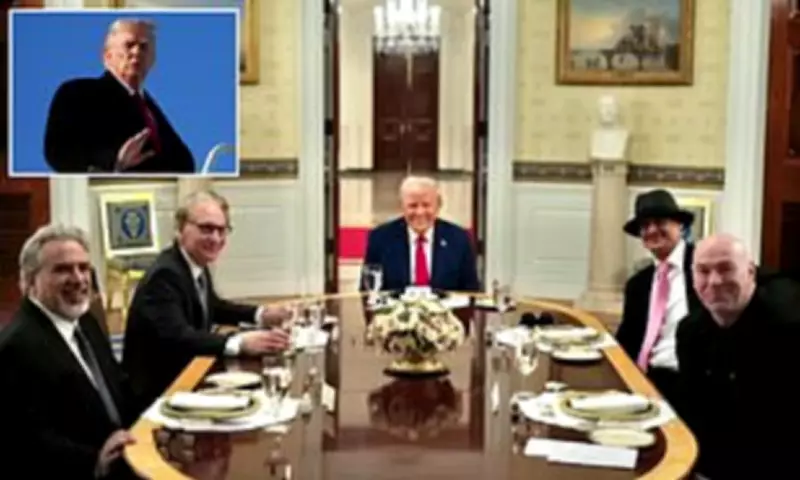
Former President Donald Trump has launched a scathing attack on comedian Bill Maher, branding their White House dinner last year as a "total waste of time" and mocking the television host for his apparent nervousness during the encounter. Trump's comments came in response to Maher's recent remarks about not being "seduced" by the president and continuing to criticise him weekly on his HBO programme.
Trump's Account of the Oval Office Meeting
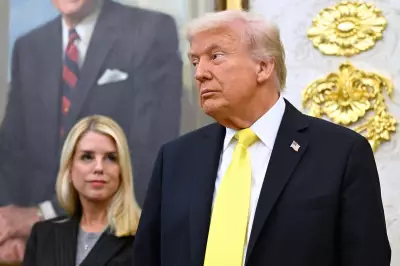
In a detailed post on his Truth Social platform, Trump recounted the April dinner, organised by singer Kid Rock and attended by UFC owner Dana White. The former president claimed Maher entered the Oval Office "much different than I thought he would be" and displayed uncharacteristic anxiety.
"He was extremely nervous, had ZERO confidence in himself and, to soothe his nerves, immediately, within seconds, asked for a 'Vodka Tonic,'" Trump wrote. According to Trump's account, Maher confessed, "I've never felt like this before, I'm actually scared," which the former president described as "somewhat endearing."

From Respectful to Critical
Trump acknowledged that initially, Maher was "very respectful" about their meeting during his first show following the dinner. However, this cordiality was short-lived. Trump accused Maher of quickly returning to his critical stance, failing to give credit for what Trump considers his administration's achievements.
Trump specifically mentioned several accomplishments he believes Maher ignored:
- The "PERFECT border" situation
- The Dow Jones Industrial Average reaching 50,000 points
- Historically low crime rates
- Strikes on Iranian nuclear facilities
- Operations that killed Iranian commander Qasem Soleimani and ISIS leader Abu Bakr al-Baghdadi
Escalating Rhetoric and Personal Attacks
Trump's criticism escalated into personal attacks, labelling Maher a "jerk" and a "highly overrated LIGHTWEIGHT." He compared Maher unfavourably to other late-night hosts Jimmy Kimmel, Jimmy Fallon, and Stephen Colbert, though conceded Maher was "slightly more talented."
The former president concluded his tirade by diagnosing Maher with "a severe case of Trump Derangement Syndrome (TDS!)," claiming "there is nothing that will ever be done to cure him of this very serious disease."
Maher's Defence and Ongoing Criticism
Maher has defended his decision to dine with Trump, arguing in a recent CNN International interview that critics are asking the wrong question. "They're always asking the wrong question, which is: How dare you have dinner with Donald Trump," Maher stated. "The question should always have been what did I say after I had dinner with Donald Trump."
The comedian continues his weekly critiques of Trump, recently addressing the former president's sharing of a video depicting Barack and Michelle Obama as apes. "The defense, I thought, from the administration, was rather lame. They said he did not mean to hit 'share.' He meant to hit 'like,'" Maher joked during his February 6 monologue.
Historical Context of the Feud
The animosity between Trump and Maher dates back to January 2013, when Maher joked he would donate $5 million to charity if Trump could prove he was not "the son of an orangutan." Trump responded by filing a lawsuit seeking the $5 million, though he withdrew the complaint just eight weeks later.
More recently, during his February 14 show, Maher hosted MSNBC host Stephanie Ruhle and Trump's former national security advisor, Lieutenant General H.R. McMaster, both of whom criticised Trump extensively. Ruhle highlighted concerns about a $500 million donation from a United Arab Emirates royal family member to World Liberty Financial, a cryptocurrency business launched by the Trump family in October 2024.
This donation preceded Trump's presidential approval of selling 500,000 Nvidia AI chips to the UAE, a decision experts believe could eventually allow China access to the technology. "There’s that pattern again," Maher commented during the segment.
The White House has defended Trump's actions, noting he does not run World Liberty Financial and emphasising that the chip deal will result in the Emiratis investing $1.4 trillion in the United States over the next decade.