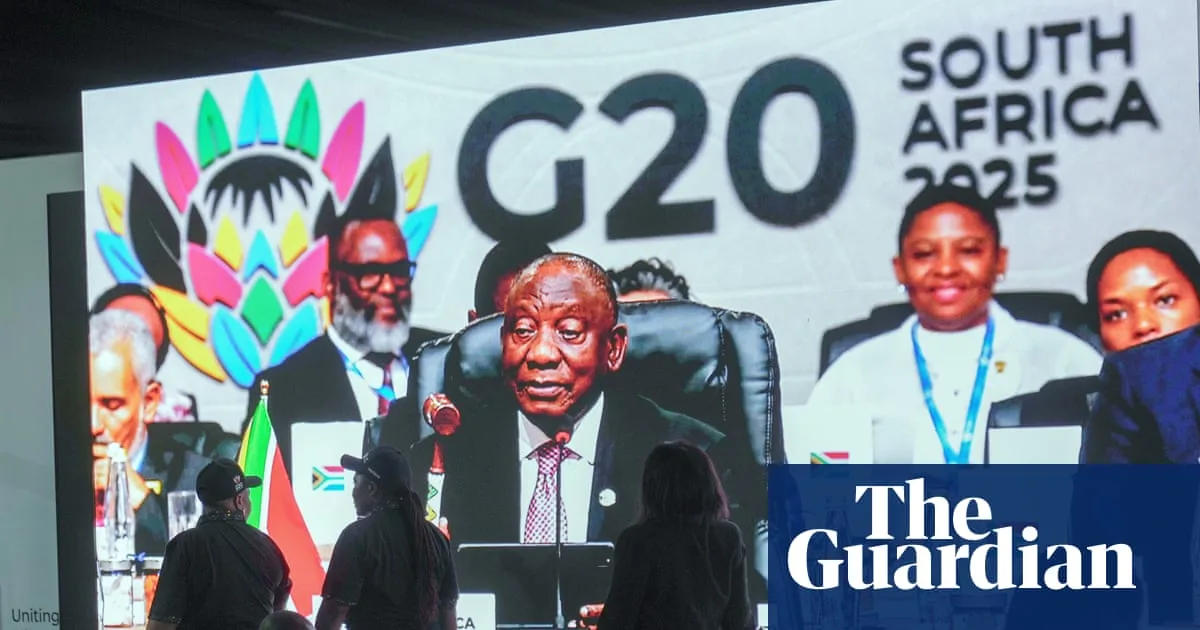
Donald Trump has said that South Africa will not be invited to G20 events in the United States when it presides over the forum next year, a measure the African nation described as “punitive”. The US president repeated widely discredited claims that South Africa is “killing white people”, extending a diplomatic row between the countries after the US boycotted the summit in Johannesburg last weekend.
Trump posted on his Truth Social platform: “At the conclusion of the G20, South Africa refused to hand off the G20 Presidency to a Senior Representative from our U.S. Embassy, who attended the Closing Ceremony. Therefore, at my direction, South Africa will NOT be receiving an invitation to the 2026 G20, which will be hosted in the Great City of Miami, Florida next year. South Africa has demonstrated to the World they are not a country worthy of Membership anywhere, and we are going to stop all payments and subsidies to them, effective immediately.”
Trump had already said in February he was stopping aid to South Africa, accusing the government of discriminating against white minority Afrikaners, who ruled the country during apartheid and remain on average many times wealthier than black South Africans, including inciting violence against white farmers and confiscating their land. South Africa’s government and many of its citizens have repeatedly pushed back against these claims, noting that land expropriation is only allowed under limited circumstances and that South Africa’s high crime rate affects everyone in the country.
A statement released by South Africa’s presidency said Trump’s comments were “regrettable”. It continued: “South Africa is a member of the G20 in its own name and right. Its G20 membership is at the behest of all other members. South Africa is a sovereign constitutional democratic country and does not appreciate insults from another country about its membership and worth in participating in global platforms. South Africa … will never insult or demean another country … It is regrettable that despite the efforts and numerous attempts by President Ramaphosa and his administration to reset the diplomatic relationship with the US, President Trump continues to apply punitive measures against South Africa based on misinformation and distortions about our country.”
After the US confirmed it was boycotting the G20 leaders summit, the first in Africa, having also not attended other G20 events in South Africa, it demanded the presidency be handed over to their acting ambassador at the event’s closing ceremony. However, South Africa rejected this, saying it would be a breach of protocol for Ramaphosa to symbolically give the presidency to a “junior” diplomat. It hailed the summit as a success for multilateralism, with a leaders’ communique that emphasised the importance of tackling issues including climate change and gender inequalities, all of which are anathema to Trump’s administration.
Trump said in his Truth Social post on Tuesday: “The United States did not attend the G20 in South Africa, because the South African Government refuses to acknowledge or address the horrific Human Right Abuses endured by Afrikaners, and other descendants of Dutch, French, and German settlers. To put it more bluntly, they are killing white people, and randomly allowing their farms to be taken from them.” In the last quarter of 2024, South African police recorded 12 murders on farms, including black-owned smallholder plots, out of almost 7,000 murders across the country. Private land ownership remains concentrated with the country’s white minority.