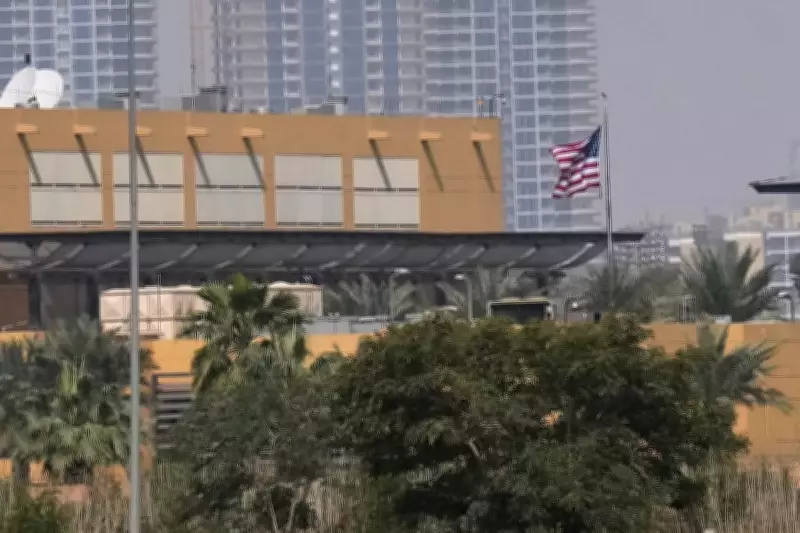
The US State Department has implemented personnel reductions at additional diplomatic missions across the Middle East, as it confronts mounting criticism regarding its preparedness for escalating regional conflict. This marks a significant expansion of security measures amid heightened tensions.
Expanded Drawdown Orders
On Monday, the department ordered the departure of nonessential staff and family members from diplomatic posts in Saudi Arabia and the US consulate in Adana, Turkey. These moves come in response to increasing Iranian retaliation following recent US-Israeli military actions.
The latest orders bring the total number of US embassies and consulates in the region with reduced staffing to ten, although only two facilities—the embassy in Kuwait City and the consulate in Karachi, Pakistan—have completely suspended operations. This represents the most substantial diplomatic personnel reduction since the beginning of the Iraq War in 2003.
Criticism and Response
The State Department faces familiar criticism from lawmakers and others who accuse the agency of inadequate planning for the conflict and insufficiently rapid response to assist American citizens abroad. Department officials acknowledge they underestimated the scale of Iran's retaliation but cite constraints including congressional limits on authority, military security considerations, and rapidly evolving circumstances.
Three anonymous department officials stated the agency was prepared for conflict but needed to navigate bureaucratic processes quickly to implement contingency plans once Iran's response became clear.
Evacuation Efforts and Challenges
The State Department reported assisting over 23,000 people with information or offers of charter flight seats to return to the United States. Americans in fourteen Middle Eastern countries have been advised to depart, with warnings issued two days after hostilities began as airspace closures and flight cancellations complicated travel.
As of Monday, at least 36,000 Americans had returned to the US, most through commercial means without government assistance. Officials noted that at least half of those offered seats on US-organized charter flights—for which reimbursement requirements have been waived—declined the offer. One flight from the United Arab Emirates was canceled over the weekend when no passengers appeared.
Political Reactions
Representative Gregory Meeks, the top Democrat on the House Foreign Affairs Committee, expressed concern about evacuation planning. "But it's an unacceptable failure of leadership that (Secretary of State Marco) Rubio did not have plans in place to evacuate New Yorkers & Americans in the Middle East until after Trump started dropping bombs," Meeks stated on social media platform X.
A group of eight Democratic senators led by Jeanne Shaheen of New Hampshire sent a letter last week criticizing what they called insufficient steps to protect diplomats and their families despite clear military planning for significant regional conflict.
Security Situation
No Americans have been injured at embassies or during evacuations thus far, though several diplomatic facilities have sustained damage. A strike caused partial roof collapse at the Riyadh embassy, while a helicopter landing pad within the Baghdad embassy compound was hit. Strikes also landed near diplomatic facilities in Dubai and Kuwait City.
Historical Context of Criticism
Criticism of State Department crisis response has been consistent across administrations, from the Iraq War to the 2021 Afghanistan evacuation. During the Afghanistan withdrawal, Republican lawmakers complained about insufficient assistance to Americans before the Kabul airport attack that killed thirteen troops.
Similar criticism emerged during the coronavirus pandemic, when nine Democratic senators criticized the department for inadequate assistance to Americans trying to return home. A subsequent Government Accountability Office report found the agency helped repatriate over 100,000 Americans from 137 countries during the pandemic's first six months.
Timeline of Recent Actions
According to internal State Department documents:
- On March 1, voluntary departure requests from embassies in Doha, Qatar and Kuwait City, Kuwait were approved and announced March 2
- On March 2, Americans in fourteen Middle Eastern countries were advised to depart via commercial means
- On March 3, with increased Iranian retaliation and many diplomats declining voluntary departure, nonessential staff were ordered to leave multiple countries
- On March 5, operations at the Kuwait embassy were suspended
- On Monday, nonessential personnel and families were ordered to leave Saudi Arabia and Adana, Turkey
The department generally approved evacuation requests from embassies and consulates within twenty-four hours, according to internal situation reports obtained by The Associated Press.