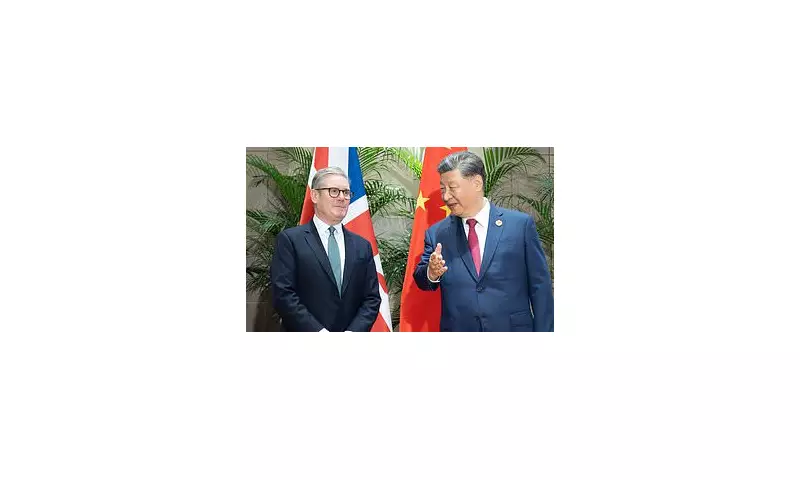
Prime Minister Keir Starmer is intensifying what critics have labelled 'Operation Kowtow', a controversial strategy to strengthen ties with China at a moment of heightened vulnerability for Britain's national security. This diplomatic push comes after the approval of China's expansive new embassy in London, a facility already branded a 'nest of spies' by detractors.
A High-Stakes Diplomatic Mission
Starmer departs for Beijing today, accompanied by Chancellor Rachel Reeves and a delegation of business leaders, marking the first visit by a British prime minister since Theresa May's trip in 2018. The Prime Minister hopes to reap rewards for what some describe as a year of significant concessions to Chinese interests. However, this overture arrives amidst a turbulent political climate in China, following the dramatic removal of General Zhang Youxia, the nation's highest-ranking military officer.
Beijing's Internal Turmoil and External Aggression
General Zhang, a longstanding ally of President Xi Jinping, has reportedly been accused of leaking nuclear secrets to the United States and accepting bribes. His downfall represents the latest casualty in Xi's sweeping purge of top military leadership, an internal crackdown not witnessed since the era of Mao Zedong. Concurrently, Xi appears increasingly impatient regarding Taiwan, having instructed his generals to prepare for a potential invasion by next year, leaving Taiwanese officials deeply anxious about their security.

This internal volatility coincides with China's assertive foreign policy. Xi is bolstering military cooperation with Vladimir Putin, whose war in Ukraine relies substantially on Chinese support. Furthermore, Beijing is confidently escalating its trade war with America while expanding its global influence through covert operations.
Security Concerns on British Soil
Ahead of Starmer's visit, alarming revelations have emerged about Chinese activities within the United Kingdom. According to the UK's Inter-Parliamentary Alliance on China, Beijing has established a network of over 75 clandestine influence outposts embedded within British businesses and universities. These operations allegedly aim to 'cultivate elites, shape debate, and suppress criticism of Beijing'.
The security apparatus surrounding the Prime Minister's trip underscores these threats. Members of Starmer's entourage are advised to use burner phones and disposable laptops, essential precautions when visiting what is described as Xi's 'hostile surveillance state'.
A Record of Appeasement and Weakness
Critics argue that Starmer's approach to China has been characterised by weakness and appeasement. The ledger of concessions is substantial: Xi reportedly refused to confirm the Prime Minister's visit until after Britain approved the new mega-embassy in London. Beijing has also petulantly denied the British Embassy in China permission for necessary refurbishments, a move interpreted as diplomatic blackmail.
Further controversies include the collapse of a high-profile spy trial last September, which the government was accused of sabotaging to avoid embarrassing Beijing. Although ministers denied these allegations, a parliamentary report condemned the handling of the case as 'shambolic'. In December, Foreign Office computers were hacked by a group known as Storm-1849, with multiple officials privately confirming Chinese involvement, yet ministers publicly refused to attribute blame.
Human Rights and Economic Coercion
The human rights dimension presents another grave concern. Jimmy Lai, a British citizen and newspaper publisher in Hong Kong, was convicted in December on fabricated security charges, including the Orwellian accusation of 'colluding with foreign forces'. He faces life imprisonment, with his sentencing potentially coinciding with Starmer's Beijing trip. Lai has become a symbol of Hong Kong's erosion of freedoms and Beijing's contempt for the UK, yet the British government's response has often appeared tepid.

Economically, Starmer advocates for deeper business ties, describing China as 'a defining force in technology, trade, and global governance'. He has argued that disengagement would be a 'dereliction of duty'. However, China routinely employs trade and investment as tools of coercion, recently weaponising its near-monopoly on rare earth minerals critical for high-tech industries, from fighter jets to electric vehicles.
The Looming 'Second China Shock'
Economists are warning of a 'second China shock' to Western economies. Unlike the first shock post-2001, which involved mass job losses from cheap exports, this new phase sees Beijing using massive state subsidies to dominate future technologies like renewables, robotics, and artificial intelligence. This strategy creates enormous overcapacity, with China aiming to dump surplus goods worth $1.19 trillion last year onto global markets, potentially decimating Western competitors.
These dependencies are not accidental but part of an explicit policy articulated by Xi to increase Beijing's leverage. This represents a perversion of free trade, where China seeks to sell everything while buying little, all while engaging in industrial-scale cyber espionage to plunder foreign technology and know-how.
A Call for Robust Diplomacy
While engagement with China is unavoidable, critics contend that Starmer confuses necessary diplomacy with kowtowing. The appropriate approach, they argue, should involve robust messaging and firm delivery. Instead, the Prime Minister appears to be travelling to Beijing with 'cap in hand', risking a humiliating spectacle that could further undermine British security and interests.
In a climate of immense geopolitical uncertainty, Starmer's determination to cosy up to Beijing is viewed by many as dangerously naive and recklessly foolhardy, placing short-term economic aspirations above long-term national security.