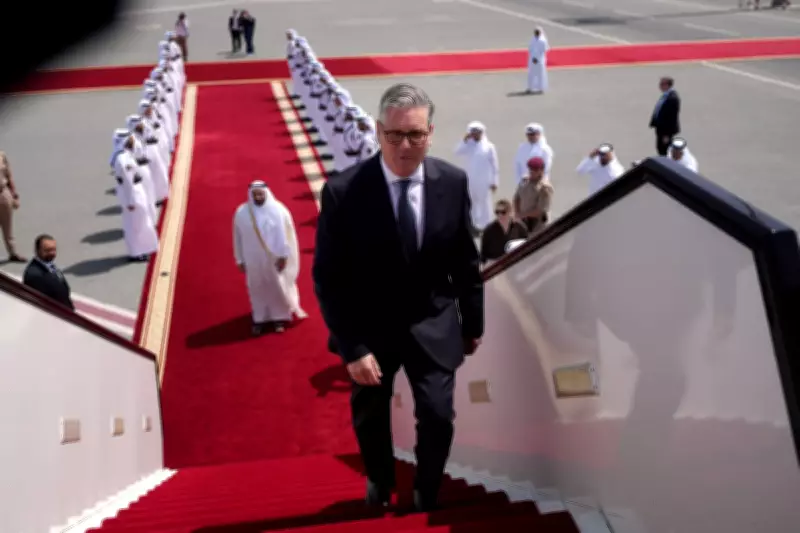
Prime Minister Sir Keir Starmer has issued a direct appeal to the United States and Iran to "find a way through" their impasse, following the dramatic collapse of crucial peace negotiations over the weekend. The British leader emphasised the absolute necessity of maintaining the fragile ceasefire currently holding in the Middle East conflict and warned sternly against any actions that could trigger further escalation.
Trump's Blockade Threat Casts Shadow Over Diplomacy
The urgent call for calm from Downing Street comes as former US President Donald Trump introduced significant new uncertainty into the geopolitical landscape. In a lengthy post on his Truth Social platform, Mr Trump declared that the United States would "immediately" commence "BLOCKADING any and all Ships trying to enter, or leave, the Strait of Hormuz."
He further asserted that the US Navy would actively "seek and interdict every vessel in International Waters that has paid a toll to Iran," adding ominously that "No one who pays an illegal toll will have safe passage on the high seas." Mr Trump claimed, without providing specific details, that "Other Countries will be involved with this Blockade."

Breakdown Over Nuclear Stalemate
The peace talks, held in Pakistan and involving US Vice-President JD Vance, concluded without an agreement in the early hours of Sunday after a marathon 21-hour session. Mr Trump stated that discussions "went well, most points were agreed to, but the only point that really mattered, NUCLEAR, was not." This core disagreement over Iran's nuclear ambitions proved to be the insurmountable obstacle to a deal.
Prime Minister Starmer discussed the failed negotiations during a call with His Majesty Sultan Haitham bin Tarik al Said of Oman. A Downing Street spokeswoman confirmed the leaders "urged both sides to find a way through" and agreed it was "vital there was a continuation of the ceasefire, and that all parties avoided any further escalation."
International Focus on Reopening Vital Shipping Lane
The leaders also addressed the critical situation in the Strait of Hormuz, a vital global oil and gas shipping lane that has been severely restricted by Iran, causing energy prices to skyrocket. Britain is set to host further talks next week with a coalition of countries focused on reopening this maritime pinch-point.
According to the readout, Sultan Haitham provided an update on the strait, and Prime Minister Starmer thanked Oman for its efforts in rescuing sailors from distressed vessels in the region. "Reflecting on international efforts to co-ordinate safe passage for shipping in the region, the Prime Minister said that following meetings convened by the Foreign Secretary and British military planners, partners continued to work towards restoring freedom of navigation for the long term," the statement detailed.
Coordinated Pressure and Planning
The upcoming meeting, expected to be the third hosted by Britain on this issue this month, will explore strategies for a sustainable end to the conflict. An official with knowledge of the planning indicated the focus would be on increasing international diplomatic pressure on Iran to reopen the strait. This includes examining coordinated economic and political measures, such as potential sanctions, and collaborating with the International Maritime Organisation to secure the release of thousands of ships and sailors currently trapped.
This diplomatic push follows Prime Minister Starmer's visit to Gulf allies earlier in the week, where he discussed support for what he described as a "fragile" ceasefire. Gulf nations have faced the brunt of Tehran's retaliation for the US-Israeli campaign, enduring thousands of Iranian missiles and drones targeting US military sites and critical energy infrastructure.
Strained Relations and Critical Voices
Mr Trump had agreed to a two-week ceasefire earlier in the week, with the reopening of the Strait of Hormuz as a key condition. This came shortly after he warned Iran that "a whole civilisation will die" if it did not meet his demands. The former president's rhetoric has drawn sharp criticism from within the UK government.

Health Secretary Wes Streeting publicly criticised Mr Trump's "incendiary, provocative, outrageous" language, advising that ministers had learned to distinguish between what the American leader "says and what he does." Mr Streeting added that disagreements over the Iran conflict, alongside other issues like Greenland and the Chagos Islands, as well as Mr Trump's repeated jibes against the UK, had "undoubtedly strained" the historically close UK-US relations.
The international community now watches anxiously as Britain attempts to steward diplomatic efforts, aiming to prevent a renewed outbreak of hostilities and secure the safe passage of global shipping through one of the world's most strategically vital waterways.