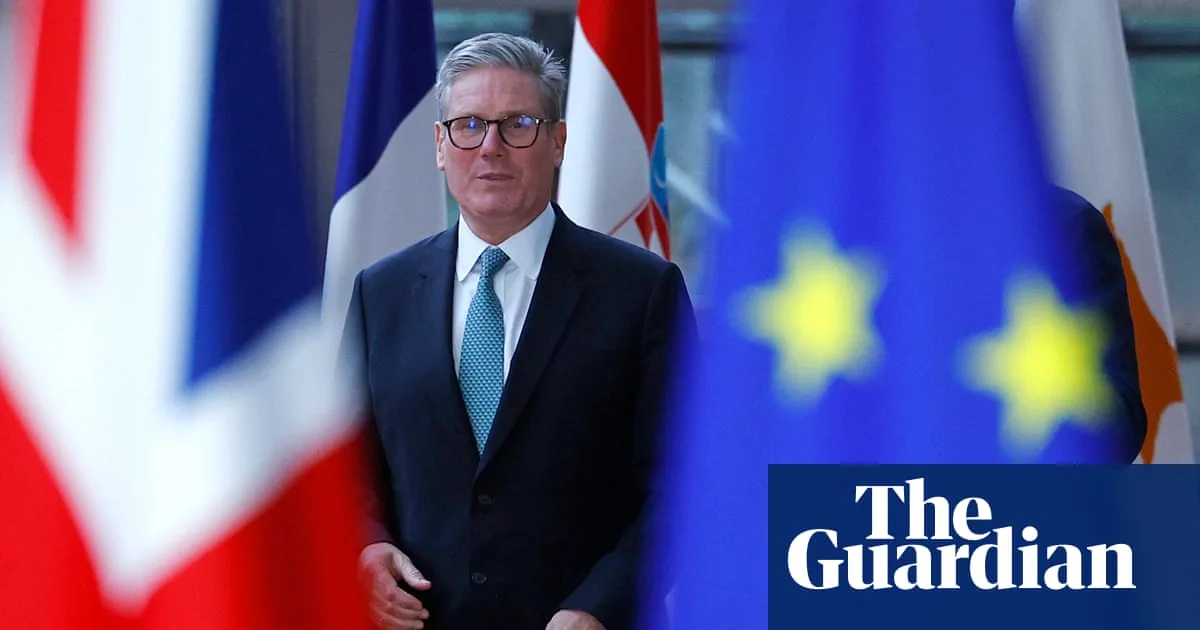
Starmer Announces Radical Shift in UK Foreign Policy Towards Europe
Prime Minister Sir Keir Starmer has announced a dramatic pivot away from America and towards Europe, marking the most significant transformation in British foreign policy in decades. This strategic reorientation fundamentally resets the United Kingdom's position in a world where American power is diminishing, according to analysis from Kyiv.
Ending the 'Special Relationship' Fantasy
Speaking at the Munich Security Conference, Starmer declared: "There is no British security without Europe, and no European security without Britain. That is the lesson of history – and it is today's reality too." While acknowledging America remains an indispensable ally, the Prime Minister emphasized that Washington is no longer Britain's only ally and cannot be considered a consistently reliable friend.
This announcement will likely cause consternation within certain quarters of Britain's armed forces, particularly the Special Forces community. However, it represents a decisive end to what many have described as Britain's "junior partner" status under the United States and dispels the long-held fantasy of an equal "Special Relationship."
The Historical Context of UK-US Relations
The relationship between Britain and America has evolved significantly over time. During the Cold War era, the partnership was more balanced, underpinned by the Five Eyes intelligence-sharing arrangement with Canada, New Zealand, and Australia. London demonstrated considerable independence during this period, notably staying out of the Vietnam War.
In 1982, the United States provided minimal support during Britain's campaign to recapture the Falkland Islands from Argentina. Similarly, when America led a UN-sanctioned mission to Somalia in 1992 to combat warlordism and famine, numerous nations including France, Turkey, Morocco, and Pakistan participated, but Britain notably abstained.
A British defence attaché in Washington during this period observed: "The special relationship is special to us but not to the Americans. They're polite and courtly and always seem to listen. Then they close the door behind us when we've gone and ignore what we said."
The Iraq War and Changing Dynamics
The dynamics shifted dramatically when Britain joined the United States in the Iraq War, effectively becoming a subordinate unit within the American military structure. During the subsequent decade of the "war on terror," this status became entrenched through chronic underfunding of British forces and excessive reliance on American "enablers" – satellite imagery, air transport, refuelling capabilities, and logistical support where the US leads globally.
Former Conservative defence committee chair Tom Tugendhat recently noted that four pillars of British defence policy have been dismantled: the assumption of automatic American support, NATO's credibility as a security guarantor, stable long-term defence planning, and political consensus that defence could remain secondary. These foundations crumbled within the first fifty days of Donald Trump's return to the White House.
Military Realities and European Focus
Britain's elite Special Air Service and Special Boat Service represent the only units where UK and US forces operate on parity, with both nations maintaining approximately equivalent numbers of highly trained Tier 1 operators. For twenty-five years, these units have worked closely together, with Britain's military reputation in Washington largely resting on this relationship despite lacking comparable specialist equipment.
Elsewhere, the partnership has proven less advantageous. In Iraq, American and Iraqi forces had to rescue British troops from a disastrous campaign in Basra and southern regions. Similarly, in Afghanistan's Helmand province, embattled British-led forces required a 30,000-strong surge of US Marines for reinforcement.
While American frontline soldiers have consistently appreciated the courage and panache of British troops, they were never militarily essential. The entire British army, now numbering around 72,000 personnel, is less than half the size of the US Marine Corps alone, which fields 172,000 troops with their own jets, transport, artillery, and ships.
The European Security Imperative
With Russia representing the primary threat to British security, Starmer argues it makes strategic sense to concentrate military efforts and enhance capabilities within Europe alongside European forces. "We are not the Britain of the Brexit years anymore," the Prime Minister declared. "Because we know that, in dangerous times, we would not take control by turning inward - we would surrender it."
Starmer advocates for a vision of European security and greater autonomy that doesn't signal American withdrawal but responds to calls for increased burden-sharing while rebuilding ties that have historically served Britain well. He emphasizes the need for Europe and the UK to invest in domestic arms manufacturing capabilities and reduce dependence on American equipment.
Britain's Position Within European Defence
The Royal Navy remains Europe's most powerful naval force, with two aircraft carriers and nuclear-powered submarines whose total tonnage exceeds that of the German, French, and Italian navies combined. While France maintains larger overall forces of approximately 200,000 personnel, Britain possesses more specialized units focused on rapid deployment.
Poland's military is expanding rapidly with around 215,000 active service members and substantial rearmament programs, while Turkey fields NATO's second-largest force after America with approximately 440,000 personnel. By working more directly with European nations, British forces can become "first among equals" in defending against Kremlin aggression and addressing Moscow's hybrid warfare tactics already affecting the continent.
This European collaboration will likely include Ukraine's battle-hardened veterans, numbering over 800,000, and Kyiv's rapidly growing military-industrial sector. "We want to bring our leadership in defence, tech and AI together with Europe," Starmer explained, "to multiply our strengths and build a shared industrial base across Europe which can turbocharge our defence production."
Although Donald Trump has advocated for increased European defence spending, the emergence of a truly independent Europe would significantly diminish American influence. Starmer's policy shift recognizes that Britain's future security lies not across the Atlantic, but across the Channel, in closer partnership with European allies facing shared threats in an increasingly uncertain world.






