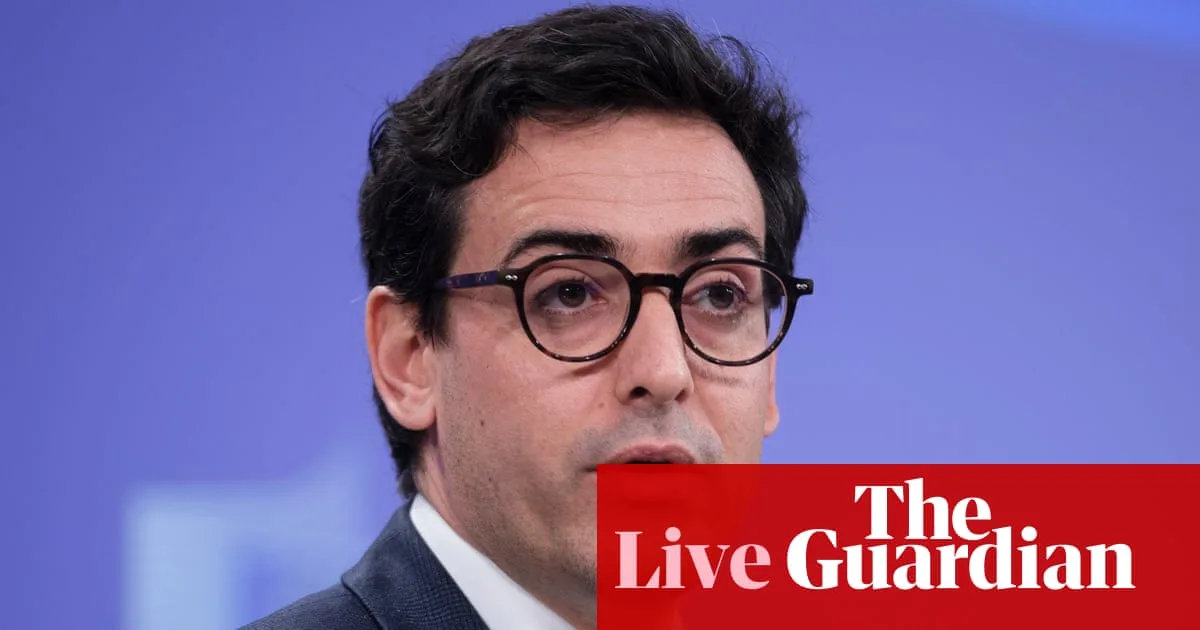
The European Union has closed ranks behind Spain after US President Donald Trump threatened to “cut off all dealings” with Madrid over its criticism of the American attack on Iran. Stéphane Séjourné, the EU’s internal market commissioner, said on Thursday that “any threat against a member state is by definition a threat against the EU”, adding that trade policy is an EU competence handled by the European Commission.
Speaking in Spanish at a press briefing in Brussels, Séjourné, who grew up in Spain and Argentina, said: “If you threaten one particular country … well, that’s what we’ve seen about Greenland. I think we saw that there was a lot of unity.” His comments followed a similarly robust response from Spanish Prime Minister Pedro Sánchez, who accused Trump of playing “Russian roulette with the destiny of millions” and declared that Spain “will not be complicit in something that is bad for the world … simply out of fear of reprisals from someone”.
France’s President Emmanuel Macron also expressed solidarity with Spain, condemning “recent threats of economic coercion” against Madrid. The show of EU unity came after Trump’s apparent displeasure at Spain’s refusal to back the US strike on Iran. Madrid also voiced disapproval of German Chancellor Friedrich Merz, who appeared to side with Trump during a White House visit and failed to defend Spain from the US president’s criticism.
Separately, several European countries continued evacuation and repatriation flights from the Middle East, using a mix of commercial and military aircraft. Poland’s Prime Minister Donald Tusk announced that Poland would use military planes to help evacuate its citizens, while the Czech Republic, Slovakia, France, Ireland and Italy also pressed ahead with operations to bring nationals home.
In a related development, EU lawmakers have decided to postpone work on legislative proposals related to the EU-US trade deal. Jörgen Warborn, a member of the centre-right European People’s Party, said “the US files have been postponed”, criticising what he called an “anti-Trump” narrative. The European Commission also unveiled plans to boost the competitiveness of the EU’s manufacturing sector, including local content requirements that could benefit non-EU countries such as the UK.