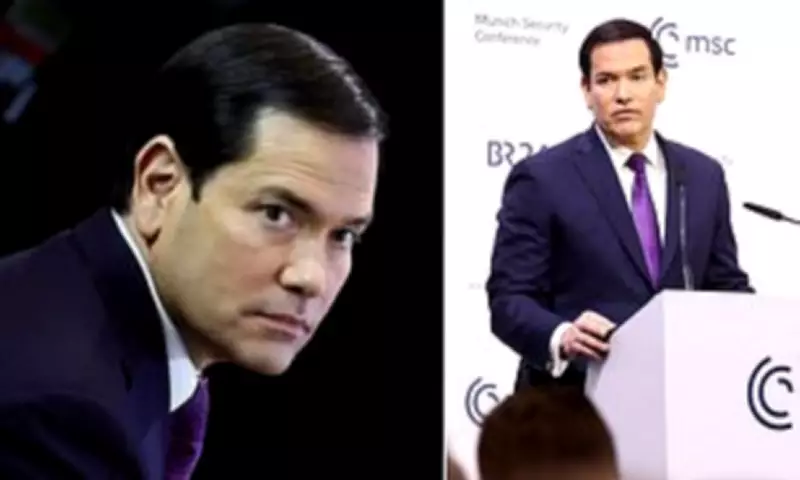
US Vice President Marco Rubio has delivered a stark warning to European leaders, declaring that mass migration represents a profound crisis that is actively destabilising Western nations. Speaking at the prestigious Munich Security Conference on Saturday morning, Rubio asserted that the West has opened its doors to an unprecedented wave of migration, which he described as an urgent threat to societal fabric and civilisation itself.
A Call for Sovereignty and Pride
In his address, Rubio emphasised that controlling borders is not an expression of xenophobia but a fundamental act of national sovereignty. He stated that failing to manage migration would constitute a fundamental abdication of duty. The Vice President appealed to Europe to be proud of its culture and Christian heritage, arguing that America seeks allies who are not shackled by guilt or shame.
"We want allies who are proud of their culture and heritage," Rubio declared to applause from the assembled audience. "We are heirs to the same great civilisation and must defend it together."

Conciliatory Notes on Transatlantic Ties
Despite his strong rhetoric on migration, Rubio struck a conciliatory tone regarding US-European relations. He affirmed that America and Europe belong together, describing the continent as one of America's cherished allies and oldest friends. "We will always be a child of Europe," he added, acknowledging the deep spiritual and cultural connections between the two continents.
Rubio explained that disagreements between the US and Europe stem from profound concern about their shared future. He referenced former President Donald Trump's demand for seriousness and reciprocity from European partners, framing it as evidence of America's deep investment in Europe's strength and survival.
Starmer's Vision for European Defence
Among the prominent attendees at the conference was British Prime Minister Sir Keir Starmer, who met with German Chancellor Friedrich Merz and French President Emmanuel Macron ahead of his scheduled address. Starmer is set to deliver a significant speech urging European allies to take greater responsibility for their own defence capabilities rather than relying heavily on American support.
The Prime Minister will argue that Europe must relinquish its overdependence on the United States, particularly amid concerns about America's commitment to NATO under the current administration. Starmer is expected to call for a more autonomous European defence alliance underpinned by stronger ties between Britain and the European Union.
Moving Beyond Brexit Mentality
In his prepared remarks, Starmer will declare that Britain has moved beyond the Brexit years, warning that turning inward in dangerous times would amount to surrendering control rather than taking it. "There is no British security without Europe, and no European security without Britain," he will assert, framing this as both a historical lesson and contemporary reality.
Starmer will praise America's historical contribution to European security while suggesting that as the Trump administration has upended traditional alliances, Europe must reduce its dependence on US protection. His vision calls for greater burden sharing and a remaking of transatlantic ties that have served Western nations for decades.
Defence Cooperation and Industrial Challenges
The Prime Minister will highlight Europe's failure to maximise its defence capabilities despite economies that dwarf Russia's tenfold. He will call for closer UK-EU defence cooperation to build a shared industrial base that can turbocharge defence production across the continent.
This comes after reported breakdowns in talks about Britain joining the EU's 150 billion euro Security Action for Europe rearmament fund, where the price for entry was deemed too high. Starmer will criticise fragmented industrial planning and drawn-out procurement mechanisms that have created capability gaps and duplication across European defence systems.

Political Warnings and Unity Calls
In a pointed political message, Starmer will criticise both Reform UK and the Green Party as peddlers of easy answers from the extreme right and left. He will accuse these groups of being soft on Russia and weak on NATO, warning that their ideologies threaten to sacrifice longstanding relationships essential for European security.
"The future they offer is one of division and then capitulation," Starmer will say. "The lamps would go out across Europe once again. But we will not let that happen."
Broader Conference Context
The Munich Security Conference has brought together approximately fifty world leaders to discuss pressing international issues, including European defence and the future of transatlantic relationships. The leaders have also met with Ukrainian President Volodymyr Zelensky to discuss efforts to end the conflict with Russia as the four-year anniversary of Vladimir Putin's full-scale invasion approaches.
Conference chairman Wolfgang Ischinger noted that Rubio's speech prompted a "sigh of relief through this hall" compared to previous addresses by US officials, suggesting a more measured tone despite the strong positions articulated on migration and sovereignty.
The contrasting messages from Rubio and Starmer highlight the complex dynamics shaping Western alliances, with America urging cultural confidence and border control while European leaders seek greater strategic autonomy within enduring partnerships.