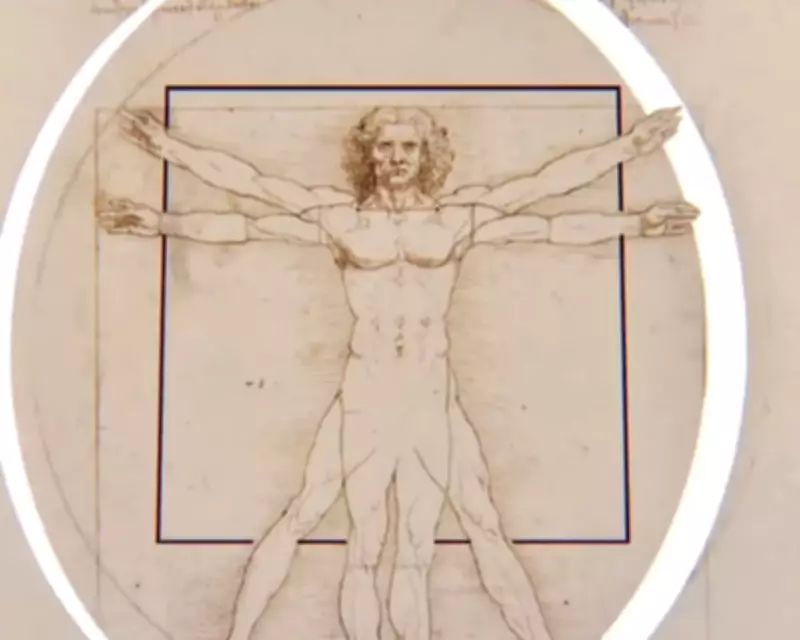
Italy's state broadcaster, Rai, has ignited a significant political and cultural controversy after being accused of censoring one of the world's most iconic artworks. The broadcaster allegedly removed the genitals from Leonardo da Vinci's renowned Vitruvian Man drawing in the opening credits for its coverage of the Milano Cortina Winter Olympics.
Altered Image Sparks Immediate Backlash
The controversy began when the Italian newspaper Corriere della Sera first noticed the alteration during the broadcast. The image of the 500-year-old Renaissance masterpiece appears at the start of the programme before transforming into the bodies of ice-skaters, skiers and other winter sports athletes. However, viewers observed that all other attributes of the Vitruvian Man's body had been faithfully reproduced except for one crucial detail that appeared to have been deliberately redacted.
Corriere della Sera posed the direct question that would echo through Italian media: "What happened to the Vitruvian Man's genitals?" This simple inquiry uncovered what many are calling an act of cultural censorship against one of Italy's most treasured artistic achievements.

Political Fallout and Parliamentary Questions
The backlash from Italy's political opposition was swift and severe. Deputies from the centre-left Democratic party have raised formal questions in parliament, directly challenging culture minister Alessandro Giuli to "shed full light on the use of the image of Leonardo da Vinci's Vitruvian Man in the Olympics opening credit broadcast by Rai."
Irene Manzi, the Democratic party group leader of the culture committee in the lower house of parliament, delivered a particularly strong condemnation. She stated that Leonardo's Vitruvian Man "was tampered with and censored, with the genitals from the original works removed ... an incomprehensible and unacceptable choice." Manzi pointedly asked whether Rai had truly "gone so far as to alter a Leonardo," highlighting the gravity of the alleged offense against Italy's cultural heritage.
The politicians are demanding answers to several critical questions. They want to know if Rai was formally authorised to reproduce the Renaissance artist's drawing, which they described as "an absolute masterpiece." Additionally, they seek clarification about whether permission for the image's alteration was granted by the custodians of the original works at Venice's Gallerie dell'Accademia, where the drawing is preserved.
Rai's Defense and Broadcasting Service Responsibility
In response to the growing controversy, Rai issued a firm statement dismissing the accusations as "yet another fake news story." The broadcaster characterized the criticism as another "spurious" controversy "improperly" targeting the public service broadcaster.
Rai provided a crucial clarification about the production process, explaining that "the management and production of the opening credit was entrusted to the Olympic Broadcasting Service and not to Rai." According to their statement, Rai "limited itself to broadcasting the official opening credit without any possibility of intervention or modification." This defense shifts responsibility to the international Olympic Broadcasting Service rather than the Italian broadcaster itself.
Broader Context of Rai Controversies
This incident occurs within a broader context of tension between Rai and Italy's political opposition, which frequently accuses Giorgia Meloni's far-right government of exerting excessive influence over the public broadcaster. The Vitruvian Man controversy has become another flashpoint in this ongoing political struggle over media independence and cultural representation.
Simultaneously, Rai faces internal challenges from its own journalists. The network's sports journalists are protesting what they describe as repeated blunders by sports director Paolo Petrecca during his commentary on the Winter Olympics opening ceremony. Most notably, Petrecca mistakenly identified Italian actor Matilda De Angelis as international pop star Mariah Carey.

In response to these professional concerns, the journalists' union Usigrai announced that reporters across Rai's news programmes would remove their bylines from their work in a show of solidarity with their sports colleagues. This internal protest adds another layer of complexity to the broadcaster's current challenges.
Cultural Significance and International Attention
The Vitruvian Man, created by Leonardo da Vinci around 1490, represents one of the most recognizable images from the Italian Renaissance. The drawing, which depicts a man in two superimposed positions with his arms and legs apart inscribed in both a circle and square, has become an international symbol of human proportion, anatomy, and Renaissance humanism.
The controversy has attracted attention beyond Italy's borders, raising questions about artistic integrity, censorship in broadcasting, and the treatment of cultural heritage in modern media. As the Winter Olympics continue, this incident serves as a reminder of how cultural symbols can become flashpoints in contemporary political and media debates.
The situation remains unresolved as parliamentary inquiries proceed and cultural authorities consider the implications of altering one of history's most significant artistic works for television broadcast. The outcome may have lasting implications for how cultural treasures are treated in mass media and who has the authority to modify artworks that belong to humanity's shared heritage.