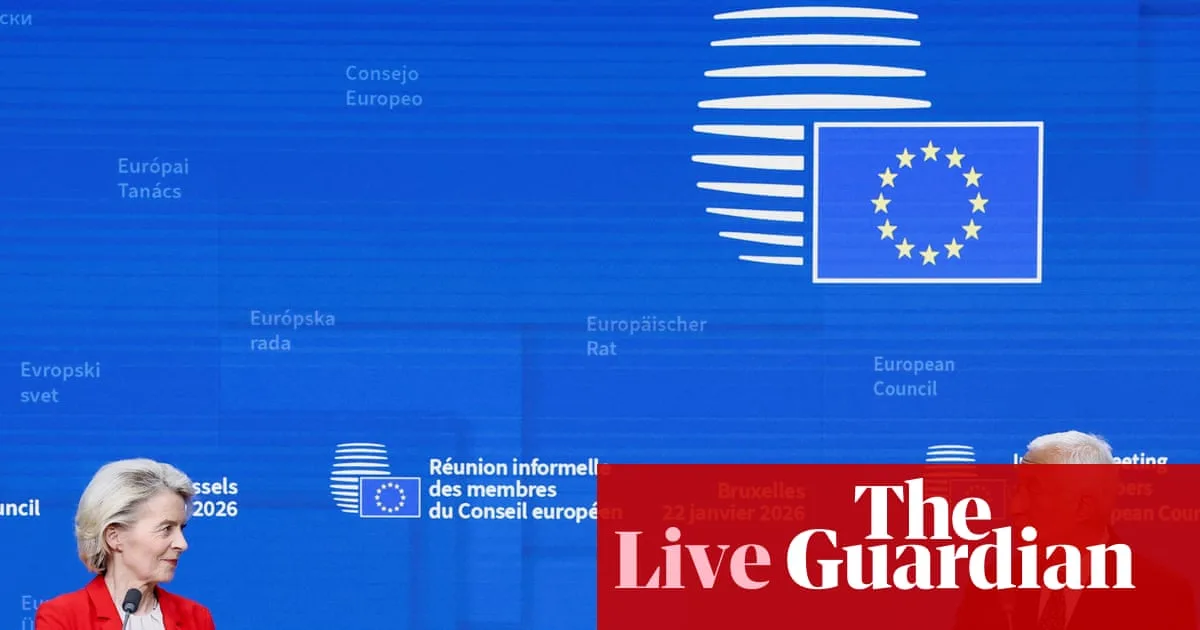
European Council President António Costa has affirmed the EU's support for Denmark and Greenland, urging the United States to maintain 'respectful' relations. The statement comes after US President Donald Trump reiterated his desire to control Greenland during a Davos speech, though he ruled out the use of force. The remarks were delivered while Danish ministers were briefing parliamentarians in a confidential, no-phone meeting, forcing officials to relay updates via scribbled notes.
Danish Prime Minister Mette Frederiksen is set to meet NATO Secretary General Mark Rutte in Brussels on Friday to discuss Greenland and Trump's comments. The meeting was confirmed by Frederiksen's office, according to Danish broadcaster DR. Meanwhile, Slovak Prime Minister Robert Fico criticised the EU's leadership during a video posted en route to the Brussels summit, accusing the bloc of being driven by 'hatred towards Russia' and calling for a change in leadership.
Fico specifically targeted EU foreign policy chief Kaja Kallas, questioning her effectiveness after US Secretary of State Marco Rubio reportedly refused to meet with her. He argued that the EU is in 'deep crisis' and needs new leadership, using a colourful analogy: 'The same rule applies to the EU as to a massage parlour: if it doesn't work, it's not enough to change the beds, you have to change the staff.'
In other developments, Ukrainian President Volodymyr Zelenskyy announced agreements on a new package of critically needed air defence systems during his Davos appearance. He also indicated that US-Russian talks could take place soon, possibly overnight. Meanwhile, Russian President Vladimir Putin held late-night talks with US envoys Steve Witkoff and Jared Kushner in Moscow, highlighting the urgency of diplomatic efforts ahead of planned discussions in the UAE.