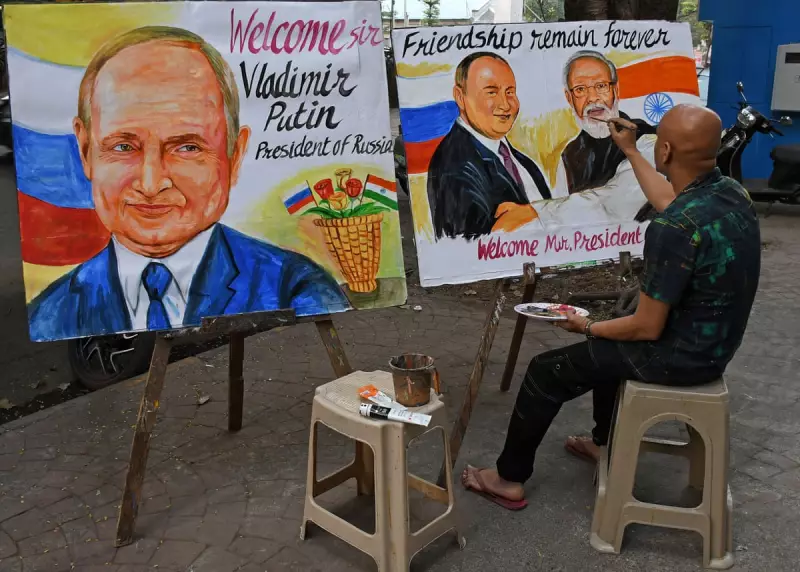
As a teacher in India puts the finishing touches to a hand-painted poster welcoming Vladimir Putin, the stage is set for a high-stakes diplomatic encounter. The Russian President's arrival in New Delhi to meet Prime Minister Narendra Modi comes at a moment of profound geopolitical peril for both nations, testing a long-standing alliance against a backdrop of global upheaval.
A World Transformed Since the Last Handshake
When Vladimir Putin last visited India almost exactly four years ago, the international landscape was markedly different. That brief, pandemic-restricted trip in late 2021, which lasted a mere five hours, focused on economic and military cooperation. Three months later, Russia's full-scale invasion of Ukraine would transform Putin into a global pariah, severely restricting his travel and isolating Moscow from much of the world.
The intervening years have also seen the seismic return of Donald Trump to the White House, whose administration has upended carefully nurtured US-India relations with inflammatory rhetoric and punishing import tariffs. This turbulent context imbues Thursday's summit with immense symbolic and practical weight, serving as a declaration that neither Moscow nor Delhi will bow to external pressure.
High Stakes Realpolitik: Defence, Oil, and the China Factor
For Russia, the very fact of the visit is a victory. Petr Topychkanov, a senior researcher at the Stockholm International Peace Research Institute based in Moscow, notes it signals Russia's tentative return to normalised international relations and eases fears of permanent political isolation. Putin arrives fresh from rejecting the latest US-backed Ukraine peace proposal, buoyed by recent battlefield advances.
For India, the calculus is even more complex. As analyst Aparna Pande of the Hudson Institute observes, Delhi faces its most challenging geopolitical climate in years, navigating "a semi-isolationist America, a weaker Russia and a very powerful China." The nation's historical reliance on Russia is deeply rooted, dating to the Cold War, with Moscow remaining its largest defence supplier. However, that dependence is strategically shifting; where Russian kit once comprised 70% of Indian defence purchases, that figure has now fallen below 40% in just four years.
The spectre of China is the dominant strategic concern. India has long viewed Russia as a crucial continental balancer against Beijing. Yet the deepening "no-limits partnership" between Moscow and Beijing causes significant anxiety in Delhi. The summit will see India attempt a delicate balancing act: purchasing enough Russian weaponry, like the S-400 air defence systems and Sukhoi Su-57 fighters, to maintain the alliance, while avoiding over-dependence that could leave it vulnerable if Russia ever sided wholly with China.
Navigating Trump's America and the Oil Conundrum
The relationship has faced recent strain from Washington. After his Ukraine peace efforts stalled, President Trump accused India of bankrolling Russia's war and imposed punitive 25% tariffs on Indian imports, triggering the worst dip in US-India relations for years. In response, India has reverted to its traditional foreign policy of "hedging," demonstrating to the US that it has other strategic options.
The question of Russian oil looms large over the talks. While Prime Minister Modi insists India will continue its purchases, new US and EU sanctions have caused a notable slowdown from the Indian private sector. In a move interpreted as an effort to placate Trump, India has concurrently agreed to import more American oil and gas. Kremlin press secretary Dmitry Peskov has acknowledged "obstacles" but predicted only brief, insignificant drops in exports, claiming Moscow possesses the technology to circumvent sanctions long-term.
As for Ukraine, analysts expect Modi's mentions to be limited to repeated calls for peace. India lacks the leverage to substantially influence the conflict's trajectory, and the summit's core focus will remain on the hard-nosed, mutual interests of defence, trade, and navigating a world order where both leaders feel the ground shifting beneath their feet.