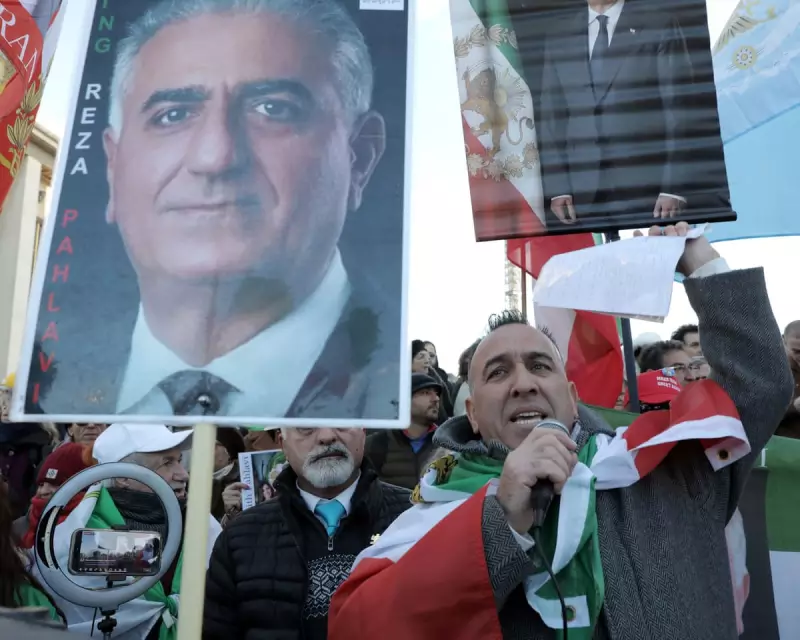
In a powerful display of international solidarity, people have taken to the streets of Paris near the iconic Eiffel Tower to voice their support for the rapidly expanding protest movement within Iran. The demonstration underscores the global resonance of the unrest shaking the Islamic Republic.
A Rallying Cry, But For What?
Within Iran, supporters of Reza Pahlavi, the exiled son of Iran's deposed shah, have been quick to claim the crowds as a direct response to his calls for action. They frame the protests as a de facto referendum on his leadership, suggesting the public response signals his victory.
However, the critical question of a viable alternative leadership for Iran remains profoundly unanswered. While many Iranians are desperate to end the 47-year rule of the clerics, a return to monarchical rule is still viewed with deep suspicion by significant segments of society. The protest slogans, analysts suggest, may reveal more about exhaustion with the present than genuine affection for the past.

International Caution and Internal Divisions
On the global stage, Donald Trump has notably withheld endorsement from Pahlavi. Mirroring his cautious approach to Venezuelan opposition, the US President appears wary of America becoming entangled in a potential civil war. Reports suggest Trump may even be exploring back-channel deals with breakaway factions within the Iranian government, with Omani officials due in Tehran as mediators.
This leadership vacuum has, paradoxically, benefited Pahlavi. With no clear rival figure or unified political manifesto beyond ending corruption, repression, and inflation, his decades of cultivating name recognition stand out. Other potential leaders, like activists Narges Mohammadi and Mostafa Tajzadeh, remain locked in Iran's prisons.
A Society at a 'Dead End'
An internal analysis provided to the Guardian offers a stark interpretation. One Iranian observer stated that the chants heard are "not a call to return to the crown; it is an escape from a dead end." They describe a society told repeatedly to wait for improvements that never came, now reacting with the raw instinct for survival rather than classical political rationality.
"The monarchist slogan is not a declaration of love for Pahlavi," the analysis continues, "it is a declaration of disgust for the Islamic Republic. It is a cry of 'no' when no 'yes' is available."
Domestic Warnings Against External Solutions
This sentiment is echoed by groups within Iran urging caution. The Iranian Writers' Association warned against "externally imposed solutions," asserting that freedom will not arrive via foreign bombs. Similarly, the influential Syndicate of Workers of Tehran and Suburbs Bus Company declared its opposition to "the reproduction of old and authoritarian forms of power," rejecting reliance on foreign powers or a leader elevated above the people.
Meanwhile, Iran's reformist leadership, struggling to comprehend the fading nationalism from June's 12-day war, has few solutions left beyond rallying against perceived foreign malice. As Ahmad Naghibzadeh, an emeritus professor at the University of Tehran, told Euronews, the ultimate solution may be historic, not technocratic: a decisive settlement in favour of the state over religion, as once happened in Europe.
As Pahlavi prepares for an event in Mar-a-Lago, Florida—stressing it is unconnected to Trump—the protest movement continues to evolve. The streets of Iran, and those of Paris in solidarity, are sounding a cry of profound discontent, but the shape of what comes next remains shrouded in the smoke of tear gas and the complexities of a nation's desperate search for a way out.