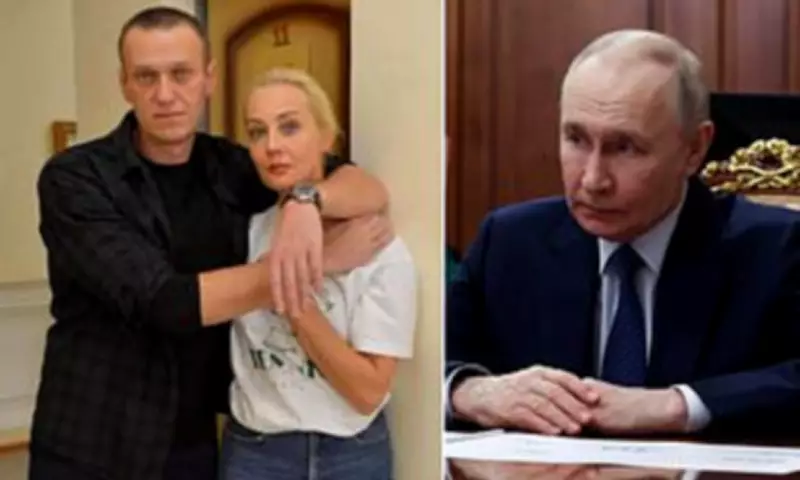
The widow of Russian opposition leader Alexei Navalny has issued a powerful demand for accountability, stating that President Vladimir Putin must face justice for her husband's murder. This call comes after a landmark international investigation concluded that Navalny was killed using a rare neurotoxin derived from the skin of Ecuadorian dart frogs.
International Investigation Uncovers Chemical Weapon Use
On Sunday night, Yulia Navalnaya publicly thanked Britain and its European allies for their meticulous two-year investigation, which established that her husband's death in a Siberian penal colony was likely caused by epibatidine. This potent toxin is naturally found only on the skin of the Ecuadorian dart frog and is classified as a chemical weapon due to its extreme potency, being approximately two hundred times stronger than morphine.
Ms Navalnaya declared: 'I was certain from the first day that my husband had been poisoned, but now there is proof: Putin killed Alexei with a chemical weapon. I am grateful to the European states for uncovering the truth. Vladimir Putin is a murderer. He must be held accountable for all his crimes.'

Joint Accusation from Five Nations
The United Kingdom, alongside Sweden, Germany, the Netherlands, and France, formally accused the Russian state of orchestrating Navalny's killing. Their joint statement, released on Saturday, revealed that laboratory analysis detected traces of epibatidine in Navalny's body. The statement emphasised that this toxin is not naturally occurring in Russia, strongly implicating state involvement.
The document read: 'Epibatidine is a toxin found in poison dart frogs in South America. It is not found naturally in Russia. Given the toxicity of epibatidine and reported symptoms, poisoning was highly likely the cause of his death. Navalny died while held in prison, meaning Russia had the means, motive and opportunity to administer this poison to him.'
Details of the Poison and Navalny's Imprisonment
Epibatidine induces a particularly agonising death through paralysis and respiratory arrest if ingested. Historically used by indigenous South American tribes in blow darts for hunting, its method of administration to Navalny remains unclear. The opposition leader was forty-seven years old at the time of his death, which was announced by Russian authorities on February 16, 2024.
Navalny had been sentenced to nineteen years' imprisonment on widely disputed embezzlement charges, which his supporters and international observers denounced as politically motivated. His allies immediately accused the Kremlin of murdering him due to the significant political threat he posed to Putin's regime.
Official Responses and Synthetic Production
Foreign Secretary Yvette Cooper confirmed on Sunday morning that Russia has possessed the toxin, noting that 'it can be produced synthetically.' She highlighted the extensive investigative work conducted over the past two years to pursue evidence and uncover the truth surrounding Navalny's death.
Ms Cooper stated: 'They wanted to silence him because he was a critic of their regime.' This assertion underscores the political nature of the killing, aligning with the widespread belief that Navalny was eliminated to neutralise dissent.
Parallel Issue: Abramovich's Frozen Chelsea Funds
In a related development, Foreign Secretary Yvette Cooper also addressed the ongoing situation with Roman Abramovich. The former Chelsea FC owner has been warned that 'time is running out' to voluntarily hand over £2.5 billion from the club's sale, which is earmarked for humanitarian causes in Ukraine.
Abramovich agreed to transfer these funds after selling the Premier League club nearly four years ago, following sanctions imposed after Putin's invasion of Ukraine. However, the money remains frozen in a bank account. Ministers informed him in December that legal action would be pursued if he failed to comply, with Cooper emphasising on Sunday that 'the clock is ticking on him.'
This financial stalemate adds another layer to the complex web of international pressure and accountability measures targeting individuals and entities associated with the Russian state.