Middle East Conflict Intensifies as Regional Powers Weigh Military Response
As the Middle East conflict enters its third week with escalating violence, speculation mounts over which nations will be drawn into direct military confrontation. Iranian attacks targeting oil facilities and strategic infrastructure across the Gulf have created unprecedented regional volatility, prompting responses from multiple governments and armed groups.
Immediate Regional Responses to Iranian Aggression
On the 21st day of hostilities, Saudi Arabia intercepted over a dozen drones in its eastern and northern regions while threatening retaliatory measures. Simultaneously, United Arab Emirates authorities announced the arrest of five members of an Iran-linked terrorist network with connections to Hezbollah. Bahrain's interior ministry directly blamed Iranian aggression for a warehouse fire caused by shrapnel, while Kuwait faced drone strikes at its Mina Al-Ahmadi refinery that sparked multiple blazes.
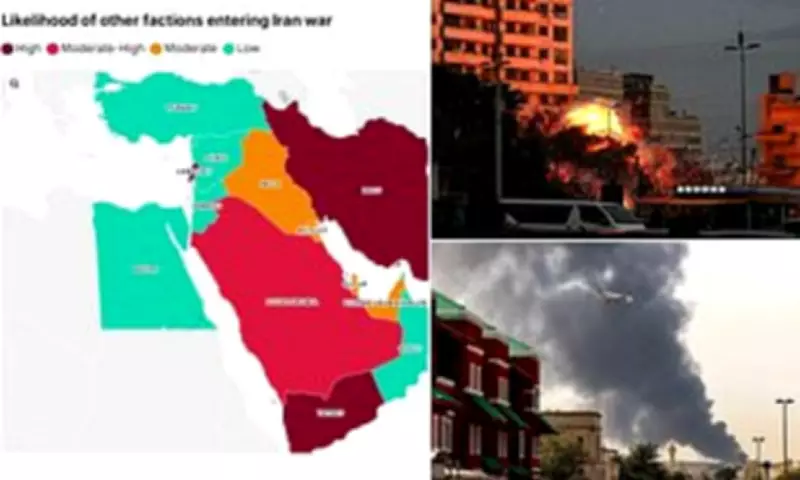
Amid this dangerous escalation, former US President Donald Trump has called for a new American front against Iran as US military forces engage Iranian ships in pitched battles to reopen the strategically vital Strait of Hormuz. The Daily Mail has conducted a comprehensive analysis ranking regional players by their likelihood of taking up arms, using a scale from 1 to 10 based on current military postures and political statements.

Already Engaged: Maximum Probability Actors
Hezbollah (Lebanon) - Probability: 10
Hezbollah represents the highest probability actor, already fully engaged in the conflict with sustained involvement confirmed. Within two days of initial strikes on February 28, the group resumed rocket and drone attacks against Israel while formally declaring its intention to eliminate US presence in the region. Since that declaration, Hezbollah has launched hundreds of coordinated attacks with Iran's Islamic Revolutionary Guard Corps, often timing assaults to coincide with Iranian ballistic missile salvos to overwhelm Israeli air defenses.
Iran-aligned Iraqi Militias - Probability: 10
The Islamic Resistance in Iraq coalition, comprising various Iran-aligned groups, maintains maximum probability of continued involvement. These militias have launched hundreds of missile and drone attacks targeting US facilities and strategic infrastructure, including the US Embassy in Baghdad, Baghdad International Airport, airports in Iraqi Kurdistan, and critical oil and gas installations. Washington's efforts to pressure Baghdad into disarming these groups have largely failed due to their strong support among segments of Iraq's Shia population.
High Probability Contingents
Houthis (Yemen) - Probability: 8
The Houthi movement demonstrates strong willingness to escalate despite not yet committing fully to military action. Leader Abdul Malik al-Houthi declared readiness to respond at any moment, stating "Our fingers are on the trigger" while large demonstrations in Sanaa show public support for Iran. Analysts suggest the current restraint represents strategic patience rather than humanitarian concern, with Michael Hanna of the International Crisis Group noting Iran may be holding Houthi attacks in reserve as potential future escalation.
Kurdish Forces (Western Iran) - Probability: 8
Kurdish groups in western Iran show significant mobilization and eagerness to join the conflict, though their involvement appears contingent on US support. Babasheikh Hosseini, general secretary of the Khabat Organisation, emphasized the current moment presents a rare opportunity to advance Kurdish ambitions for autonomy or independence. However, mixed signals from Washington have created uncertainty, with Kurdish leadership stating they want to understand America's policy position before committing to full-scale operations.
Gulf States: Varied Responses to Direct Threats
Saudi Arabia - Probability: 7

Saudi Arabia has adopted an increasingly assertive stance as Iranian strikes continue across the region. Foreign Minister Prince Faisal bin Farhan explicitly warned that Saudi patience is "not unlimited" while reserving the right to take military actions if deemed necessary. The kingdom has already intercepted hundreds of Iranian missiles and drones, with officials noting the precision of targeting indicates premeditated, organized attacks.
Bahrain - Probability: 6
As host to the US Navy's Fifth Fleet, Bahrain has moved quickly away from neutrality, citing its legal right to respond to Iranian attacks. The Kingdom's Council of Representatives stressed the right to take "all necessary measures" against what it described as heinous attacks. Bahrain has taken a leading diplomatic role while facing direct attacks on its oil infrastructure, including a refinery strike near Manama that caused injuries.
Qatar - Probability: 6
Qatar's position has hardened significantly following direct strikes on its energy infrastructure, particularly the Ras Laffan facility. The government described Iranian attacks as "brazen" and a "direct threat to national security" while warning that Iran's actions are pushing the region toward the abyss. Despite ordering Iranian diplomats to leave within 24 hours, Doha continues to call for de-escalation through diplomatic channels.
Defensive Postures with Response Capabilities
United Arab Emirates - Probability: 5
The UAE has shifted to a defensive position after suffering significant Iranian strikes on Dubai International Airport and the Habshan gas facility. Abu Dhabi has declared itself in a "state of defense" while reaffirming its full right to take necessary measures against Iranian aggression. Since conflict escalation began, UAE air defenses have intercepted 327 ballistic missiles, 15 cruise missiles, and 1,699 drones.
Kuwait - Probability: 5
Kuwait faces direct targeting by Iranian missile and drone strikes, including repeated attacks on the Mina Al-Ahmadi refinery. The Emir emphasized Kuwait's "full and inherent right to self-defense" while stating the country has been subjected to brutal attacks despite not permitting use of its territory for military action against Iran. Repeated attacks on Kuwaiti territory increase the likelihood of eventual military response.
Iraq (Government) - Probability: 5
The Iraqi government attempts to maintain diplomatic neutrality despite Iran-aligned militias operating from within its borders. Prime Minister Mohammed Shia' al-Sudani condemned attacks targeting Iraqi territory as violations of sovereignty while reiterating commitment to security and stability. Baghdad's ability to remain fully neutral remains limited by the presence and actions of pro-Iran militias within its territory.
Low Probability Actors Prioritizing Diplomacy
Jordan - Probability: 2
Jordan remains focused on defending its territory while actively pushing for de-escalation, having intercepted more than 100 missiles and drones during the conflict's first week. In coordination with Egypt, Jordan has refused to allow its territory to be used for offensive operations while prioritizing sovereignty and regional stability through non-alignment.
Turkey - Probability: 2
Turkey emphasizes preparedness without direct military involvement, with President Recep Tayyip Erdogan stating the country will not be "dragged into" the war. Turkish officials have asserted their right to retaliate following ballistic missile interceptions while NATO deploys additional Patriot systems in southern Turkey as defensive measures.
Oman - Probability: 2
Oman maintains neutrality while advocating strongly for diplomacy, with Foreign Minister Badr bin Hamad al-Busaidi describing the conflict as a catastrophe and grave miscalculation. Oman has been among the most vocal countries pushing for de-escalation while acknowledging Iran's attacks on Gulf states as inevitable reactions to US-Israeli assaults.
Egypt - Probability: 2
Egypt consistently pushes for diplomacy and regional stability, refusing to allow its territory to be used for military operations in coordination with Jordan. President Abdel Fattah El Sisi reaffirmed Egypt's full support for Gulf states facing attacks while engaging in active diplomatic efforts to persuade all parties to de-escalate.
Syria - Probability: 2
Syria stresses good relations with regional countries while carefully avoiding conflict involvement. President Ahmad Al Shara described current events as major historical occurrences while emphasizing Syria's careful calculation to maintain development and reconstruction paths away from regional conflicts.