

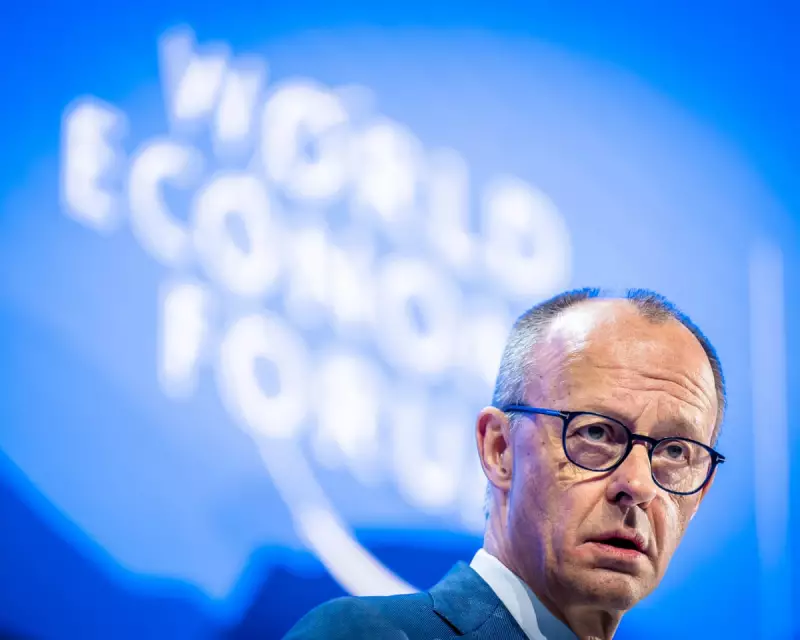
German Chancellor Delivers Stark Warning on Global Power Shift at Davos
German Chancellor Friedrich Merz has delivered a sobering assessment of international relations, declaring that the world is entering a period of "great power politics" where strength and force increasingly dictate global dynamics. Addressing political and business leaders at the World Economic Forum in Davos on Thursday, Merz cautioned that the established international order is being dismantled at what he described as a "breathtaking pace."
A World That Is 'Not a Cosy Place'
In his keynote speech, Merz pointed to several seismic developments reshaping geopolitics. He cited Russia's ongoing war in Ukraine, China's ascension into the ranks of global superpowers, and the significant transformation of United States foreign and security policy under former President Donald Trump as key drivers of this new reality. "This new world of great powers is being built on power, on strength and when it comes to it, on force," Merz stated. "It is not a cosy place." He urged the assembled global elite not to passively accept this emerging landscape but to actively work to shape the future.
Echoing Calls for Strength and Unity
The German leader's remarks aligned with sentiments expressed earlier in the week by Mark Carney, the former Governor of the Bank of England. Merz quoted Carney's assertion that nations must "no longer rely only on the power of our values. We must also recognise the value of our power." Merz affirmed his agreement, telling the Davos audience, "I share that view. And when I look into this hall, I want to say: we share it. That is a good starting point." He emphasised that the greatest strength for democratic nations lies in their ability to forge partnerships and alliances based on mutual trust and respect.

Historical Lessons and Contemporary Dangers
Merz issued a grave warning about the perils of a world governed solely by raw power, noting that such an environment is dangerous first for smaller states, then for middle powers, and ultimately for the great powers themselves. He drew a poignant lesson from Germany's own 20th-century history. "I do not say this lightly," Merz said. "In the 20th century, my country, Germany, went down this road to its bitter end. It pulled the world into a black abyss."
Europe's Path Forward: Defence, Competitiveness, and Unity
In response to these challenges, Chancellor Merz outlined a clear agenda for Europe. He argued that the continent must enhance its unity and economic competitiveness to effectively navigate and counterbalance this new era of great power rivalry. This strategy necessitates substantial investment in defence capabilities, policies to bolster economic performance, and unwavering solidarity among European nations and their like-minded international partners.
The reshaping of the global order has been a dominant theme throughout this week's annual forum, with discussions intensifying amid former President Trump's expressed interest in acquiring Greenland, which has tested NATO alliances. Merz welcomed Trump's subsequent announcement of a tentative agreement framework with NATO regarding Greenland but issued a firm warning. He stated that any attempt to seize European territory by force would be "unacceptable." Addressing Trump's previously threatened tariffs over the Greenland dispute, Merz cautioned that "new tariffs would undermine the foundations of transatlantic relations," pledging that Europe's response would be unified, calm, measured, and firm.
Financial Tensions and Transatlantic Relations
The forum concluded amid further tensions as Donald Trump, who departed Davos on Thursday afternoon, warned in an interview with Fox Business Network that he would enact a "big retaliation" against European countries if they sold off their holdings of US Treasury bonds. This threat followed analysis from Deutsche Bank suggesting such a sell-off was possible. However, US Treasury Secretary Scott Bessent sought to downplay these concerns, insisting he was not worried about European debt dumps and dismissively remarking that "Denmark's investment in US Treasury bonds, like Denmark itself, is irrelevant."

Chancellor Merz's address at Davos serves as a powerful reminder that the post-Cold War era of relative stability is giving way to a more contested and unpredictable international system, demanding renewed vigilance and cooperation from democratic nations.





