Kim Jong-un Issues 'Destroy' Warning to South Korea in Ominous Broadcast
The Supreme Leader of North Korea, Kim Jong-un, has delivered a chilling threat against South Korea, asserting that his nuclear-armed nation could "completely destroy" its southern neighbour if provoked. This stark declaration was broadcast by state media on Thursday, following a rare congress of the Workers' Party Central Committee held earlier in the week.
Five-Year Policy Goals Set Amid Escalating Rhetoric
During the pivotal party congress in Pyongyang, which concluded on Monday, Kim Jong-un outlined his policy objectives for the next five years. The authoritarian leader reiterated his refusal to engage with counterparts in Seoul, though he notably left open the possibility of dialogue with the United States. This congress, the most significant political event in North Korea, previously convened in 2016 and 2021.
In recent years, Kim has sharpened his rhetoric toward South Korea and explicitly rejected inter-Korean diplomacy. Experts suggest this aggressive posture is less about imminent military action and more about asserting a more forceful regional role, backed by his expanding nuclear arsenal and strengthened ties with Moscow and Beijing.

Military Expansion and New Weapons Systems
The official Korean Central News Agency (KCNA) reported that Kim called for the development of new weapons systems to bolster North Korea's military capabilities. Key priorities include:
- Intercontinental ballistic missiles (ICBMs) capable of being launched from underwater platforms.
- An expanded arsenal of tactical nuclear weapons, such as artillery and short-range missiles, specifically targeting South Korea.
- Advanced reconnaissance satellites and artificial intelligence-equipped attack drones.
- Enhanced electronic warfare capabilities to disable enemy command centres.
Kim emphasised naval advancements, indicating plans to fit ICBMs on a nuclear-propelled submarine currently under construction. He also announced phased annual deployments of more nuclear-capable artillery systems along the inter-Korean border, aiming to "fortify" the frontier.
South Korea's Response and Regional Tensions
South Korea's Unification Ministry expressed regret over North Korea's continued definition of inter-Korean relations as hostile. A spokesperson stated that Seoul would "patiently" pursue efforts to stabilise peace on the peninsula. Tensions are expected to rise further next month with the annual South Korea-U.S. military exercises, which North Korea consistently portrays as invasion rehearsals and uses as a pretext for its own military demonstrations.
At the congress, Kim derided liberal South Korean President Lee Jae Myung's calls for engagement as deceptive, accusing successive Seoul governments of seeking the North's collapse. He declared there is "absolutely nothing to discuss" with an enemy state and that the North would "permanently exclude" the South from the notion of a shared nation.
Strategic Shifts and International Relations
Kim's comments reflect a significant strategic shift since 2024, when he discarded the long-standing goal of peaceful reunification and declared South Korea a permanent enemy. Analysts note that his vilification of Seoul stems from a view that South Korea is no longer a useful intermediary with Washington but an obstacle to his efforts to establish a more assertive regional footing.
Regarding the United States, Kim stated that the prospects for U.S.-North Korea relations "depend entirely on the U.S. attitude." He asserted, "Whether it's peaceful coexistence or permanent confrontation, we are ready for either, and the choice is not ours to make." Diplomacy between Washington and Pyongyang has been stalled since the collapse of Kim's second summit with former U.S. President Donald Trump in 2019.

Domestic Campaigns and Family Presence
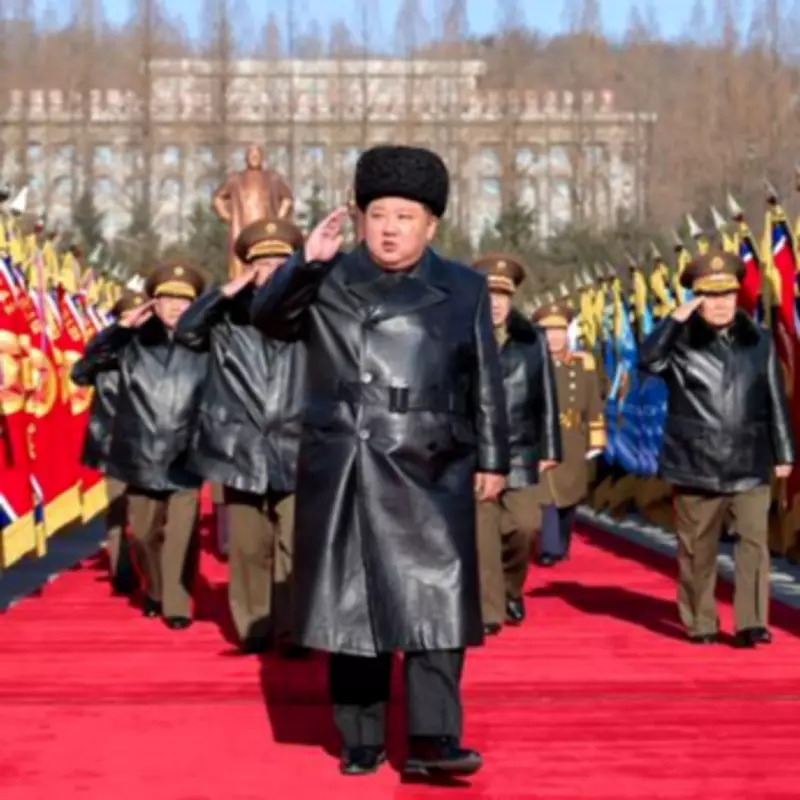
Kim has also intensified domestic campaigns to block the influence of South Korean culture and language among the North Korean population, aiming to tighten his family's authoritarian grip. The congress concluded with a military parade in Pyongyang, where Kim was accompanied by his increasingly prominent daughter, Kim Ju-ae, believed to be around 13 years old. In a speech, he claimed his forces were capable of "immediately and thoroughly retaliating" against any hostile threat, though state media did not confirm whether the parade showcased his largest weapons, including ICBMs potentially capable of reaching the U.S. mainland.
Over the past five years, North Korea has developed or tested much of the weaponry from Kim's 2021 wish list, including solid-fuel ICBMs, tactical nuclear systems, and purported hypersonic weapons. The regime launched its first military satellite in 2023 and has recently claimed progress in building a nuclear-propelled submarine, underscoring its commitment to advancing its nuclear forces in the coming years.