The Unseen Power Behind Libya's Dual Governments
When NATO forces helped overthrow Muammar Gaddafi in 2011, there were widespread hopes for a democratic new beginning in Libya. A decade later, the country stands as a stark lesson in the unintended consequences of foreign intervention. Today, former CIA asset Khalifa Haftar effectively runs Libya through a complex system of shadow control, answering to no formal authority while holding Europe's migration and energy security in his hands.
Europe's Migration Dilemma and Haftar's Conditions
In July 2025, four of Europe's most senior officials arrived in eastern Libya for urgent discussions about surging migrant arrivals. Italy's interior minister had watched numbers climb dramatically over six months, while Greece's migration chief was reeling from 2,000 people reaching Crete in a single week. Malta's home minister feared his island would be next, and the EU's migration commissioner was scrambling to salvage a failing agreement worth hundreds of millions.
Libya's 1,100-mile coastline, the Mediterranean's longest, has become the primary departure point for migrants heading north. Since Gaddafi's fall, successive civil wars have torn the nation apart, with Russia, Turkey, Egypt, and the UAE arming rival factions. From military bases in southern Libya, Russia and the UAE now funnel weapons and fighters into Sudan's civil war, driving hundreds of thousands more refugees toward Libya's coast.

The European delegation sought a private audience with Haftar in Benghazi, but encountered his signature condition: they must first meet publicly with ministers from the eastern administration that he claims to serve. Since Europe doesn't officially recognize that government, meeting its ministers would grant legitimacy; refusing meant no access to Haftar. When the Europeans declined, they were denied entry, never making it past the airport lounge. This humiliation exposed Libya's central fiction: to reach the country's most powerful man, you must pretend he isn't.
The Architecture of Shadow Control
Libya is officially split between two governments—the UN-recognized Government of National Unity in Tripoli and the eastern administration in Benghazi appointed by the House of Representatives in 2022. Neither controls the oil fields, military bases, or migration routes that make Libya strategically important to Europe. One man controls all three: 82-year-old Khalifa Haftar, general commander of the Libyan National Army.
Haftar's title doesn't convey his vast power. His forces hold oilfields and export terminals across central Libya. His coastline units police the eastern shore and operate smuggling routes feeding Europe's migration crisis. His bases host foreign militaries involved in Sudan's war. For Europeans confronting migration, energy insecurity, and regional spillover, Haftar controls everything that matters.
"The foreign powers maintain the pantomime as much as Haftar does," said Tarek Megerisi, senior fellow at the European Council on Foreign Relations. "They can claim to support Libya's sovereignty while backing the man who undermines it."
A System Built on Silence and Pretence
For over a decade, as Libya's politicians fought over diplomatic recognition, Haftar accumulated the oil, territory, and foreign backers that constitute real power. He claims to serve the eastern government, but approves its ministers, surrounds its parliament with his soldiers, and permits its laws only when convenient. Meanwhile, the rival Tripoli government survives on oil revenues flowing through territory he can close at will.
This system is propped up externally by foreign powers and internally by enforced silence. Egypt, Russia, and the UAE officially recognize Tripoli's government while practically supporting Haftar. The UAE bankrolls his operations and provides weapons. Egypt offers intelligence and military base access. Russia supplies mercenaries guarding his oilfields and fighting his wars. In May 2025, Vladimir Putin received Haftar at the Kremlin, offering diplomatic protection at the UN Security Council.

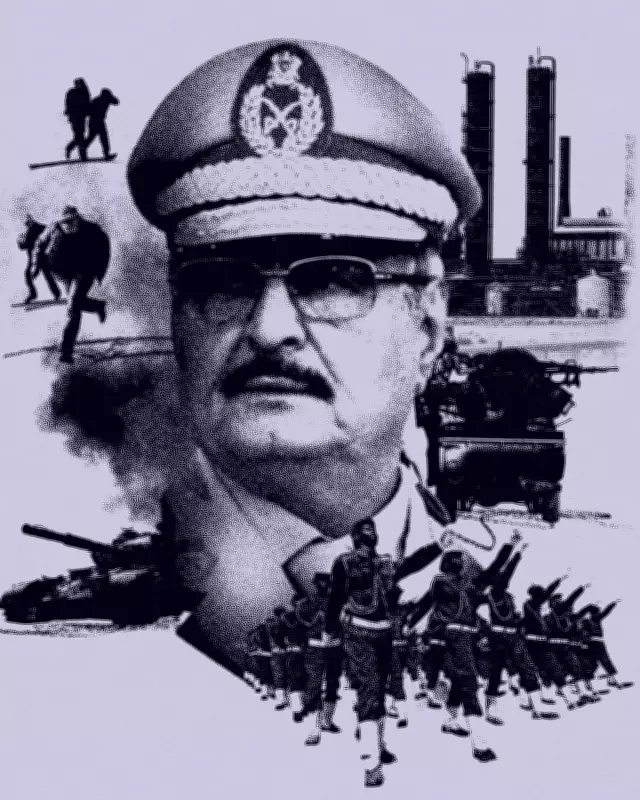
In eastern Libya, Haftar's face watches from billboards across Benghazi and hangs in government offices. In May 2025, the eastern government named a new city after him. His sons command military units, oversee reconstruction contracts, and conduct foreign meetings like heirs apparent. Yet stating what everyone knows is dangerous.
"People believe Haftar's reach has no limit," says Hanan Salah, associate director for North Africa and the Middle East at Human Rights Watch. "His forces take someone from their home, whether a citizen or a parliamentarian, and they vanish. He controls the courts. He controls the investigations. He operates with total impunity because the international community has chosen appeasement over accountability."
From CIA Asset to Shadow Ruler
Haftar's political education began with betrayal. On September 1, 1969, the 25-year-old stood shoulder-to-shoulder with Gaddafi as junior officers overthrew King Idris. Rising through Gaddafi's revolutionary state, he became a trusted military commander until his 1987 defeat in Chad, where Gaddafi mockingly denied knowing him.
Captured with over 1,000 soldiers, Haftar transformed the prison camp into his first power base, controlling food distribution and communications while cultivating CIA contacts. The Americans saw a trained commander with embittered soldiers and a grievance they could use. By June 1988, Haftar announced the Libyan National Army—a name he would revive decades later—turning a discarded prisoner into a commander again.
After extraction to the US, Haftar lived in Virginia near CIA headquarters, but proved an unreliable asset. By the mid-1990s, US intelligence considered him a cold-war relic with no war left to fight, yet his ties to Gaddafi endured. In 2005, Gaddafi visited Haftar's family in Cairo, calling him "like a brother."
When revolution erupted in February 2011, Haftar returned to Benghazi on March 15, arriving late to a movement that didn't need him. The revolutionaries distrusted career military officers with foreign ties and old-regime baggage—everything Haftar represented. Initially sidelined, he watched as NATO bombed Gaddafi's forces, rebels took Tripoli, and Libya held its first elections since 1969.
Building Power Through Division
As revolutionary brigades turned into militias dividing Tripoli, and assassinations plagued the east, Haftar saw his opportunity. In February 2014, he attempted a coup but fled to Benghazi with an arrest warrant. There, he organized former regime officers and armed groups feeling abandoned and humiliated.
On May 16, 2014, Haftar launched Operation Dignity, declaring a "war on terror" against Islamists and reviving the Libyan National Army. Backed by Egyptian and Emirati airstrikes, his forces attacked jihadist factions and revolutionary brigades, plunging Libya into civil war. Everyone opposing Haftar was branded an Islamist.
By year's end, Libya had two governments, two parliaments, and no reconciliation mechanism. In early 2015, Aguila Saleh, chief of the eastern parliament, appointed Haftar head of the army. On paper, Haftar answered to Saleh; in reality, the parliament sat in territory his forces controlled—dissenting politicians disappeared or fled.
The Foundations of Economic Control
From an ageing Soviet-era airbase in Rajma outside Benghazi, Haftar runs his system. The foundation is oil: in September 2016, his forces seized the "oil crescent," a 250-mile coastal strip containing Libya's four major export terminals. Two-thirds of Libya's crude flows through these ports. Under international pressure, Haftar handed operational control back to Tripoli's National Oil Corporation but kept military control, giving him extraordinary leverage.
From 2016 to 2019, while two governments claimed legitimacy, Haftar was courted at summits in Paris and Abu Dhabi. Despite meetings with UN-backed Prime Minister Fayez al-Sarraj, he dismissed all compromises. "We offered him legitimate power," former US special envoy Jonathan Winer recalled. "Control of a military council under civilian oversight, or leadership through elections if the Libyan people chose him. He just shook his head. He would not be subservient to anyone, elected or not."
The Price of Dissent and Failed Assaults
Inside Haftar's territory, dissent is classified as terrorism. A protest, conversation, or Facebook post can carry a death sentence. In October 2016, so many bodies were found on Al-Zayt Street's outskirts that locals renamed it "corpse street."
By 2019, Haftar had accumulated $25 billion in debt, funding his army through unofficial bonds, commercial bank loans, and Russian-printed dinars. On April 4, 2019, he launched a full assault to capture Tripoli, with the Trump administration effectively authorizing the move. Days after the assault began, Donald Trump called to praise Haftar's "counterterrorism" efforts.
Russian mercenaries joined the ground forces, transforming what was conceived as a lightning coup into a protracted siege. That July, Benghazi MP Seham Sergiwa appeared on pro-Haftar television urging dialogue; her broadcast was cut mid-sentence. That night, gunmen dragged her from her home, spray-painting "the army is a red line" on the building. She hasn't been seen since.
Haftar's assault ultimately failed. In late 2019, Turkey intervened on behalf of the UN-backed government, forcing Haftar to negotiate. At a Berlin conference convened to end the war, as world leaders waited to announce an agreement, Haftar was nowhere to be found—he had gone to take a nap. "It wasn't fatigue," former UN envoy Stephanie Williams recalled. "It was theatre, designed to show that he operated outside the rules." No agreement was reached.
Financial Manipulation and Counterfeit Currency
In late 2024, officials at Tripoli's central bank discovered nearly 10 billion new dinars in circulation bearing serial numbers that didn't exist in their system. Counterfeit notes had flooded the economy from the east, financing Haftar's forces and paying debts to Russian mercenaries. The notes circulated as real currency in eastern Libya and were traded for US dollars on hidden markets—giving Moscow access to hard currency cut off by Western sanctions since Ukraine's invasion.
The central bank faced a choice: expose the fraud and trigger another financial crisis, or absorb the loss in silence. "We knew exactly where the notes came from," said a central bank insider. "But saying so would mean confrontation, and confrontation means the oil stops, and the dinar loses more value. So we absorbed them and said nothing. That is how institutions survive in Libya. You accept what you cannot confront."
In October 2025, the counterfeit notes were withdrawn quietly, written into the bank's books, and Haftar's wealth grew. "It's easier to deal with a lie you can manage," a former Western official noted, "than a truth you can't fix."
The Succession Dilemma
Now 82, Haftar faces the ultimate quandary of his creation: how to transfer power in a system depending on institutions that function only because no one admits who controls them. Observers agree Haftar would like to secure his legacy through his children.
"His eyes would light up when he introduced you to his sons," Williams recalled. According to those who knew the family, Saddam was always his favorite. Haftar's sons have divided the system: Saddam as deputy commander-in-chief and heir apparent; Khaled as chief of staff; Belkacem directing reconstruction contracts; Al-Siddiq managing tribal politics; Okba overseeing cryptocurrency and AI sectors. Each holds a title; none holds elected office.
Recent reporting suggests US diplomats are involved in discussions about a deal to unify Libya's governments with Saddam as president. But Haftar built his system for one man, not five. His sons must divide what their father never shared in a fractured Libya where a rival government commands its own militias and foreign backers.
Gaddafi groomed his sons for decades, giving them an ideology to recite; Haftar's sons have no creed to share, only the pragmatism of survival. Gaddafi claimed to preside over popular rule; Haftar's system claims nothing except silent assent. As Libya continues as a parable of intervention's unintended consequences, the space between what everyone knows and what no one can say remains where Haftar rules—power without a throne, answerable to no one.