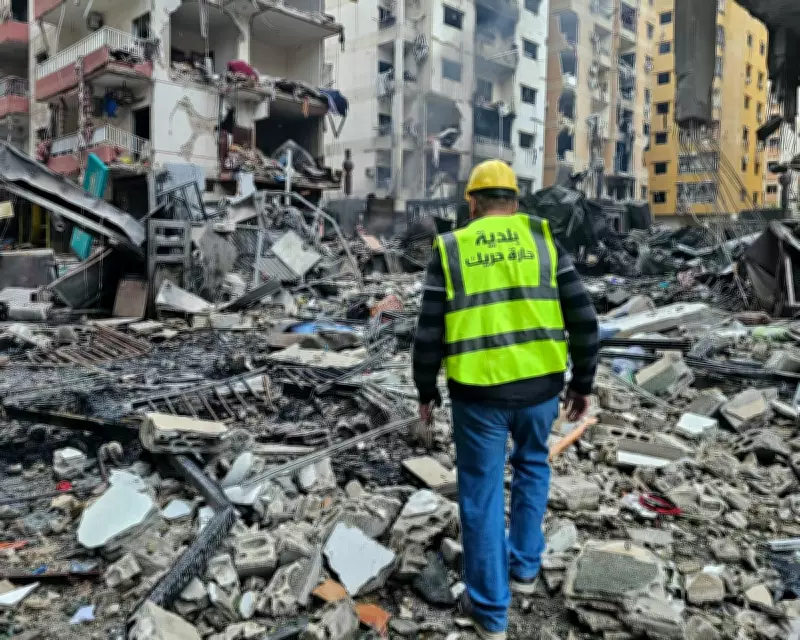
Israel's Lebanon Ground Campaign Expansion Sparks Fears of Prolonged Occupation
Israel's announcement on Monday of an expanded ground campaign into new areas of southern Lebanon has intensified fears among hundreds of thousands of displaced Lebanese civilians about a potential prolonged occupation. The concerns emerged following statements from Israeli Defense Minister Israel Katz, who drew direct comparisons with Israel's military operations in Gaza.
"Hundreds of thousands of Shi'ite residents of southern Lebanon who have evacuated or are evacuating their homes in southern Lebanon and Beirut will not return to areas south of the Litani line until the safety of northern residents is ensured," Katz declared in an official statement. He added that Prime Minister Benjamin Netanyahu had jointly instructed the Israel Defense Forces to destroy what they describe as "terror infrastructure" in border villages, mirroring operations against Hamas in Gaza.
Violation of Ceasefire Agreements
The current escalation follows the breakdown of the November 2024 ceasefire agreement, which stipulated that Hezbollah would withdraw from southern Lebanon while Lebanese military forces would assume control, in exchange for Israel ceasing its bombardment. Israel maintains that Lebanon never fulfilled its obligations under this agreement, leading to continued near-daily airstrikes against alleged Hezbollah positions.

The conflict reignited dramatically on March 2 when Hezbollah launched rocket attacks against Israel, prompting an immediate and extensive Israeli military response across Lebanon. This new phase has already surpassed the scope of the previous 13-month Israel-Hezbollah war of 2023-24, resulting in approximately one million displaced persons and reports of between 826 to over 850 fatalities since the escalation began.
Human Rights Concerns and Historical Parallels
Ramzi Kaiss, a Lebanon researcher for Human Rights Watch, warned that Katz's statements significantly increase the risk of forced displacement, which constitutes a war crime under international law. "Preventing civilians from returning to their homes in an area that is nearly 10% of Lebanon's territory, until some vague 'safety' standard is secured, would be unlawful and further raises the risk of forced displacement," Kaiss emphasized.
For many displaced residents, particularly those from villages south of the Litani River, the Israeli defense minister's remarks evoke traumatic memories of Israel's previous occupation from 1982 to 2000. Abbas Awadeh, a displaced municipal member from the border town of Naqoura, expressed widespread apprehension: "God forbid we return to the days of the previous border-strip occupation. We're afraid of that, honestly. It took us years before we were able to return to Naqoura."
Displacement Orders and Humanitarian Crisis
The Israeli military issued sweeping displacement orders beginning March 4, instructing all residents south of the Litani River to move northward temporarily ahead of planned strikes against Hezbollah targets. Subsequent orders expanded to different regions of the country, creating a massive humanitarian crisis with many displaced persons now sleeping on streets and struggling to secure basic necessities like food.
"People really want to return to their towns, because the situation is very difficult. Sometimes a person can't even secure food. Displacement is humiliating," Awadeh described, capturing the desperation felt by many affected families.
Israel's New Security Doctrine
Professor Yagil Levy, head of the Open University Institute for the Study of Civil-Military Relations in Israel, explained that the ground operation represents a fundamental shift in Israel's security strategy following the October 7 attacks. "It is unfolding the renewed occupation of parts of southern Lebanon. Yet Israel is not returning to the years 1982–2000, when it occupied part of Lebanon but was dragged into a guerrilla war whose casualties forced it to withdraw," Levy analyzed.

He continued: "This time, it seizes territory and removes the population, thereby ensuring full freedom of action and reducing the risk of guerrilla operations emerging from villages." This approach mirrors Israel's establishment of security perimeters in Gaza and reflects what Levy describes as international acceptance of Israel's right to absolute security, even when it involves displacing civilian populations.
Selective Displacement and International Response
Despite comprehensive displacement orders, the Israeli military has adopted a selective approach, particularly allowing residents of certain border villages with large Christian populations to remain in their homes. This pattern parallels Israel's 1982 occupation strategy, when Christian and Sunni villages were permitted to stay while others were evacuated.
In the Arqoub area along the eastern Lebanese-Israeli border, seven villages decided to remain after receiving assurances from Israeli military officials. Qassem al-Adiri, mayor of Kfar Shouba, recounted: "They said: 'Don't leave your homes, don't go anywhere, don't get involved and don't allow any strangers to come close to you.'"
Similarly, municipal officials in Rmeish, a Maronite Christian village on the western border, received calls from the Israeli military guaranteeing their safety provided they prevented Hezbollah fighters from entering the area.
International Diplomatic Efforts
The leaders of five Western nations issued a joint statement on Monday evening urging restraint and warning against a large-scale Israeli ground offensive in Lebanon. Canada, France, Germany, Italy, and the United Kingdom collectively declared: "A significant Israeli ground offensive would have devastating humanitarian consequences and could lead to a protracted conflict."
Analysts suggest Israel's expanding military operations in southern Lebanon may be strategically designed to reshape the regional balance of power before any diplomatic settlement, establishing new facts on the ground that would strengthen Israel's negotiating position in future talks.