
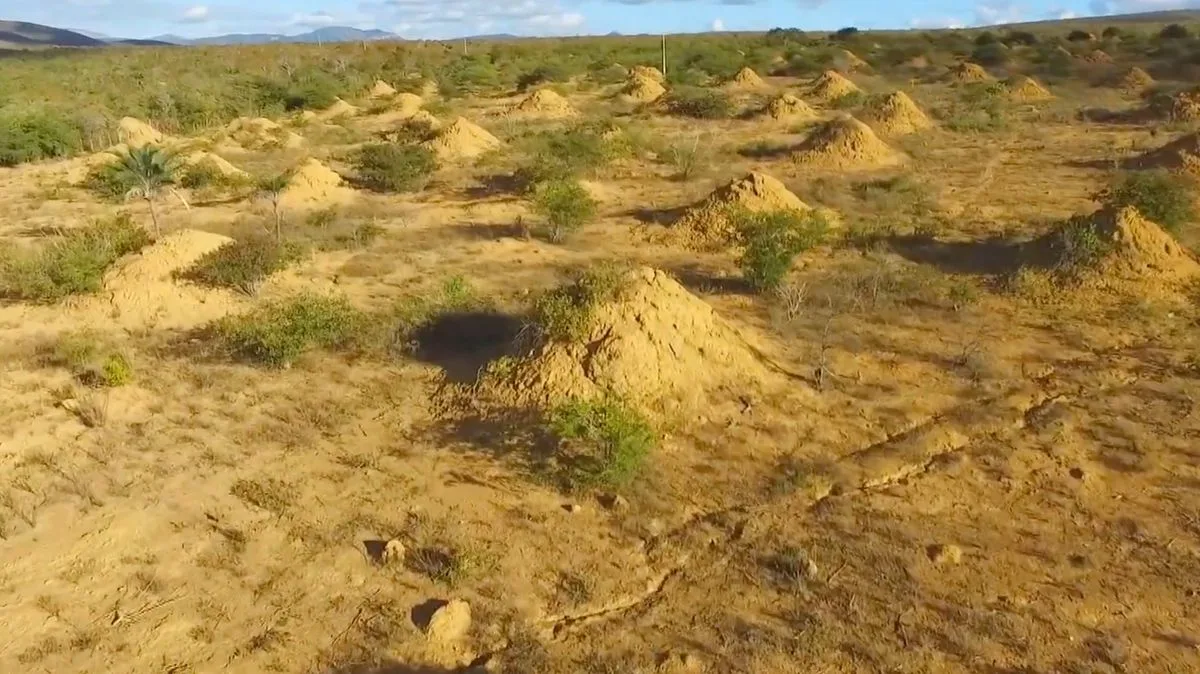
An enormous termite colony in Brazil, built by the species Syntermes dirus, spans an area equivalent to Great Britain and is visible from space. The complex consists of approximately 200 million mounds, each up to 7 feet tall and 30 feet across, with some taking thousands of years to complete.
Researchers estimate that the termites have shifted around 10 cubic kilometres of earth, enough to build 4,000 piles the size of the Great Pyramid of Cheops. The mounds are essentially waste heaps from an extensive network of interconnected subterranean 'cities' stretching for miles.
Despite local knowledge for centuries, the true scale was only revealed through satellite imagery. Stephen Martin from the University of Salford told New Scientist in 2018: 'I looked on Google Earth and realised they're everywhere in this area, but I could find nothing about them online.'
The termites, measuring just over half an inch, feed on leaves from a single tree species that drop only once a year. Martin described the frantic collection process: 'It's like if all the supermarkets were open for one day a year - the person with the fastest car would get the most food.'
Each mound does not represent a distinct colony, as termites from neighbouring mounds are not hostile to each other. However, termites moved several miles away will fight. The structure of the colonies remains a mystery, as no royal chamber has been found, and how the termites survive on a brief annual food supply is unknown.




