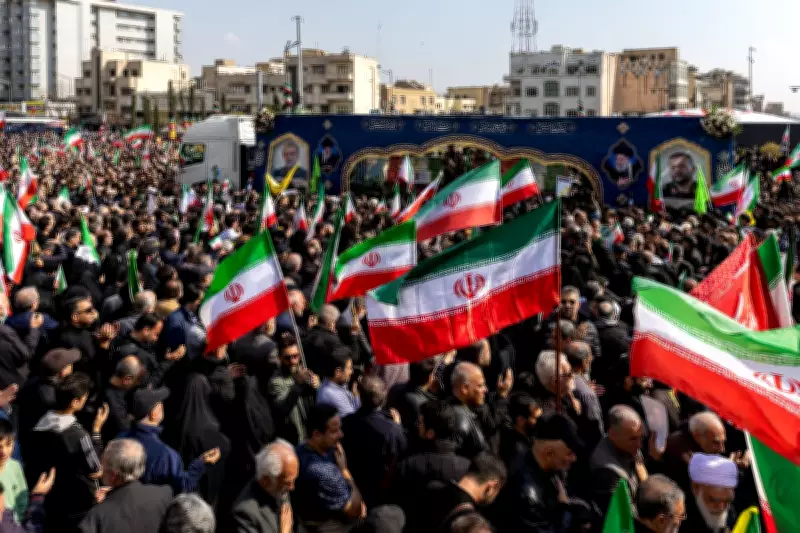
Iran's Basij Force Maintains Strength Despite Israeli Airstrike Campaign
The feared Basij paramilitary force of Iran remains operationally strong and maintains its firm domestic control despite an intensified Israeli campaign of airstrikes targeting its leadership and infrastructure. This resilience comes amid a joint United States and Israeli effort to dismantle the Islamic Republic's tools of internal security.
Targeted Strikes on Command and Control
Israeli drone strikes have specifically targeted Basij roadblocks and checkpoints across Tehran in recent weeks, with one notable strike occurring just hours after the killing of a senior Basij commander. These attacks represent a tactical shift, extending the threat from top echelons to lower-ranking members of the force that was instrumental in quelling widespread protests earlier this year.
Despite these sustained bombardments, which have focused up to one-third of their firepower on the Revolutionary Guard and its Basij volunteers, there has been no significant disruption to the force's operations. The Basij, alongside police and Revolutionary Guard units, continues to maintain an intimidating presence throughout the capital, according to residents and war monitors.

Decentralized Structure Provides Resilience
Expert analysis suggests the Basij's strength lies in its highly decentralized structure within Iran's already fragmented security apparatus. "The Basijis are highly ideological and the most decentralised force within an already highly decentralised system," said Hamidreza Azizi, an expert on Iran's security and foreign policy.
This decentralization means that even the killing of top commanders like General Gholam Reza Soleimani is unlikely to disrupt operations significantly. Basij leadership is selected primarily for ideological rigidity and loyalty to the supreme leader rather than operational expertise, playing a more symbolic role while local units operate with considerable autonomy.
Checkpoint Campaign and Civilian Response
Israeli Prime Minister Benjamin Netanyahu has explicitly stated the campaign aims to land "crushing blows on the Revolutionary Guards and the Basij, both in the streets and at checkpoints" to create conditions for Iranians to overthrow their government. Since March 11th, at least fifteen checkpoint strikes have been documented in a single day by monitoring groups.
Basij checkpoints have proliferated across Tehran, with residents reporting five or six new checkpoints in some upscale neighborhoods alone. These checkpoints, often consisting of simple traffic cones and a few vehicles, conduct vehicle searches, document examinations, and sometimes phone inspections.
Interestingly, some Iranians have been sharing checkpoint locations on social media, tagging Israeli military accounts and urging strikes, particularly in areas where protesters were previously killed. Others share information to alert commuters about traffic disruptions, while several videos show checkpoints being set up under bridges apparently for protection from airstrikes.
Ideological Foundation and Domestic Role
The Basij, which translates to "mobilisation" in Farsi, operates as a volunteer force under Revolutionary Guard command with tens of thousands of members. Most volunteers are unarmed and engaged in ideological and political activities, functioning similarly to the Communist Party in the Soviet Union with branches in schools, universities, government institutions, and other organizations.
These volunteers work to ensure loyalty to the Islamic Republic through religious lectures, enforcement of social restrictions, and mobilization for state-organized events including counterprotests. During times of domestic unrest, district-level paramilitary units deploy armed with everything from batons and electroshock devices to live ammunition.
Ongoing Crackdown and Internet Restrictions
Despite the external pressure from airstrikes, Iran's domestic crackdown continues unabated. Authorities recently executed three men detained during January's protests and have arrested over one hundred people across Iran in the past week, most accused of conspiring with enemy states or sharing media with foreign entities.

The government maintains an unprecedented internet blackout that began on January 8th, with Starlink dishes becoming one of the only ways to access the global internet. Authorities have reportedly shut down parts of Iran's internal internet, revoked VPN cards, and detained people for taking pictures identifying military locations.
Security forces have also reportedly opened fire at checkpoints, with one incident resulting in the deaths of two teenage brothers who honked their car horn in celebration of reports about the supreme leader. The Basij continues to provide crucial manpower for checkpoints, allowing other security agencies to focus on information gathering and arrests despite what experts describe as likely fatigue among core forces.