Iran Issues Stark Warning to Trump as Hormuz Deadline Approaches
Iran's central military command has delivered a fiery response to Donald Trump's latest ultimatum, warning that the entire Middle East region will become "hell" if the United States escalates the ongoing conflict. The warning comes directly after Trump threatened to destroy Iran's vital infrastructure unless it reopens the strategically crucial Strait of Hormuz within 48 hours.
Trump's Truth Social Ultimatum
On his Truth Social platform, the former president wrote: "Remember when I gave Iran ten days to MAKE A DEAL or OPEN UP THE HORMUZ STRAIT. Time is running out. 48 hours before all Hell will reign (sic) down on them. Glory be to GOD!" This represents Trump's most explicit deadline yet in the conflict that began with joint US-Israeli bombardment of Iran on February 28.
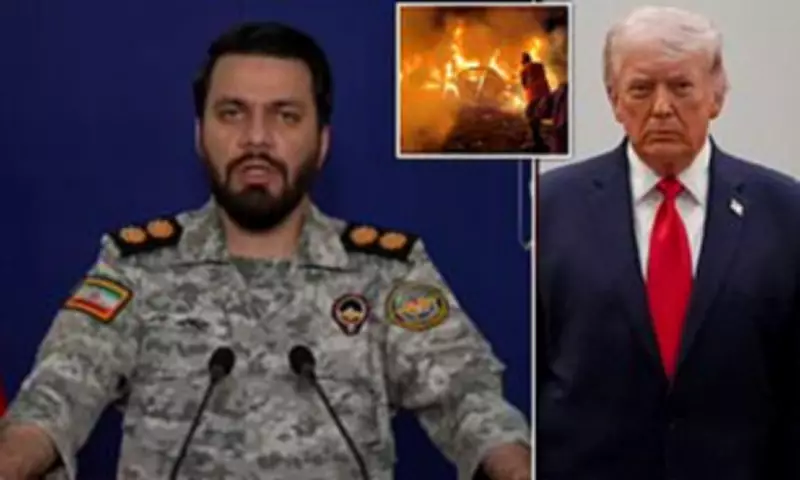
General Ali Abdollahi Aliabadi of Iran's Khatam al-Anbiya Central Headquarters dismissed Trump's threat as a "helpless, nervous, unbalanced and stupid action" while issuing a counter-warning that "the gates of hell will open" for the United States should tensions escalate further. The Iranian statement deliberately echoed Trump's own apocalyptic language, creating a rhetorical standoff between the two nations.

Military and Diplomatic Pressure Mounts
The United States and Israel have significantly increased pressure on Tehran to reopen the vital waterway, threatening strikes on Iranian energy infrastructure if compliance isn't forthcoming. Meanwhile, both Iranian and American forces are engaged in a search operation for a missing American crew member from one of two downed warplanes, adding another layer of complexity to the already volatile situation.
Trump's messaging throughout the conflict has oscillated dramatically between suggesting potential diplomatic progress and threatening to bomb Iran "back to the Stone Ages." In what appears to be a coordinated pressure campaign, a senior Israeli defense official confirmed that Israel is preparing to attack Iranian energy facilities and is simply awaiting authorization from Washington to proceed.
The Strait of Hormuz: Global Economic Chokepoint
The strategic importance of the Strait of Hormuz cannot be overstated. This narrow waterway normally carries approximately one-fifth of the world's oil and liquefied natural gas, making it a critical artery for global energy markets. Since the conflict began, Iran has effectively shut down the strait, implementing a selective blockade that only permits vessels from nations it considers "friendly," including China, Russia, India, Iraq, and Pakistan.
In a notable development, a French container ship recently became the first vessel from a Western nation to be allowed passage through the strait. This occurred after French President Emmanuel Macron publicly criticized Trump's aggressive rhetoric in the Middle East and urged serious efforts to reopen the vital shipping route. French authorities have not officially commented on the vessel's transit, though the ship reportedly signaled its non-hostile status to Iranian authorities during the journey.
Economic Consequences and Domestic Pressure
The closure of the Strait of Hormuz has triggered significant economic repercussions worldwide. According to AAA, average gasoline prices in the United States have surged to $4.10 per gallon, representing a 37 percent increase since before the conflict began when prices hovered just below $3 per gallon. This price spike has contributed to growing domestic discontent with the ongoing military campaign.
Recent polling data reveals that a majority of Americans believe the war in Iran has gone too far, with even Republican voters showing increasing skepticism about the Middle Eastern campaign. Many conservative voters had supported Trump's reelection based partly on his repeated promises to avoid starting new foreign conflicts, creating political complications for the administration.

Diplomatic Openings and Military Realities
Despite the bellicose rhetoric, Iranian Foreign Minister Abbas Araqchi has left the door open for potential peace talks mediated by Pakistan, stating on social media platform X: "We are deeply grateful to Pakistan for its efforts and have never refused to go to Islamabad. What we care about are the terms of a conclusive and lasting END to the illegal war that is imposed on us." However, he gave no indication that Tehran would bow to Trump's specific demands regarding the Strait of Hormuz.
The conflict has already exacted a heavy human toll, with Iranian officials reporting more than 1,900 fatalities from Israeli and American airstrikes. According to US Central Command, thirteen American service members have been killed and over three hundred wounded, though no troops have been taken prisoner by Iranian forces.
Trump recently addressed the nation, claiming significant degradation of Iran's military capabilities, stating: "Their navy is gone. Their air force is gone. Their missiles are just about used up or beaten." However, US intelligence sources have contradicted these assertions, telling Reuters that approximately two-thirds of Iran's missile arsenal remains intact. This discrepancy highlights the fog of war surrounding the conflict's actual progress.
As the 48-hour deadline approaches, the situation remains dangerously fluid. Trump initially set a late March deadline before extending it to April 6 at 8pm Eastern Time following an Iranian request for additional time. Should this latest ultimatum lapse without resolution, the former president has explicitly stated his willingness to resume bombing Iran's energy infrastructure, potentially triggering the regional "hell" that Iranian commanders have warned about.