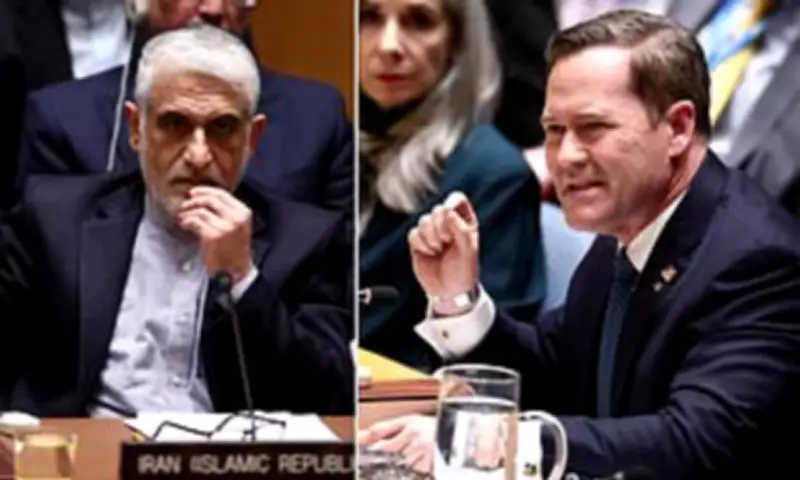
Iran's UN Ambassador Delivers Terse 'Be Polite' Message to US After Airstrikes
In a dramatic emergency United Nations meeting convened on Saturday, Iran's representative delivered a remarkably brief but pointed message to the United States following deadly airstrikes earlier that day. Ambassador Amir Saeid Iravani stated he had 'one word only' for the American delegation, advising them to 'be polite' during the high-stakes session.
A Tense Diplomatic Confrontation Unfolds
The emergency gathering at UN headquarters in New York City was called in response to Operation Epic Fury, a coordinated military action by the United States and Israel that targeted Iran's nuclear and missile infrastructure. Iravani framed the conflict starkly, declaring it a war 'against international law and international legal order under the United Nations Charter.'
'This morning, the United States regime - jointly and in coordination with the Israeli regime - initiated an unprovoked and premeditated aggression against the Islamic Republic of Iran for the second time in recent months,' the Iranian ambassador asserted. He went further, labeling the strikes not merely as aggression but as 'a war crime and a crime against humanity.'

US and Israeli Representatives Mount Forceful Defense
US Ambassador Mike Waltz responded with dismissive defiance to Iravani's remarks. 'Frankly, I'm not going to dignify this with another response,' Waltz stated, before launching into a vigorous justification of the military operation. He characterized the action as a moment requiring 'moral clarity' and detailed its strategic objectives.
According to Waltz, the operation aimed to:
- Reduce missile capabilities threatening regional allies
- Target naval assets operating in international waters
- Disrupt machinery supplying weaponry to militant groups
'No responsible nation can ignore persistent aggression and violence,' Waltz argued, specifically citing Iranian support for organizations like the Houthis, Hezbollah, and Hamas. He emphasized the overarching goal: ensuring 'the Iranian regime can never, ever threaten the world with a nuclear weapon.'
Israel Cites 'Existential Threat' as Justification
Israeli Ambassador Dany Danon supported the American position, describing the pre-dawn strikes as an 'act of necessity' to counter what he termed an existential threat. 'This is not the anger of a radical fringe,' Danon contended. 'It is State-sanctioned hatred.'
The military action, which commenced around 1:15 AM on Saturday, was designed to dismantle what Waltz called Iran's 'security apparatus.' He referenced a series of UN Security Council resolutions—including 1696, 1737, 1747, 1803, 1835, and 1927—that collectively represented, in his view, 'the world's collective judgement' that Iran posed a grave danger through its pursuit of advanced missile capabilities and nuclear ambitions.
UN Leadership and Officials Express Grave Concerns
UN Secretary-General António Guterres issued a stern rebuke to all parties involved, condemning both the initial strikes and Iran's promised retaliatory measures. 'We are witnessing a grave threat to international peace and security,' Guterres warned. 'Let me be clear: There is no viable alternative to the peaceful settlement of international disputes.'
The Secretary-General's concerns were echoed by numerous senior UN officials:
- High Commissioner for Human Rights Volker Türk condemned the attacks
- President of the General Assembly Annalena Baerbock reiterated that the UN Charter mandates peaceful dispute resolution
- World Health Organization Director-General Tedros Ghebreyesus expressed deep worry for civilians caught in the crossfire
Baerbock specifically emphasized that 'all Member States must settle their international disputes by peaceful means in such a manner that international peace and security, and justice, are not endangered.'

Legal Arguments and the Path Forward
The emergency session revealed sharply conflicting legal interpretations. According to UN News reporting, the strikes were assessed as failing to meet criteria for lawful self-defense, potentially constituting a violation of Article Two of the UN Charter. In response, Iran announced it would 'without hesitation' invoke Article 51, asserting its inherent right to self-defense.
This diplomatic confrontation underscores the profound tensions surrounding Iran's nuclear program and regional activities. With accusations of war crimes, assertions of existential threats, and fundamental disagreements about international law, the emergency meeting highlighted the volatile state of Middle Eastern geopolitics and the challenges facing multilateral diplomatic institutions in de-escalating such crises.