Iranian Retaliation Strike Sets UAE Oil Terminal Ablaze Following US Assault on Kharg Island
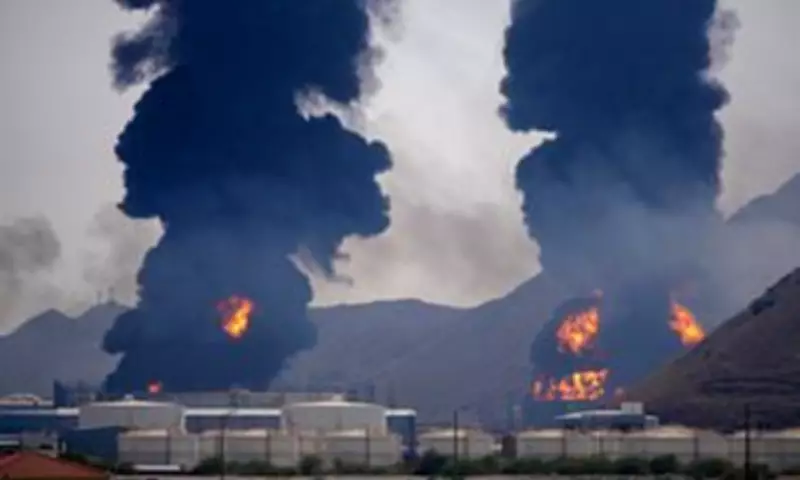
A colossal plume of black smoke billowed from a critical oil storage depot in the United Arab Emirates on Saturday, marking a dramatic escalation in regional hostilities. The inferno was triggered by a coordinated drone assault launched by Iran, a direct act of vengeance for United States military strikes that had earlier targeted Iran's vital Kharg Island oil infrastructure.
Critical Infrastructure Targeted in Fujairah Port
The attack focused on a major oil facility within the port of Fujairah, a crucial hub for global energy exports. The resulting blaze forced an immediate suspension of all operations at the terminal. This depot is a linchpin of global supply, exporting in excess of 1.7 million barrels of crude oil every single day. This volume represents nearly two percent of the entire world's daily oil consumption, underscoring the attack's potential to trigger significant market volatility.
The retaliatory move came swiftly after former US President Donald Trump declared that American forces had 'obliterated' military targets on Kharg Island. Tehran had issued furious threats of reprisal, which were realised with the precision strikes on UAE soil. In a statement, Trump clarified that the initial US bombardment had deliberately avoided Iran's oil infrastructure on the island but warned he would 'reconsider' that stance if Iran continued its blockade of the Strait of Hormuz.
Global Call to Secure the Strait of Hormuz
As the conflict intensifies control over the strategic waterway, Trump publicly urged world leaders to assist in safeguarding maritime traffic. He specifically called upon China, France, Japan, South Korea, and the United Kingdom to deploy naval vessels to escort oil tankers through the perilous Gulf chokepoint. Concurrently, US military operations continue to target Iranian drone, missile, and boat launch sites along the northern coast of the strait.
Trump boasted about the destructive power of the Kharg Island raids in a social media post, describing them as 'one of the most powerful bombing raids in the History of the Middle East'. He coupled this with a stark warning: any interference with shipping in the Strait of Hormuz would prompt an immediate reassessment of US targeting policy.
Economic Stakes and Global Repercussions
The geopolitical standoff carries immense economic consequences. Global oil prices have already skyrocketed by approximately 40 percent since Iran initiated its blockade of the Strait, which normally facilitates about 20 percent of the world's total oil supplies. The targeted Fujairah facility is itself a global giant, having sold 7.33 million metric tons of marine fuels, ranking it as the world's fourth-largest bunkering port after Singapore, Rotterdam, and Zhoushan.
Iranian officials responded to US threats with severe warnings of their own. State media reported that any US strike on Iranian oil facilities would result in the immediate destruction of American-linked energy infrastructure, turning it to 'a pile of ashes'. Parliament Speaker Mohammad Bagher Qalibaf emphasized that attacks on Iran's southern islands would cause the nation to 'abandon all restraint', highlighting Kharg Island's central role in the country's economy and national security.
Strategic Importance of Kharg and Fujairah
Kharg Island is a small but critically important coral formation located 21 miles off the Iranian coast. It hosts extensive oil facilities and storage tanks, serving as a primary export terminal. Oil revenue contributes significantly to Iran's annual state income, estimated at $78 billion, with major shipments destined for countries like China.
Conversely, the port of Fujairah holds strategic value for the UAE due to its connection to the Abu Dhabi Crude Oil Pipeline (ADCOP). This 1.5 million barrel-per-day pipeline allows the UAE, OPEC's third-largest producer, to bypass the Strait of Hormuz partially by transporting crude from Abu Dhabi's fields directly to Fujairah for export, primarily of the Murban grade to Asian markets. A sustained disruption at Fujairah could force significant production shutdowns.
International Diplomacy and Military Toll
The crisis has spurred intense diplomatic activity. UK Energy Secretary Ed Miliband stated Britain is 'intensively looking' at solutions to reopen the Strait of Hormuz and break Iran's stranglehold. He emphasized the need for de-escalation and coalition-building to ensure safe maritime shipping.
However, the international response to escort proposals has been cautious. Iran's foreign minister warned other nations against actions that could widen the conflict. Key US allies like South Korea and Japan indicated reluctance, with Japanese officials noting the 'extremely high' legal bar for deploying naval forces.
Iran's new Supreme Leader, Ayatollah Mojtaba Khamenei, vowed to maintain the closure of Hormuz, a claim dismissed by Trump. The human cost of the conflict continues to mount. Iranian health ministry figures, which remain unverified, report over 1,200 fatalities from US and Israeli attacks. The US Department of Defense confirms at least 13 American military deaths and claims to have struck over 15,000 enemy targets. The UN estimates up to 3.2 million people have been displaced within Iran since hostilities began.
Despite facing superior military technology, Iran has demonstrated its capacity to retaliate, launching missile and drone attacks against at least ten countries. In a development offering a sliver of relief, media reports indicate that operations at the fire-ravaged Fujairah oil facility have now resumed.