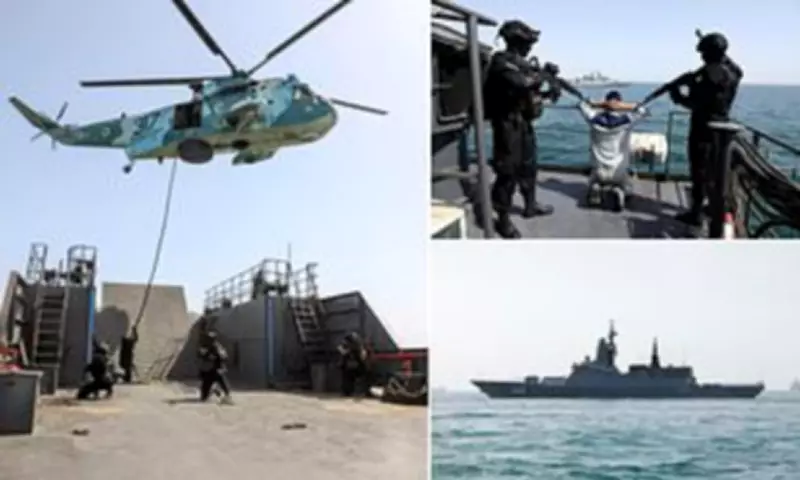
Iran and Russia Stage Joint Naval Exercises Amid Rising US-Iran Tensions
Iran and Russia carried out joint military drills on Thursday, escalating regional tensions just days after Iran's unprecedented temporary closure of the Strait of Hormuz. This move served as a fierce warning to US President Donald Trump, as diplomatic and military posturing between the nations continues to intensify.
Naval Maneuvers and US Carrier Deployment
The announcement of the joint naval exercises in the Gulf of Oman coincided with the arrival of the USS Gerald R. Ford, the world's largest aircraft carrier, near the mouth of the Mediterranean Sea. This vessel joins a significant buildup of other US military assets in the region, underscoring the growing standoff.
These latest drills follow Tuesday's exercises by Iran's Revolutionary Guards in the Strait of Hormuz, the narrow chokepoint through which approximately one-fifth of the world's traded oil passes. During those maneuvers, Tehran temporarily shut down parts of this vital waterway and fired cruise missiles, issuing a stark warning about the potential catastrophic fallout for the global economy should the US follow through with threats to attack Iran.

Diplomatic Talks and Military Warnings
The military exercises ran parallel to diplomatic negotiations in Geneva, where Iranian Foreign Minister Abbas Araghchi held a second round of indirect nuclear talks with US envoys Jared Kushner and Steve Witkoff on Tuesday. Concurrently, US Vice-President JD Vance warned that Iran's theocratic regime was failing to acknowledge President Trump's stated 'red lines,' amid a heavy buildup of American warplanes traveling to the Gulf region.
While the movement of additional American warships and aircraft does not guarantee a US strike on Iran, it provides President Trump with the immediate capability to execute such an operation should he choose to do so. In a related development, Polish Prime Minister Donald Tusk urgently advised all Polish citizens to evacuate Iran on Thursday, cautioning that the window to leave might close 'within a few hours.'
Details of the Joint Drills and Regional Unrest
The joint exercises on Thursday saw Iranian forces and Russian sailors conduct operations in the Gulf of Oman and the Indian Ocean. According to Iran's state-run IRNA news agency, the drills aimed at 'upgrading operational coordination as well as exchange of military experiences.' Rear-Admiral Hassan Maghsoudlou, a spokesman for the exercise, stated that Iran would be conducting 'anti-terrorism and vessel protection operations,' with the goal of enhancing 'security and sustainable maritime interactions in the Gulf of Oman and northern Indian Ocean.'
Meanwhile, Iran continues to grapple with significant domestic unrest following its crackdown on widespread protests. Mourners are now holding ceremonies honoring their dead, a traditional practice observed 40 days after their killing by security forces. Some of these gatherings have included anti-government chants, despite threats from authorities.
US Military Buildup and Strategic Calculations
Tracking data indicated the USS Gerald R. Ford was off the coast of Morocco in the Atlantic Ocean midday Wednesday, positioning the carrier to potentially transit through the Strait of Gibraltar and station in the eastern Mediterranean with its supporting guided-missile destroyers. This £9.5 billion floating fortress transports 90 aircraft – equivalent to more than six RAF squadrons – and is manned by approximately 4,000 sailors and airmen.
Deploying the carrier group could provide American forces with additional aircraft and anti-missile capabilities to potentially protect allies like Israel and Jordan should a conflict erupt with Iran. The combination of the Ford strike group and the already deployed USS Abraham Lincoln aircraft carrier in the Arabian Sea has led analysts to speculate that President Trump may be preparing a sustained military campaign against Tehran.

Broader Military Mobilization and International Concerns
Beyond the carrier groups, the US military buildup continues to expand. More firepower is en route as 150 military cargo flights have begun rapidly transferring weapon systems and ammunition to US bases in the Middle East. Dozens of US fighter jets, including advanced F-35s, F-22s, and F-16s, have departed bases in the US and Europe heading to the region in recent days.
According to the Military Air Tracking Alliance (MATA), a team of open-source analysts, they have tracked more than 85 fuel tankers and over 170 cargo planes heading into the region. Regional allies, including Turkey and Saudi Arabia, have reportedly urged the White House to reconsider any strike over fears it could trigger a wider regional war.
On Tuesday, Iran's Supreme Leader Ayatollah Ali Khamenei directly threatened President Trump, vowing to 'sink' US warships stationed in the Gulf. He warned, 'The strongest army in the world might sometimes receive such a slap that it cannot get back on its feet,' adding that weapons capable of sinking warships are more dangerous than the vessels themselves.
The protests in Iran, which began on December 28 over economic grievances, have reportedly led to a significant loss of life. While the Iranian government acknowledges 3,117 deaths, the US-based Human Rights Activists News Agency estimates the toll exceeds 7,000, with many more feared dead, highlighting the severe domestic crisis compounding the international tensions.