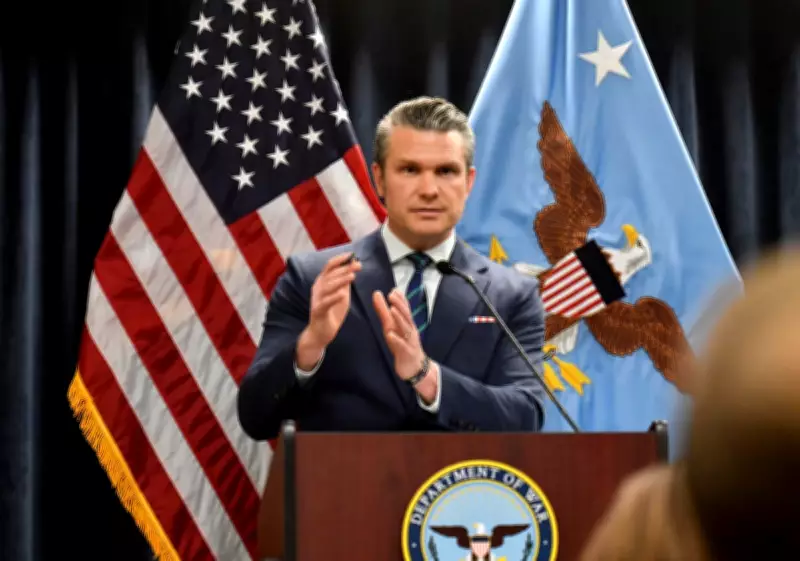
A comprehensive review by the Guardian has uncovered that US Defense Secretary Pete Hegseth has harbored a violent antipathy towards Iran for many years, expressed through various media including books, Fox News broadcasts, educational videos, and public speeches. This revelation sheds new light on his personal commitment to the ongoing war against Iran, positioning the Islamic Republic as the pre-eminent enemy of the United States.
Historical Context of Hegseth's Rhetoric
In a 2020 book titled American Crusade, Hegseth wrote that Iran's leaders are "actively seeking the military means – especially nuclear weapons – to bring the West to its knees." Similarly, in a 2017 video for PragerU, a hard-right media platform, he described Iran as "America's mortal enemy." These comments highlight a consistent pattern of maximal confrontation advocated by Hegseth, often framed in apocalyptic and religious terms.
Speeches and Public Appearances
During a 2018 speech at an Israeli media conference in Jerusalem, Hegseth referred to Iran as "the octopus," with "many tentacles that the Iranian regime has in the world today, nefariously both for Israel and for the United States." He emphasized Iran's efforts to build "a nuclear capacity which threatened the very existential existence of America." This speech, attended by Israeli government ministers, underscores his unconditional allegiance to Israel and his belligerent stance towards Iran.

Integration into US Culture Wars
Hegseth's rhetoric often intertwines with domestic US culture wars. In his 2020 book, he writes, "You can love America without loving Israel – but that tells me your knowledge of the Bible and Western civilization is woefully incomplete." He further states, "If you love America, you should love Israel. We share history, we share faith, and we share freedom," and positions Israel as a target for both Islamists and international leftists.
Fox News Contributions and Advocacy
Throughout his tenure as a Fox News guest, contributor, and host, Hegseth consistently advocated for aggressive actions against Iran. In 2014, he criticized the Obama administration's nuclear deal, claiming it showed "willful blindness" towards Iran's true intentions. In 2020, he celebrated the killing of Quds force commander Qassem Suleimani, threatening further Iranian leaders and asserting US dominance.
Strategic and Political Implications
The rationale behind the current war on Iran has been questioned across the political spectrum, with Hegseth and former President Trump offering mixed messages on its progress. Trita Parsi, co-founder of the Quincy Institute for Responsible Statecraft, noted that Hegseth's comments reflect pervasive anti-Islamic sentiments in Republican circles and suggested the administration lost control of the war early on.
Theological Framing of Foreign Policy
Hegseth frequently frames the US-Israel relationship in theological terms, citing biblical passages to justify support for Israel. In his 2018 speech, he urged action based on support from "patriotic Americans, amongst evangelical Christians, amongst believers," and advocated for controversial measures like rebuilding the Jewish temple on the Temple Mount, a highly sensitive issue in Middle Eastern politics.
Conclusion and Broader Context
This review illuminates Hegseth's deep-seated animosity towards Iran, revealing how his personal views have influenced his approach to defense policy. His rhetoric, characterized by religious crusade language and unwavering support for Israel, raises questions about the strategic direction of US foreign policy under his leadership. The Pentagon did not respond to requests for comment on these findings.