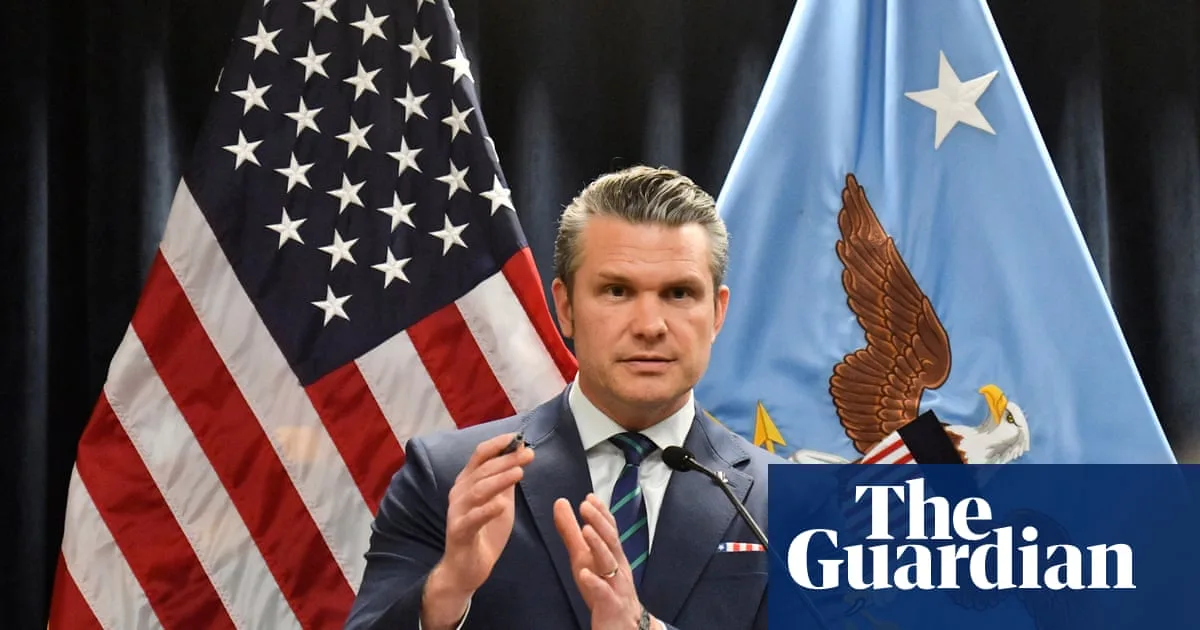
US Defense Secretary Pete Hegseth has expressed extreme antipathy towards Iran for years, according to a Guardian review of his books, Fox News broadcasts, educational videos, and a 2018 speech in Jerusalem. In a 2020 book, Hegseth wrote that Iran's leaders are 'actively seeking the military means – especially nuclear weapons – to bring the West to its knees'. In a 2017 video for PragerU, he described Iran as 'America's mortal enemy'.
Speaking to an Israeli audience in 2018, Hegseth referred to Iran as 'the octopus', with 'many tentacles that the Iranian regime has in the world today, nefariously both for Israel and for the United States'. He accused Iran of building 'a nuclear capacity which threatened the very existential existence of America'. His comments often came in the context of unconditional support for Israel, with whom the US is now jointly attacking Iran in an intense bombing campaign.
In his 2020 book, Hegseth wrote: 'You can love America without loving Israel – but that tells me your knowledge of the Bible and Western civilization is woefully incomplete'. He added: 'If you love America, you should love Israel. We share history, we share faith, and we share freedom'. He also folded Israel into domestic US culture wars, stating: 'Israel is enemy number one for both Islamists and international leftists – which is reason alone to love it.'
The comments shed new light on Hegseth's personal commitment to the current war on Iran, showing him positioning Iran as the pre-eminent enemy of the US and advocating maximal confrontation. Trita Parsi of the Quincy Institute said Hegseth's history reflects 'anti-Islamic, anti-Muslim sentiments' pervasive in Republican circles. Parsi added that the administration 'lost control over this war after four days', lacking a plan B when the initial strategy failed.
In his book 'American Crusade', Hegseth placed Iran alongside al-Qaida and Islamic State as existential threats, writing: 'Al Qaeda, the Islamic State, the Taliban, Iran, and the likes are the latest manifestations of an Islamist movement that has no plans to 'coexist.'' He also criticised Saudi Arabia, a US ally, for funding radical Islamic schools. The Guardian contacted the Pentagon for comment but received no response.