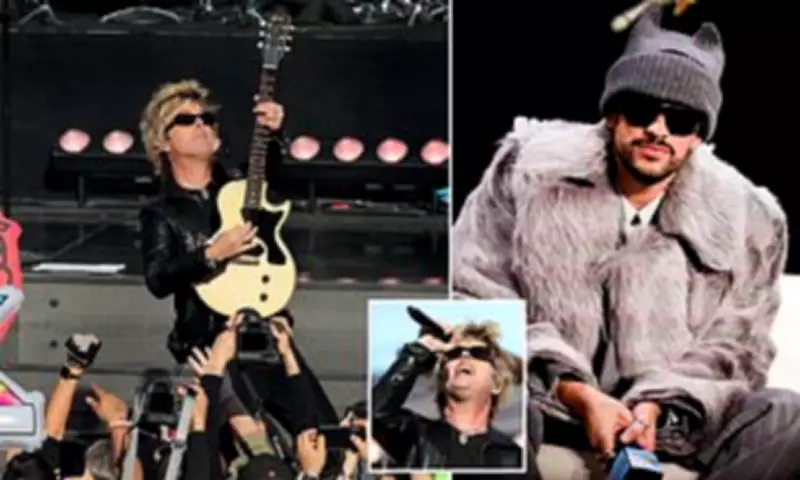
Green Day launched Super Bowl LX with a spectacular and energetic opening ceremony that has ignited a passionate debate among football and music fans. The iconic Bay Area punk rock band delivered a powerful performance at Levi's Stadium in Santa Clara, setting the stage for the championship clash between the Seattle Seahawks and the New England Patriots.
An Electrifying Performance Sequence
The band commenced their set with an instrumental rendition of their classic track 'Good Riddance,' immediately captivating the audience. They swiftly transitioned into the high-energy anthem 'Holiday,' before slowing the tempo with the introspective 'Boulevard of Broken Dreams.' The performance culminated with their legendary hit 'American Idiot,' which brought the crowd to a fever pitch.
Fan Reactions and Halftime Show Controversy
Following the opening ceremony, numerous fans expressed their belief that Green Day would have been a superior choice for the halftime show compared to the scheduled performer, Puerto Rican rapper Bad Bunny. Social media platform X became a hub for this discussion, with one user stating, "I’m not even a Green Day fan… but I’d take them over Bad Bunny for the halftime show any day." Another fan emphatically declared, "Green Day is a 400 million times better artist than Bad Bunny." Additional comments included sentiments like "Green Day would’ve been a better halftime performer than Bad Bunny!" and "Bad Bunny and Green Day could’ve swapped gigs tonight," while one succinctly posted, "Green Day > Bad Bunny."

Political Commentary and Censorship Speculation
Notably, frontman Billie Joe Armstrong, who is renowned for incorporating anti-Donald Trump lyrics into live performances, did not deliver his customary political message during the Super Bowl opening. Some viewers speculated that NBC's live broadcast might have censored Armstrong, particularly as he often alters lyrics in 'American Idiot' to critique Trump and the MAGA movement. However, it is understood that the network only censored explicit language, with Armstrong voluntarily omitting his typical political remarks on this occasion.
Background on the Halftime Performer
Bad Bunny, whose real name is Benito Antonio Martínez Ocasio, is poised to take the stage for the halftime show, five months after his announcement sparked considerable controversy. The Latino artist has faced criticism from some quarters due to his anti-Trump stance and the fact that the majority of his songs are performed in Spanish. This has led to planned boycotts by certain segments of the American audience.
Political Tensions and Alternative Programming
In response to the backlash against Bad Bunny, Turning Point USA, the nonprofit organization founded by the late MAGA activist Charlie Kirk, has organized an alternative halftime show. This conservative-oriented broadcast will feature legendary country rock singer Kid Rock, aiming to cater to viewers who oppose Bad Bunny's political views.
Recent Political Statements from Both Artists
Bad Bunny has been vocal in his criticism of the Trump administration, previously citing Immigration and Customs Enforcement (ICE) agents as a reason for excluding mainland US dates from his tour. At the 2026 Grammy Awards last weekend, after winning an award, he stated, "ICE Out," and received a substantial ovation. He continued, "We are not savage. We are not animals. We are not aliens. We are humans, and we are Americans. The hate gets more powerful with more hate. The only thing that is more powerful than hate is love."
Although Armstrong refrained from political commentary during the Super Bowl opening, he did address ICE agents at a pre-Super Bowl party in San Francisco. He urged them to "Quit your s**tty a** job," adding, "Because when this is over, and it will be over at some point in time, [Homeland Security Secretary] Kristi Noem, [White House advisor] Stephen Miller, [Vice President] JD Vance, Donald Trump, they're gonna drop you like a bad f**king habit. Come on this side of the line."
The opening ceremony has thus not only provided thrilling entertainment but also highlighted the ongoing cultural and political divisions surrounding major sporting events in the United States.